
Three material questions before disturbance
Separate cross-sections represent unknown board or insulation, layered paint and masonry, above one shared stop boundary.
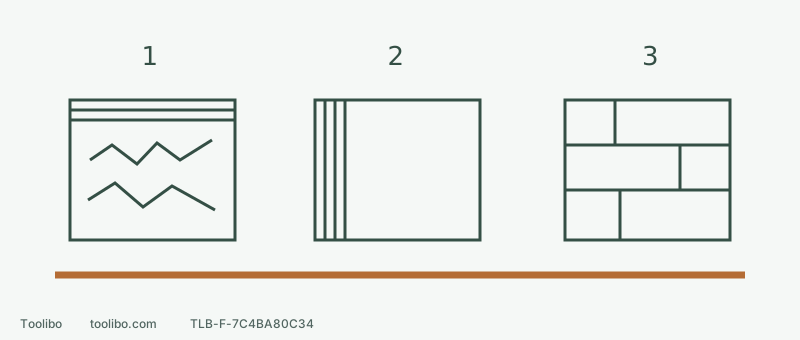
1 · Unknown composition
Suspected asbestos: keep undisturbed and seek an accredited inspector, not a DIY sample.
2 · Coating layers
A new topcoat does not establish the safety of older layers; choose the correct lead assessment category.
3 · Dust-control system
Silica-containing material needs a task-specific plan covering capture, airflow, filtration and maintenance.
Textures are conceptual and cannot identify asbestos, lead or silica by appearance. More than one concern can coexist.
Gather existing information without touching the material
Record what you plan to install, the exact wall or board, hole count and proposed depth. Collect existing building dates, renovation records, product labels and previous assessment reports. Mark missing fields unknown; a fresh coating or tidy surface does not establish what lies beneath.
Use existing photographs and documents. Do not scrape paint, remove coverings, sweep debris or approach damaged suspect material just to improve a photograph. If potentially hazardous dust has already been made, pause work, restrict access and seek the appropriate professional advice. Do not dust, sweep or vacuum suspected asbestos debris yourself.
The output is a consultation record, not your own declaration that the material is harmless. Distinguishing a confirmed report from a guess about plasterboard is more useful than selecting a bit first.
Three hazards require different questions
Swipe or scroll horizontally to see all columns.
| Clue | Pause this action | Whom to ask and what to ask |
|---|---|---|
| Suspect board, insulation or covering that the work may disturb | No drilling, scraping or DIY sampling | Trained, accredited asbestos inspector: does this material need assessment or professional sampling? |
| Old paint at the planned hole, with uncertain underlying layers or reports | Do not treat a new topcoat as clearance | Lead-paint inspection/risk-assessment professional: do existing results cover this component and proposed work? |
| Concrete, mortar or other silica-containing material | Do not start without a dust-control plan | Person competent and responsible for the work: how will the exact drill, extraction, maintenance and personal protection be matched? |
These concerns can coexist. Identifying concrete does not clear its coating; lead-renovation credentials do not automatically qualify someone to assess asbestos.
Find the appropriate US route
For asbestos, use EPA’s state asbestos contacts to reach the local agency and ask for current accredited-professional listings and applicable requirements. Explain that you need inspection and assessment, not a removal booking. Inspectors and removal/repair contractors have different roles; check training and accreditation and avoid a sales conflict in the assessment.
For lead, use EPA’s Lead-based Paint Professional Locator. Choose inspection or risk assessment when evaluating an unknown coating. Ordinary renovation and specialized lead-hazard abatement are different service categories. Follow the locator to an authorized state, tribal or territorial program where applicable; an eco-friendly advertisement is not certification.
An absent company listing is neither proof of no certification nor permission to assume certification. EPA’s official lookup guidance provides the National Lead Information Center as a verification route. These are US pathways; elsewhere consult the relevant local environmental, occupational-safety or building authority.
Treat silica extraction as a system
OSHA’s handheld/stand-mounted drill guidance specifies a collection shroud, vacuum, hose, filtration and filter-cleaning mechanism, not just a connected hose. Its requirements include a compatible shroud, airflow meeting the tool manufacturer’s recommendation, at least 99% filter efficiency and a cleaning mechanism. Necessary cleaning inside drilled holes separately calls for HEPA-filtered vacuum capture.
These are particular US construction-guidance requirements, not a declaration that your equipment complies. Give the responsible person exact tool, shroud, vacuum and filter models and ask them to confirm the whole arrangement and maintenance. A HEPA label on one filter does not establish complete equipment suitability, material clearance or personal protection. This article does not teach hazardous-material removal or contamination cleanup.
Fill in a useful consultation record
- Location/component____; installation____; hole positions/count/proposed depth____.
- Existing material, coating and renovation records____; exact area covered____.
- Uncertain composition or damage____; whether disturbance has occurred and present condition____.
- Professional category, organization and credential verification____.
- Further assessment needed, responsible person and expected decision____.
- Work still paused____; who confirms material handling and dust controls after approval____.
For example, a freshly painted old wall is intended to carry a shelf, but its underlying coating and board are undocumented. A valid outcome is location recorded, assessment needed, drilling paused, not only a few holes with a domestic vacuum. Useful screening identifies the missing information, the right person and who decides whether work may proceed.