
Change the work location before stretching farther
A supported clamped component at a bench contrasts with a crossed-out leaning worker applying sideways force from a stepladder.
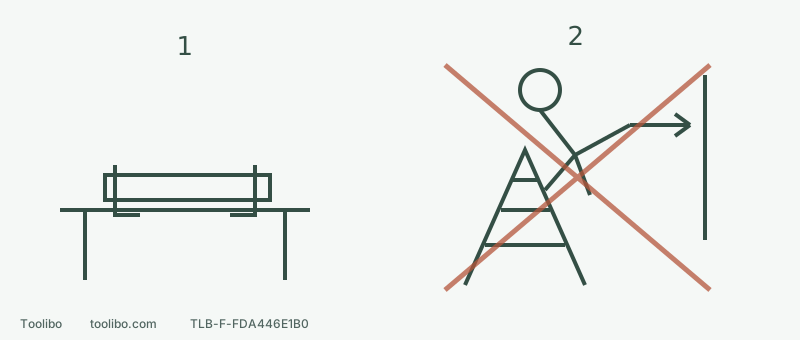
1 · Avoid height where feasible
Confirm whether the removable component may be machined and reinstalled before moving the task to a bench.
2 · Reach and side load change the task
Do not copy the crossed-out posture. Have a competent person reassess access, two-hand control and the area below.
Planning illustration only, not an approved ladder position or platform setup. Bench relocation also requires permission and suitable workholding.
Can the work move to ground level?
If a removable component may be machined, consider supporting and clamping it at a bench. Removal, reinstatement and function still need approval from the responsible person; do not dismantle a fixed component just to avoid a ladder.
For work that must stay overhead, record every hole, total expected duration and the most awkward position. Include preparation, repositioning, cleanup and tool handling, not only seconds of rotation. Unknown ceiling materials, services and fixing requirements are independent reasons to pause.
Record complete equipment and actual movements
Bare-tool weight excludes the fitted battery, bit, required side handle and relevant extraction equipment or hose effects. Do not remove a required grip to reduce weight or assume a short body establishes overhead suitability.
Give this record to the person assessing access. It is not a formula for granting yourself ladder permission.
Swipe or scroll horizontally to see all columns.
| Item | Record | If unresolved |
|---|---|---|
| Avoiding height | Whether bench work is possible and who approves removal | Confirm before dismantling |
| Duration and repetitions | All positions, moves and expected total work | Do not describe only the last hole |
| Force direction | Upward, sideways into a wall or other direction | Mark possible side loading |
| Hands and support | Required hands, sustained pressure and grip positions | Do not release a required grip to maintain support |
| Complete load | Person, clothing, tools, battery and other carried items | Check actual equipment ratings and assessment |
| Area below | Doors, routes, people and falling-debris area | Change arrangements if exclusion is not feasible |
Why side load and reach are separate questions
UK HSE stepladder guidance specifically cautions against overreaching and side-on drilling into solid materials. Work without a maintained handhold requires a justified assessment including height, lightness of work, side load and reach.
This is not permission for two-handed drilling whenever it is brief, or a claim that tying a ladder makes every task suitable. Where sustained two-hand control or side force is needed, have a competent person select appropriate access equipment. HSE supplies a planning example here, not a substitute for local rules, equipment instructions or site assessment. This is not a ladder-securing or platform-erection guide.
Do not gain extra height from chairs, boxes or stacked supports. Change an unsuitable arrangement rather than stretching the drill farther.
Include visibility and people below
Consider where chips, dust or a dropped accessory can travel throughout preparation, work and clearing away. A doorway or occupied route needs a maintained exclusion/access arrangement, not just a shouted warning.
Use eye protection suited to falling debris; a face shield alone does not replace safety glasses or goggles. Assess material hazards, extraction and visibility separately. If a hose pulls the tool, obstructs vision or affects balance, reassess the arrangement from ground level rather than improvising one-handed handling during work.
Test the plan against the final position
If earlier holes are directly overhead but the last requires reaching sideways, posture, grip and load direction have changed. Previous success does not authorize that position. Include all locations and arrange relocation or different equipment where needed.
Stop if fatigue, restricted sight, unstable footing or poor grip develops; withdraw according to the site’s safe arrangement and reassess. More speed, pressure or removal of a side handle is not a shortcut through the last few minutes.
A useful handover states what moves to the bench, which in-place work needs professional arrangements, the assessed access method, who controls the area below and what changes require stopping. Without these answers, pause before taking the drill up.