
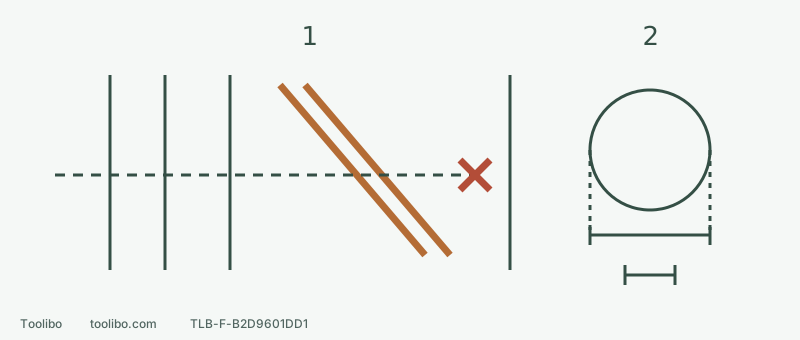
Describe a path, not just a point
Record installation purpose, position, diameter, proposed depth, corresponding areas on both sides and whether breakthrough is possible. Required fixing depth and permitted wall penetration are different questions; anchor length does not prove the space is clear.
Ask the owner or building manager for existing electrical, water, gas, heating and alteration records, and whether they cover this room and recent work. Nearby outlets or fittings suggest questions, not a guaranteed straight service route. Record discrepancies instead of inventing a route to complete an old drawing.
Specific D-tect 150 limitations
These examples come from D-tect 150 instructions 1 609 92A 4G0, August 2018. They are not a capability table for other detectors.
Swipe or scroll horizontally to see all columns.
| Condition or mode | Stated limitation | Planning consequence |
|---|---|---|
| Multilayer walls, angled objects and cavities | Results can be impaired; cavities may appear as objects | One surface reading does not reconstruct every layer |
| Moisture, metal-containing materials, foil insulation or conductive wallpaper | Can interfere with readings | Do not dismiss an uncertain indication as merely wall material |
| Larger cylindrical objects | Displayed width can be smaller than actual width | Do not plan a hole just beside the displayed edge |
| Drywall mode | Empty plastic pipes are not recognized; filled pipes and timber can look identical | An icon alone cannot identify material or purpose |
| Hollow block mode | Plastic pipes and non-live cables are not detected; humidity can also limit detection | No warning especially does not establish no services |
Cycling through modes does not create a guarantee. Someone competent with the equipment and building must assess its applicable instructions, conditions and other information. Scanning is not electrical isolation or verification of absence of voltage; this article gives neither isolation/testing nor service-handling procedures.
Give the responsible person four questions
- Do existing records explain electrical, water, gas, heating and structural conditions near the whole path? What alterations are missing?
- Are the detector and mode suitable for the layers, moisture and target types? Which targets could be missed?
- What uncertainty remains in displayed boundaries, depth or material? Is further appropriate inspection required instead of an exploratory hole?
- Who may approve the position, and who confirms professional intervention, fixing suitability and subsequent work conditions?
An owner’s permission to hang an item is not confirmation of clear services. An empty display is not structural permission. Keep authorization, identification and work arrangements separate.
A situation that needs a pause
A shelf bracket is planned near a socket. Drawings show only the original wiring, a later wall covering exists and adjacent scans disagree. At this point, the intention to install is known; a safe path is not.
Keep the existing position sketch and reading information for the responsible person or appropriate tradesperson. Do not make a shallow hole or move a few millimetres past a display icon to try your luck. An alternative position or non-penetrating attachment still needs its own load, material and authorization checks.
Make the handover explicit
Fill in purpose____; position sketch____; diameter/depth____; known wall layers____; record dates and gaps____; detector/mode and limits____; contradictions____; person verifying____; final approved scope____.
Record confirmed information only and leave unknowns visible. Keep work paused while service, material or structural questions remain. A shorter bit, lower speed, insulated grip or eye protection does not make an unknown path safe; these address other issues.