
Do not swap these contact sequences
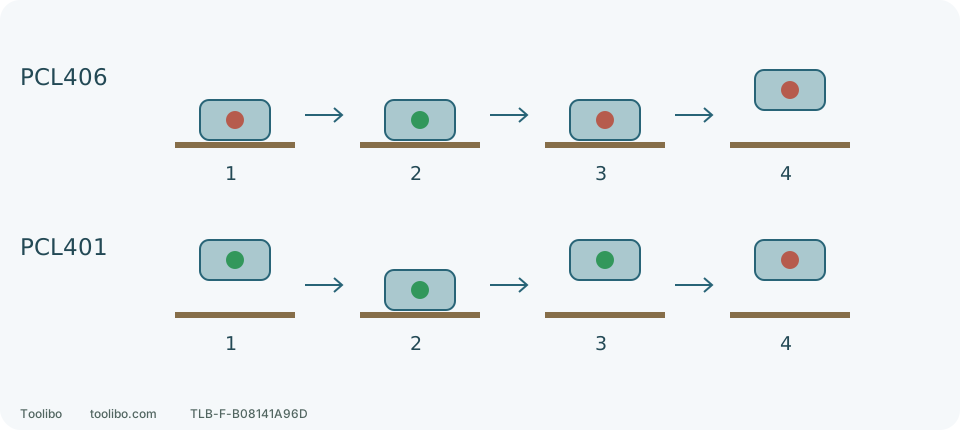
Normal sanding contact sequence after complete safe setup. Green means running and red means switched off. PCL406 step3 switches off and waits for complete stop on the work before step4 lifts away. PCL401 step4 switches off clear of the work and waits for complete stop.
PCL406Random-orbit sander
- 5-inch random-orbit pad; English orbit specification 3/32 inch.
- 10,000 OPM.
- 5-inch hook-and-loop discs with pad holes aligned.
PCL401Orbital quarter-sheet sander
- Orbital quarter-sheet tool; 1/16-inch orbit.
- Product: 14,000 OPM. Manual page 6: 14,000 r/min (RPM). Conflict retained; no conversion inferred.
- Clamped non-adhesive or specified adhesive-backed quarter sheets; use the matching punch.
PCL406
1 flat/off; 2 start; 3 switch off and wait on work; 4 lift only after complete stop.
PCL401
1 start clear; 2 lower at speed; 3 lift while running; 4 switch off and wait before setting down.
Normal sanding contact sequence after complete safe setup. Green means running and red means switched off. PCL406 step3 switches off and waits for complete stop on the work before step4 lifts away. PCL401 step4 switches off clear of the work and waits for complete stop.
Compare the actual tools together
US PCL406B is the tool-only PCL406 random-orbit configuration; PCL401B is the PCL401 quarter-sheet configuration. K1 adds power components, not another sanding motion. The package guide covers contents; choose the tool here by the workpiece.
Swipe or scroll horizontally to see all columns.
| Dimension | PCL406 | PCL401 |
|---|---|---|
| Motion and shape | 5-inch circular random-orbit pad | Quarter-sheet pad with small orbital movement |
| Abrasive retention | 5-inch hook-and-loop discs, holes aligned | Clamped non-adhesive paper or the manual’s adhesive option; matching punch |
| Published orbit diameter | 3/32 inch | 1/16 inch |
| Rate label | Manual 10,000 OPM | Product 14,000 OPM; English manual 14,000 r/min (RPM) |
| Nominal vacuum options | 1-1/4 and 1-7/8 inches | 1-1/4 and 1-7/8 inches |
| First contact | Flat on work before start | Start off work, reach speed, then lower onto work |
PCL401 has the same number with different units. Do not silently harmonize it, infer pad rotation or rank removal efficiency. PCL406’s translated metric orbit value also conflicts with its inch value; retain 3/32 inch rather than building a precise comparison on the inconsistent conversion.
A tabletop versus a framed cabinet door
On broad open panels, PCL406’s round pad is relatively easy to support fully and hook-and-loop changes are direct. Its manual permits parallel, circular or crosswise passes. That suits accessible flat preparation, not a guarantee of no scratches. Clogging, trapped particles, dwelling and heavy pressure can all spoil a surface; keep the pad flat.
On a framed door or already fairly flat wood, PCL401’s straight front edge helps approach a straight boundary; its manual expressly describes flush sanding. Choose it for access and paper workflow, not because 14,000 is a bigger number. The front edge does not enter every pointed enclosed corner: housing, clamps and orbital movement still need clearance. Narrow rails unable to support the pad and thin veneer edges may need a hand block or suitable detail tool, not an angled machine.
Include preparation in abrasive costs
Both need suitable grit and abrasive for the material. PCL406 needs the correct disc diameter, hook-and-loop backing and dust path; adhesive paper is not a substitute. PCL401 permits two retention methods on its specified cushion, not arbitrary interchange on other tools.
Only handle stable equipment safe to approach. If a battery smokes, leaks or remains abnormally hot, do not approach, touch or remove it to inspect; keep away and seek local emergency guidance. Normally switch off, wait for complete stop and remove the battery before changing paper. Keep it removed throughout setup.
For PCL401 non-adhesive paper, place about 1/2 inch under the rear clamp first, lock it, pull tightly around the cushion and secure the front, then use the matching punch. This is not the front-first procedure used by some other sanders. PCL406 instead needs aligned pad/disc holes and firm even pressing. Compare local prices at equal grits, changeover time and usable stock; neither cheap sheets nor quick discs are automatically lowest total cost.
A hose diameter is not the whole dust plan
Both manuals list 1-1/4 and 1-7/8-inch connections, but check the actual hose end, secure fit and routing. Physical connection does not make a vacuum suitable for the material’s dust, and hose drag must not steer the sander. PCL406 prohibits its dust bag when sanding metal; this page provides no substitute metal-dust collection system.
Unknown coatings or suspected lead/asbestos require qualified assessment before sanding, not a trial to pick a tool. Bags and adapters alone do not establish safe indoor or hazardous-coating work.
Remember the opposite contact sequences
First fit the correct abrasive and extraction under the applicable manual, secure the work, establish battery compatibility and confirm switch off. Install the battery and verify its latches. These sequences summarize normal sanding contact, not all preparation.
- PCL406: place the entire disc flat on the work, start and keep moving. To finish, switch off while on the work, wait for complete stop, then lift away.
- PCL401: start clear of the work, reach operating speed, then lower gently and move. To finish, lift away before switching off; wait for complete stop before setting down or removing the battery.
These are the distinctions in 998000620 REV: 02 (11-25-24) and 998000675 REV: 02 (8-9-22), not universal rules for circular and rectangular tools. Abnormal vibration, failed retention or abnormal stopping calls for stopping use and resolving the fault, not borrowing another model’s habits.
Models referenced