
Contact, path, support and unresolved eligibility
A contrasts a neutral wide end-tooth blade with a separate spiral side-fluted bit. B contrasts a short straight line and a continuous curved line, with a crossed curved-arrow cue for twisting the oscillating blade. C shows a neutral guide-contact footprint over a proposed curved path and a separate unresolved hand-evidence card, not a grip. D separates a conditional MM35 eligibility card from a rotary hold card.
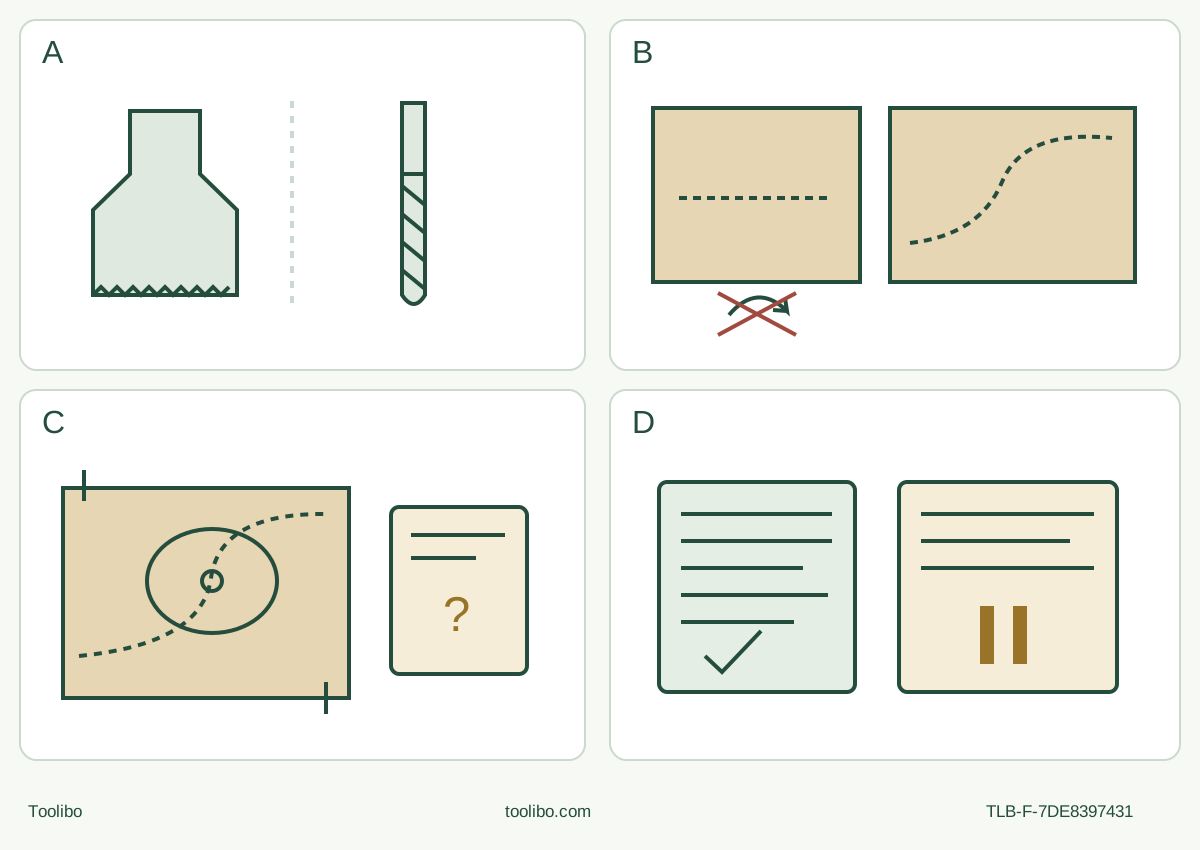
A · Compare the cutting contact
Original MM480 end teeth and 561 side flutes have different contact geometry. Neither outline supplies usable reach, radius or approval for a substitute accessory.
B · Preserve the intended path
Qualify a complete straight MM35 route without twisting an engaged blade. A continuous curve may justify a different mechanical investigation, not a rotary trial.
C · Keep the full-system gate open
Actual guide contact, support, hands, cord and cutting exposure matter. The 4000 six-inch hand rule remains unresolved for this 565 operating setup; do not invent a grip.
D · Record the decision or handoff
A fully evidenced MM35 straight task may be selected for later qualified work. The rotary route remains HOLD, with exact missing evidence sent for authoritative clarification.
Original unpowered decision schematic, not scale, assembly or operation. Accessory shapes establish only contact concepts. No hand is positioned beside the rotary bit; C deliberately leaves that safety evidence unresolved. D is a documentary outcome, not a safety certificate or completed cut.
Decide the contact and path before choosing the tool
A small cutter is not automatically a substitute for a narrow saw blade. This comparison produces an unpowered decision card for known dry, untreated, uncoated loose flat softwood: keep an eligible MM35 straight-cut system, or hand off a curved-path requirement with explicit missing evidence. It does not perform or teach a rotary cut.
The oscillating example is the exact US MM35 covered by its 2018 instructions, with an original positively identified MM480 wood blade. The external mechanical reference is a documented US Dremel 4000 with the 565 guide and 561 spiral bit. The current 561 material statement bounds this comparison to softwood strictly less than 12 mm thick. That is not a guaranteed usable cutting depth for either assembled system. Measure the actual stock and inspect both faces; exclude hardwood, plywood, MDF, coatings, hidden fasteners and installed work.
The rotary operating choice remains on hold. The 4000 manual requires at least six inches between a hand and the spinning bit, while its general close-grip illustrations do not establish a 565-specific operating grip satisfying that requirement. This article does not waive the warning, invent a rear grip or clamp-held tool, or use a powered experiment to resolve it. Mechanical relevance and permission to operate are different decisions.
Identify what removes the wood
The MM480 has a broad end-tooth cutting zone. The MM35 manual shows controlled back-and-forth cutting and explicitly prohibits twisting the engaged tool because the blade can bind. This favors assessing a short straight feature as a complete blade-width and approach problem: will the entire tooth line stay inside the intended cut, and can the blade reach the required face without striking retained wood or support?
The 561 instead cuts with its side flutes, as the 4000 attachment chapter explains. Its 565 guide adds a contact surface and depth-adjustment assembly around that small cutting region. A continuously turning line is therefore a mechanically different question, not simply the same MM480 cut made with a smaller accessory. The whole guide, tool, cord and required hands must still have a supported route. Bit diameter alone proves neither a minimum turning radius nor the ability to leave a particular corner or finish.
Do not transfer a direction rule between systems. The rotary chapter has its own direction and entry instructions; those are not an oscillating-blade technique. Conversely, the MM35’s permitted back-and-forth motion is not permission to rotate an engaged wide blade around a curve. This decision guide does not supply a rotary entry or feed sequence.
Draw the work, then the complete equipment envelope
Mark the proposed path, retained material and waste on the actual loose stock. Specify whether the result is a short straight separation or a continuously changing contour. Keep the underside inspectable. Check the wood and route for nails, screws and other foreign material; unknown content means stop the assessment rather than select a more aggressive cutter.
With tools OFF, fully stopped and unplugged, compare the actual proposed approach without touching sharp cutting edges or moving an accessory by hand through a simulated cut. Include more than the visible tip:
- For MM35, include the entire original blade, holder, body, both insulated gripping areas, controls, clear vents and cord. An angled installation does not make the remaining body or hands disappear.
- For the rotary reference, include the guide’s actual contact area, depth assembly, exposed cutting portion, tool body, controls and cord, plus a documented safe hand position that is presently unresolved. Do not sketch a convenient invented grip and call the gate closed.
- For either, map retained-stock clamping and separate stable waste support through final separation. A clamp or support cannot occupy any cutting or movement envelope, and waste must not close onto the cutter. Do not hold small stock in one hand and a tool in the other.
The guide’s stated adjustment up to 3/4 inch does not override the current 561 softwood limit. Overall bit length is not exposed cutting-flute reach. Likewise, an MM480 catalogue outline is not proof of useful reach in a particular mounted orientation. Missing actual geometry remains conditional, not a numerical clearance formula.
Close the system evidence without teaching refitting
For the MM35 route, record the physical body and matching 2018 manual, original MM480 identity and material approval, and accessory rating of at least 21,000 OPM. Confirm an already correctly assembled native interface. The spring hold in its Easy-Lock mechanism is only temporary; the documented final clockwise hand-tightening must have been completed. A blade merely resting on the interface is not an eligible assembly. Missing parts, unknown installation or a change of orientation sends the reader to the complete exact owner instructions, with power isolated—not to an improvised refit here.
For the rotary inventory, the current 565 product names 4000, and the current-linked 4000 manual itself covers 565/561. The older linked 2004 attachment sheet does not independently list 4000; it is not a substitute for that model’s instructions. The exact chapter requires the 480 collet and collet nut, not a Dremel chuck. Its smooth-shank exposure requirement concerns mounting, not a depth below the board. These facts identify the evidence needed for an original qualified assembly; they do not provide a fitting recipe or resolve the hand-clearance conflict.
Both actual US bodies require their own correct regional supply, intact cord and reliable controls. Reject cracked, bent, blunt, loose or suspected-damaged cutting accessories and uncertain tool condition; no energized seating or fault test is part of this assessment. Any physical handling follows OFF, complete stop, unplug and cooling, with appropriate protection from sharp edges. MM35 requires protective gloves for work and changes, including thick cushioned gloves and frequent rest breaks for vibration exposure. Maintain ventilation and suitable eye, hearing and material-appropriate respiratory protection.
Dust management is a separate prerequisite, not a benefit inferred from tool size. Any chosen equipment must be appropriate, correctly connected, operating and checked under its own instructions before later cutting. Isolate both tool and extractor before connections. These reference sources do not establish a cutting-capture attachment for either example; do not borrow a sanding hood, invent a connector or claim that a small job produces harmless dust.
Worked choice A: retain a qualified short straight-cut route
Suppose the task is a short straight separation from an accessible edge of the known loose softwood. The actual MM480 tooth width and full reach fit inside the intended path; retained wood can be clamped, waste independently supported, and both grips, underside and cord remain clear throughout separation. The owner has the correct native assembly, supply, dust/PPE system and complete normal stopping instructions.
That evidence can justify selecting the MM35 system for the later separately qualified cut. It is a conditional example, not a claimed trial or a promise that every stock size fits. If the proposed rotary guide lacks a continuous supported contact area at that same edge, reject it for this particular route; in any event, its unresolved grip gate still prevents a positive rotary operating choice here. The decision is based on the whole setup, not an assertion that an oscillating tool is universally safer, faster or more precise.
The later MM35 procedure retains its own medium initial-entry instruction and separate softwood material row, not a rotary speed. RPM and OPM are different measures; neither the 4000’s general 561 table nor its accessory-specific wood range can set the MM35 dial or rank cutting performance. This article ends before power is connected.
Worked choice B: preserve the curved task, reject a false solution
Now suppose the retained edge must follow a continuously changing line rather than a short straight cut. Do not qualify the selected MM480 by proposing to twist it through that line, bend it or enlarge the waste until the intended shape is lost. Record why its documented contact and no-twist rule do not establish this route.
The 561’s side-cutting action makes the rotary system relevant to investigate, but not ready to use. Record the exact actual guide footprint, supported path, entry requirements, flute reach and cord route still needed. Most importantly, request authoritative instructions for the actual 4000/565/561 grip and control arrangement that satisfy the literal six-inch warning. General pencil-grip pictures do not cancel it. Do not reinterpret it as applying only to a supporting hand, measure an illustration as a clearance drawing, or attempt a cut to discover a workable hold.
The completed outcome is therefore: selected MM480 route not established for this curve; rotary operating route on hold; defined task and missing evidence handed to the manufacturer or a qualified provider. If that evidence cannot close, choose neither system for this job. Changing the design or outsourcing the cut is a separate decision, not permission hidden in a comparison.
Finish with a usable decision card
Write down the material and measured thickness; path and retained/waste sketch; actual accessory identity; complete support/contact/hand/cord envelope; sound original assembly and supply; known OFF/full-stop/isolation actions; dust/PPE arrangements; and the unresolved items with their evidence owner.
Mark the MM35 route eligible only where every prerequisite actually closes. Mark missing evidence conditional with no start. Keep the rotary route on hold in this assessment, even where its cutting motion looks promising. Do not describe either a completed sample or an accepted finished edge: the deliverable is the justified choice or actionable handoff before operation.
Evidence used
Dremel MM35 original US instructions, August 2018, especially pages 3–4, 9–13 and 15, plus its contemporary launch identity; Dremel 4000 instructions 1600A012FM AB 06/2019, especially pages 3–6, 9–13, 26 and 30–31; current exact US 565 and 561 product material/applicability statements. The 2004 attachment sheet is dated corroboration, not independent 4000 operating authority. No counterpart model or tool-family count is added.
Models referenced