
Path, stroke, entry and local-cut eligibility
A shows a curved open path on a board and a neutral jigsaw foot footprint on the supported face. B shows a blade passing below supported stock with a dashed larger motion envelope and free space beneath. C separates a starting-hole symbol marked at least 12 mm from a neutral slanted tool/base entry concept, both conditional. D shows a local oscillating blade through supported loose wood with free underside and a question mark.
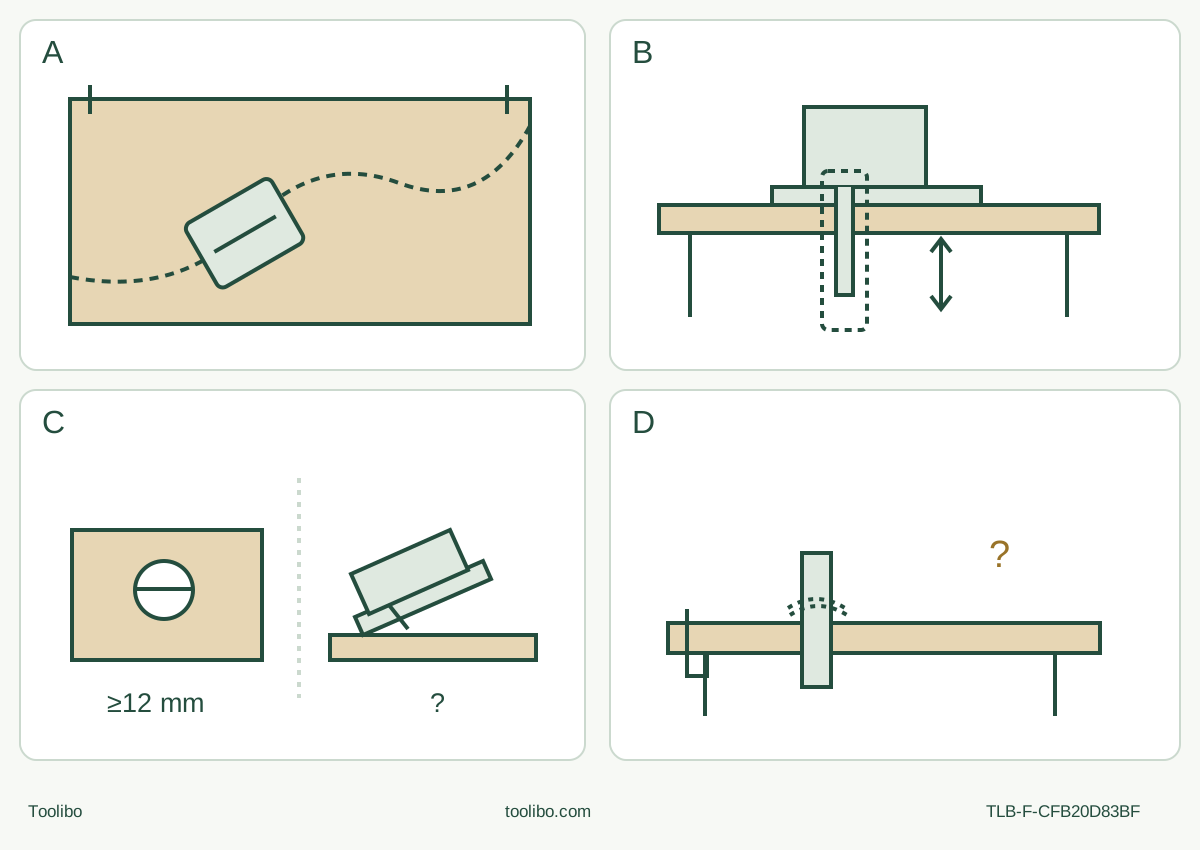
A · Follow the whole supported route
An open curve is only a candidate when the actual approved blade can follow it and the base remains flush. Check every support and waste transition; no circle-guide transfer.
B · Clear the complete blade motion
Assess the actual blade and full stroke below all of the route. Stroke and rated capacity are not interchangeable with installed reach or a safe bench gap.
C · Qualify the actual entry
The source describes a starting hole of 12 mm or more and a separate plunge method. Actual blade fit, waste location, support and complete owner procedure still govern; missing evidence means no start.
D · Assess the local oscillating alternative
A short interior feature may suit a qualified native blade only if reach, overrun, all moving parts, safe grip and complete underside clearance close. Otherwise choose neither.
Original eligibility schematic, not scale or an operating sequence. A requires the actual base, housing, grips and cord/hose to clear the whole path. B’s dashed envelope is not a measured bench gap. C acknowledges both source-documented starter-hole and plunge options; neither symbol teaches or approves entry. D is a neutral blade-section/envelope diagram, not a complete tool assembly; it has its own blade/holder/hand and breakthrough requirements, not automatic suitability.
Choose a path that the entire system can follow
A drawing of a cut line is not yet a cutting plan. Before choosing an oscillating multi-tool or a jigsaw, account for entry, the retained piece and waste, the tool’s support, the moving blade below the wood, and the controlled end of the cut. This guide produces a qualified path, a conditional path awaiting evidence, or a neither-tool decision. It does not promise a faster cut, a particular finish or an automatic preference for either machine.
The oscillating example is strictly the documented DEWALT DWE315 Type 1, with the actual body, nameplate and supplied N252379 July 2013 instructions matching. It is not a current Type 2 kit claim. Use only an actually identified DEWALT-recommended native wood-cutting accessory suitable for the proposed cut; a generic “wood blade” label or matching-looking interface is insufficient.
The Makita 4350FCT is an external mechanical reference, using its exact US product identity and manual 884715B942. It is not an oscillating model or a new family entry. Its appropriate actual wood blade, secure original assembly and complete owner instructions must already be qualified. This is not a jigsaw blade-fitting, drilling or plunge-cutting tutorial. Unknown blade identity, unsupported entry or uncertain supply remains a reason not to start.
Both worked decisions concern known, dry, new, uncoated loose wood. They exclude installed trim, enclosed services, demolition, metal, old coatings and hidden backing. Inspect both faces and the route for nails, screws and foreign material. If the back cannot be examined and kept clear, neither example authorises cutting it.
Map more than the line on the top face
Mark what must be retained and what will become waste. Draw the start and finish, any internal entry, direction changes and every place where support changes as the cut progresses. Secure the retained work to a stable platform; provide independent support for waste where necessary so it cannot fall, twist the blade or close the kerf. Neither hand-held stock nor a clamp across the blade’s path is a solution.
The jigsaw’s base must remain flush with the workpiece during normal cutting. Its housing, main-handle grip, any permitted supporting hand, cord and dust hose also need a continuous route. A blade might follow the drawn line while the base runs off an edge, meets a clamp or bridges a hole; that route does not qualify. Do not solve it by lifting the base or forcing a bent blade around an obstruction.
Below the work, assess the entire actual reciprocating blade envelope, not just the portion visible at one position. The manual’s 26 mm stroke is movement, not a universal required bench gap, a blade length or a usable cutting depth. The published wood capacity likewise does not prove that the actual installed blade reaches through this stock throughout the necessary motion. Account for the blade, selected action, thickness and all supports under the complete path. No formula here replaces that assessment.
The oscillating accessory also needs its full moving envelope and breakthrough clearance. Its smaller-looking motion does not make a hidden underside safe. Check the actual tooth area, usable reach, holder and housing approach, hand position and cord route. Do not assume that the cut-guide arm is a jigsaw base or that it supports a moving assembly over a void.
Worked choice A: a long, open curved outline
Suppose a loose wooden panel needs a broad, gently changing outline entered from an accessible outside edge. The jigsaw is a plausible candidate when an appropriate blade can follow the actual curve without forced sideways bending, its base can remain fully supported along the whole route, and the complete blade stroke stays clear underneath. The manual tells the owner to advance very slowly on curves; that is a control limitation, not a promised turning radius or permission to force a tight bend.
This example is not a circle-guide operation. If the real task instead becomes a circle or circular arc, the manual’s separate procedure and its B-17, B-18, B-26 or B-27 blade restriction must be addressed. Do not apply the general outline discussion to an arbitrary blade on the optional circular guide. Nor does a catalogue capacity or a narrow blade prove a particular radius is possible.
For the DWE315, ask whether the actual recommended oscillating blade can produce the entire intended line without twisting, levering, unwanted overrun or repeated incompatible approaches. A succession of short local cuts is not automatically a controlled continuous curve. If this actual accessory cannot follow the required shape and preserve the retained edge, reject that route rather than calling the multi-tool universally versatile.
A supported, fully documented jigsaw route can therefore be the selected candidate for this particular outline. If the base or underside fails the assessment, the conclusion is not automatically “use the multi-tool.” Revise the workholding or choose another documented process; until the complete route closes, record neither.
Worked choice B: a short interior feature
Now suppose the loose stock needs one short interior slot or a bounded local cut, with both faces visible and clear. The DWE315 manual includes plunge-cutting applications, so a positively qualified native wood blade may be a candidate when its actual reach, approach and full oscillation envelope suit the feature. The blade’s width and overrun must stay compatible with retained material; a short intended line does not itself prove that the blade fits.
Interior entry is not exclusive to the oscillating tool. The 4350FCT manual explicitly describes two cutout methods: a pre-bored starting hole, and a prescribed plunge procedure without a starting hole or edge lead-in. The starting-hole method specifies a diameter of 12 mm (1/2 inch) or more. That is a documented minimum, not proof that every blade, angle or proposed hole arrangement fits. The hole must be within permitted waste, and the actual blade and intended path must still be qualified.
The alternative plunge method has its own front-base-edge support and controlled lowering sequence. A generic “jigsaws cannot plunge” rule would misstate this source, but recognising the option does not teach or approve it for this project. If the owner lacks the complete matched instructions, appropriate blade/material evidence or stable support for that exact entry, mark the jigsaw option conditional or reject it. Do not improvise entry from a small illustration or transfer another model’s plunge method.
Compare the whole paths after entry. An interior hole that admits the blade but leaves inadequate base support is not enough. An oscillating plunge that reaches the underside but overruns a retained corner is not enough either. For a larger closed opening, every side, corner, waste-support transition and final separation needs its own complete plan. This short-feature example does not automatically approve removing a free plug or making a structural opening.
Qualify controls, condition and dust before retaining either option
Carry out inspection and access assessment with the actual tool OFF, fully stopped and unplugged. Establish the correct OFF state even if a maintained-run control was previously engaged. Isolate extraction equipment under its own instructions before connections or adjustments. Reject cracked, bent, dull, loose or unidentified blades, damaged cords, unreliable switches and uncertain assemblies; do not run a doubtful setup to see whether it holds.
The tools have different controls and grips. The DWE315 has a proportional trigger and a separate lock-on arrangement; its actual Figure 13 main-handle grip remains the reference, not a borrowed two-handle template. The 4350FCT has a trigger/lock control, a separate speed dial and a cutting-action selector. Its manual specifies the main handle, with front support by the other hand if necessary. Know the exact normal and locked-run stopping actions before choosing the system, keep hands away from the blade and underside, and use the specified insulated gripping surfaces where the own-cord hazard applies. Do not stare into either worklight or treat illumination as proof of safe setup.
The Makita’s straight up/down and orbital-action options are not oscillating-tool modes. Its wood dial row does not set the DWE315 trigger, and no strokes-per-minute versus oscillations-per-minute comparison establishes cutting performance. A later qualified cutting procedure must start with the blade clear and establish the required operating condition before contact. The Makita specifically requires OFF and complete blade stop before removal from the workpiece. For the selected DWE315 project, stopping fully before controlled withdrawal is a conservative project choice, not a quotation of a different model’s rule.
Require material-appropriate dust controls, ventilation, correct respiratory protection and eye/hearing protection. For the DWE315, retain the manual’s certified ANSI Z87.1 eye protection (or its stated CAN/CSA counterpart), ANSI S12.6 hearing protection and appropriate approved respiratory equipment. The jigsaw’s actual optional nozzle and matching equipment must be documented if that extraction route is selected; the mere presence of a port does not prove capture. The DWE315 gets no invented native cutting hood from this comparison. Any chosen extraction system must be correctly connected, operated and checked under its own instructions before dust is produced.
Write the decision and the acceptance condition
For each candidate, record:
- Exact body/manual, actual recommended wood blade, known secure assembly and correct supply.
- Entry evidence, complete top-face route and retained/waste boundaries.
- Full base or tool-approach support, blade movement below the wood, grip/cord/hose access and changing waste support.
- Known control and stop actions, sound isolated condition and actual dust/PPE arrangements.
- The remaining uncertainty and the manufacturer-qualified evidence needed to resolve it.
Choose the system only if its complete route is qualified. If a prerequisite is missing, record conditional—do not start. If the geometry, support or entry cannot work safely for either, record neither; do not convert a missing path into an unproven accessory purchase.
After a separately qualified sample cut, full stop and isolation precede inspection of both faces. Allow the blade and workpiece to cool before handling, and keep clear of sharp edges. Accept only the intended path and complete separation where required, with retained material intact and no uncontrolled tear-out, scorching, shifted support or unexplained blade marks. No numerical tolerance is promised. A remaining bridge or inaccessible corner calls for reassessment, not prying with a blade or a blind extra pass.
Evidence used
DEWALT DWE315 Type 1 manual N252379, July 2013, especially printed pages 3–5 and 7–9; Makita 4350T/4350CT/4350FCT manual 884715B942, complete English pages 1–9 and back page 28, especially actual pages 3–8; and the exact current Makita US product/manual link. The external reference adds evidence about a different motion and support system, not a new model count or an operating qualification.
Models referenced