
Full contact, corner geometry and evidence
A shows circular and triangular abrasive footprints wholly on separate broad wooden faces. B shows a circular footprint leaving a true inside corner uncovered and a triangular candidate remaining on the face. C shows three separate evidence cards leading to a check, question mark or cross.
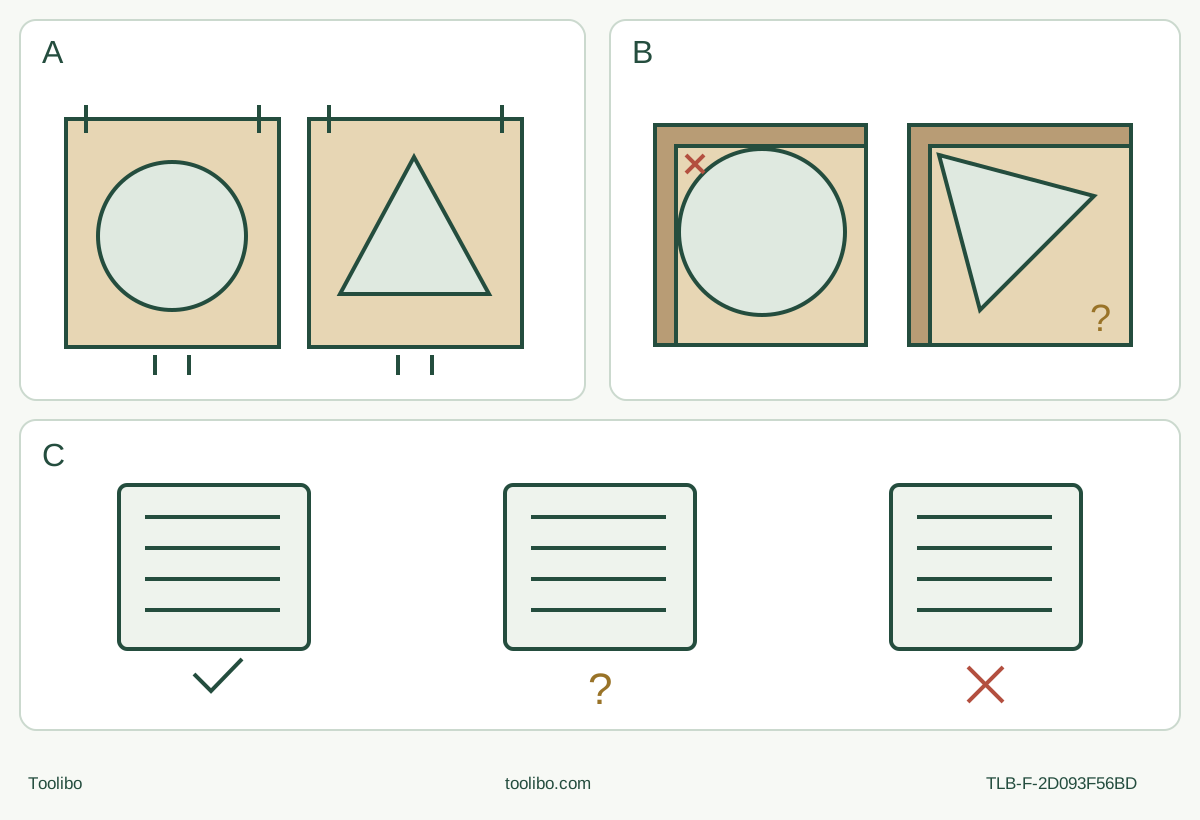
A · Assess the full face
Keep the complete pad supported and include the housing, required grips, clamps, cord and collection system in the access check. Either system may qualify; shape is not a finish ranking.
B · Check the actual corner
Do not tilt a circular pad onto its rim to reach a square corner. A whole triangular plate is only a candidate if the original complete system also fits safely.
C · Close the evidence card
Record the exact body/manual, original wood abrasive, supported path, sound condition, known stop control and actual dust system. Missing evidence means conditional/no start; unsafe geometry means neither.
Original decision schematic, not scale or clearance approval. A permits either shape only after the complete system qualifies. B is a geometric inference; a triangular footprint is only a candidate, not proof that housing, hands and extraction fit. C means qualified for the stated task, conditional with no start, or neither. No mounting or powered fit test is shown.
Choose a complete sanding system, not just a pointed or round outline
An oscillating multi-tool and a random-orbit sander can both carry an abrasive sheet, but that does not make them interchangeable. This decision starts with a known, dry, new, uncoated loose wooden workpiece and ends with a written choice: one qualified system, either of two qualified systems, a conditional choice awaiting evidence, or neither. It does not rank removal rate, finish quality, vibration comfort or value, and it is not a disc-fitting or sander operating lesson.
The oscillating example is the already documented US FEIN FMM350QSL, exact 120 V/60 Hz body and May 2018 owner instructions, with its positively identified original small triangular sanding plate, original appropriate wood sheet and complete matching extraction. Its original owner restrictions remain in force. An attachment that merely fits is not evidence that FEIN recommends it for this task.
The Makita BO5041 is a mechanical reference, not another oscillating model or a newly commissioned system. The current US product page links the English BO5040/BO5041 manual numbered 884946-222. That document contains European electrical information. Its disc-fitting paragraphs describe peeling backing paper and poor adhesion after removal, while its accessory list and the current product specify hook-and-loop discs. Those discrepancies are not resolved here. Do not derive a regional electrical setup, adhesive substitution or disc-refitting procedure from this comparison. An actual BO5041 can be eligible only with its correct regional owner instructions and an already positively qualified original pad/disc system; unresolved evidence means hold.
Make the task card before choosing a machine
Describe the face that must be sanded, the edges that must remain sharp, and any raised side or inside corner. Identify the wood and exclude old coatings, preservatives, unknown contamination, nails and embedded debris. Neither “bare-looking” nor a small workpiece establishes harmless dust. This article excludes wet sanding, old paint removal, installed surfaces and uncertain materials.
Draw the workholding and the full travel area. The loose stock must be clamped or otherwise securely supported on a stable surface without hands holding it in the working zone. Clamps cannot occupy the pad, housing, grip or dust-system path. A thin strip that flexes, a small piece that rocks, or a corner that can only be reached by defeating support is not yet a power-sanding task. Do not invent a minimum safe area from the pad’s nominal size.
Define the intended result: a uniformly prepared face appropriate to the next project step, with the retained profile intact. This is not a guaranteed flatness or roughness specification. A tool choice cannot compensate for a warped part that actually needs a different process, or for an abrasive whose material and purpose are unknown. Record the actual approved abrasive identity and its intended wood application rather than choosing by colour or appearance.
Compare motion and contact, not speed numbers
The BO5041 reference has a circular 125 mm abrasive footprint and random-orbit motion. Its manual warns that the pad rotates clockwise under load and may turn counterclockwise without load. This is not a fixed-direction cutting wheel. The operating illustration and text require the pad to remain flush, with slight pressure; working on its edge may damage the pad. The front grip and switch handle are both required during operation, so their clearance matters as much as the disc outline.
The FEIN is an oscillator. Its manual expressly includes small surfaces, corners and edges within its intended uses, but requires sanding with the whole plate, not just its tip, using continuous movement and moderate pressure. The original small triangular plate has a different contact shape from a round disc. That shape may help qualify a corner task; it does not authorise driving the point into a recess or using it as a miniature grinder.
The two manuals’ frequency figures and dial positions are not a common performance scale. Do not transfer a BO5041 dial choice to the FEIN, compare unlike counts as a removal-rate test, or claim that a pointed plate necessarily gives a better finish. This decision uses the actual material, contact shape and complete-system access instead.
Worked choice A: an accessible broad face
Suppose the known loose board has an open, flat face, no raised perimeter and enough support for the actual circular pad throughout the intended path. The BO5041 reference is intended for large-surface sanding, so this is a plausible geometry. Now check the real tool envelope: both grips remain usable, the body and collection equipment clear the clamps, and the cord can stay clear without pulling the tool or stock. If reaching an edge would require tipping onto the pad rim, the proposed path fails; revise the workholding or leave that part of the face outside this operation.
The FEIN small triangular system might also qualify on that same face. Its presence does not turn the choice into a contest with a predetermined winner. If both complete systems are documented, suitable and supported, record either is eligible for this bounded face, then choose using actual available qualified equipment and project requirements—not an invented speed or surface-quality advantage. If only one system has complete accessory and dust evidence, that evidence may decide the choice before motor power becomes relevant.
Worked choice B: a face meeting a genuine inside corner
Now consider a loose wooden assembly with a flat face bounded by two raised sides. A circular pad cannot cover the exact square inside corner while staying flat. That is a geometric inference from the shape, not a manufacturer clearance rating. Do not tilt the BO5041 onto its rim, remove a required grip or grind the raised sides to manufacture access.
The FEIN’s original small triangular plate is a candidate only after a complete, unpowered access assessment. Its whole working face must remain supported, and the actual plate orientation, housing, safe grip, original extraction ring and hose must all clear the raised sides. A point that reaches while the housing collides or the plate rocks does not qualify. Keep hands away from the application tool and do not use a powered trial to discover a collision.
If that full arrangement fits and its wood abrasive and dust system are qualified, select the FEIN route for this bounded task and follow its exact owner procedure separately. If neither complete arrangement can maintain contact and safe control, record neither, and seek another supported process. This comparison does not invent a narrow-channel attachment, a minimum corner radius or a guaranteed reach dimension.
Dust and control can overturn a geometrically attractive choice
For the FEIN, the native extraction assembly shown in its owner manual and a vacuum matched to the developing dust are part of the system, not optional decorations. Its material-specific respiratory protection, ventilation, overheating precautions and timely collection care still apply. The correct original plate and sheet must work with that assembly; do not remove extraction merely to squeeze the body into a corner.
The BO5041 reference shows its own collection arrangements and requires properly used collection where provided, ventilation and appropriate respiratory protection. A fitted bag does not prove adequate control of the particular wood dust. Do not infer a universal vacuum connector, a numeric airflow threshold or permission to omit other protections. Obtain the actual equipment instructions and material-appropriate collection arrangement; if suitability is unresolved, the choice stays conditional even when the pad fits.
Inspect condition only with the tool OFF, fully stopped and unplugged; isolate any extractor under its own instructions before connections or adjustments. Reject cracked pads, damaged cords, loose or uncertain assemblies and unreliable controls rather than testing them under power. The FEIN slide control and BO5041 trigger/lock arrangement are different: the owner must already know the correct normal and maintained-run stop actions for the actual machine. A switch label or familiar brand is not enough. Eye and hearing protection remain separate requirements; dust collection does not replace them. Keep loose clothing, hair and gloves away from moving parts, while observing the FEIN manual’s protective-glove requirement.
Close the decision with evidence and a stop condition
Write one short card for each candidate:
- Exact body, regional instructions and actual approved wood abrasive/pad identity.
- The face to be worked and the retained edges; a complete pad-contact and grip-access assessment, including housing, clamps, cord and collection equipment.
- Stable workholding, actual material-specific dust controls and the equipment instructions needed to establish them.
- Known control and stop actions, sound isolated condition, and the owner procedure that would govern any later sanding.
- The unresolved item, if any, and who can provide manufacturer-qualified clarification rather than a guessed substitute.
Mark the result qualified for the stated task, conditional—do not start, or neither. A conditional result must name the missing evidence, not merely say “be careful.” After any separately qualified sample operation, stop fully and isolate before accepting the face: intended preparation should be consistent, without unintended edge rounding, gouges, scorching, loose abrasive or moved stock. Those defects require reassessment of the setup and task; they do not justify extra pressure or a different tool chosen solely by its shape.
Evidence boundaries
FEIN FMM350QSL US owner manual, May 2018, especially printed pages 4–5, 7 and 12–17; Makita BO5040/BO5041 manual 884946-222, complete English pages 1–8 and back page 12, especially the actual illustrations on pages 5–7; and the current Makita US BO5041 product/manual link. The Makita reference assessment concerns the same underlying document already recorded in the baseline source, not a new edition, physical model or family. No electrical or abrasive-fitting conflict is silently resolved.
Models referenced