
Contact stop, supported base and separate decisions
A is a neutral section through a thick wood sample: a blade ends inside it while a separate contact-stop symbol meets the continuous top surface. B is a neutral blade section passing through supported stock, with a broad base-contact symbol, free underside and a dashed guided-travel cue. C shows two separate evidence cards and an unresolved or rejected outcome; neither system supplies the other’s missing parts.
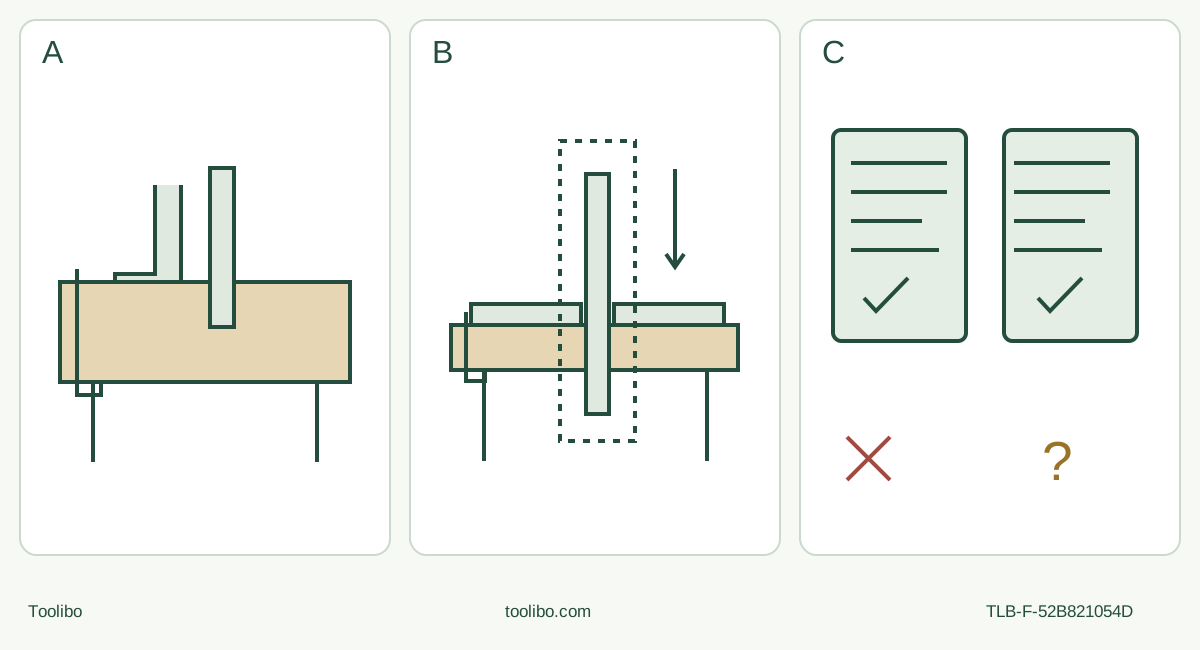
A · Preserve continuous stop contact
The selected narrow-stop/straight-blade route requires a sound reference throughout an inspectable non-through kerf. Lost contact or an unmeasurable result means hold, not more pressure.
B · Qualify the full guided base
The single-slot route needs full base support, actual guided reach, safe finger pads, free breakthrough and active qualified built-in extraction. A nominal dimension does not close those gates.
C · Keep the decisions independent
Choose an eligible route, keep missing evidence conditional, or reject both. Two separate project stages require two complete qualifications, not a hybrid fixture or carried-over setting.
Original schematic, not scale or native assembly. A and B compare reference/contact architectures only; all actual tool, hand, support and hose envelopes still require evidence. The through-slot does not free a plug. No arrows or marks specify a setting, fixture interchange or automatic return.
Choose the reference surface, not the word “guide”
A depth stop touching the wood and a positioning aid supported on a base solve different setup problems. This guide produces a job-eligibility decision for two exact existing systems: the US Bosch GOP18V-34 with OSC004 and original OSL114 wood plunge blade; and the US Festool OSC 18 with original OSC-A, OSC-AH and USB 78/32/Bi/OSC. It is not an assembly or cutting tutorial, and the parts are not interchangeable.
The bounded jobs use known dry, new, uncoated loose wood, with both faces and all space beneath visible. Choose a partial-depth kerf or one perpendicular single-plunge through-slot before choosing the fixture. Neither system detects hidden services or establishes permission for an installed panel, four-sided opening, free plug, structural joint or blind cut.
The useful distinction is not “less accurate versus more accurate.” It is what must remain in contact, what movement is constrained, where the operator can safely hold the system, and how the intended result can be inspected. A published maximum, a blade’s nominal size or a scale on hardware does not answer those questions.
Route A: a continuously supported contact stop
For the selected Bosch straight blade, the matched manual specifies the OSC004 narrow stop. Its bracket and guide establish a user-selected travel limit through contact with the work surface. The owner must still control the blade and preserve the intended reference contact during the whole cut. The wide stop shown for round/segment blades and another guided-cut arrangement is not the selected straight-blade route.
A suitable task is a short, deliberately non-through kerf in a sound loose softwood sample. Its bottom must be accessible to a reliable inspection or measurement method afterwards. The stock’s actual thickness, target depth and remaining material are project inputs, not a universal safe margin. If the depth cannot be inspected, the result cannot validate the setup merely because the button or stop appears unchanged.
Trace the stop’s actual bearing area along the planned movement. A step, void, unsupported edge, loose debris or clamp under the stop can destroy the reference. A blade that still reaches the line does not rescue that failure. Do not plan to compress, flex or hold the stop in place by hand to gain travel. The full blade, holder, tool body, both hands and supports must remain clear, with stable clamping that does not distort the stock.
Route B: a full-base, guided single plunge
For the selected Festool route, the OSC-AH base and guide support a perpendicular single plunge. The original long offset USB 78/32/Bi/OSC must agree with the actual fixture instructions; a short blade or a similar-looking accessory is not a substitute. Its catalog evidence supports wood use, but not a strongest-suitability rating for every solid wood. Keep the exact actual material and blade qualification.
This route needs enough uninterrupted top face for the full base and its defined safe finger pads, together with room for the guide columns, tool, blade travel and hose. The base must remain seated while the blade advances and during the controlled stopped withdrawal. If the base would overhang a void, tilt, run into a clamp or force a hand into the central pinch zone, do not choose the fixture simply because it has a depth adjustment.
The intended result here is one through-slot with the surrounding wood retained. Blade nominal dimensions do not guarantee slot width, installed reach or finished tolerance. The product’s stated maximum plunge depth is a limit, not a default setting. Actual stock thickness, blade position, guided travel and free underside must permit complete penetration without touching support or exceeding the documented limits. No automatic spring return is assumed.
Verify two separate original systems
Use the exact matched documents and positive original-part identity, not a shared platform logo or a photograph alone. This comparison preserves the existing owner qualifications:
- Bosch: actual GOP18V-34, March 2023 instructions, original intact OSL114 wood blade rated at least 21,000 OPM, complete OSC004 bracket/narrow stop, and an already commissioned battery/charger combination covered by the matched list and actual component instructions. Its OSL/OSP interface permission does not admit OSM.
- Festool: actual US OSC 18 and 718544_J instructions, original OSC-A/OSC-AH and selected blade, plus an already commissioned original BP 18 system with complete actual power-component instructions. Original Festool-only requirements remain; a holder tier does not create blanket cross-brand permission.
Both assemblies must already have been correctly established under their own complete owner procedures. The Bosch bracket clamp orientation, guide selection and red-button adjustment are not the Festool adapter/guide procedure. Festool’s two original adapter screws require the specified 7 Nm; that is not blade-holder or depth-knob torque. Its blade must have been placed on the guide before engagement in the holder, and its actual depth adjustment must be tightened. This is an evidence checklist, not a shortened installation recipe. Missing hardware, uncertain sequence or unknown retention means return to the complete matched instructions or qualified service before any project.
Do not stack the Festool OSC-AV on OSC-AH or borrow a Bosch stop for the Festool holder. Do not assume the same blade angle or old stop setting remains correct after a blade, orientation or fixture change. Each such change creates a new geometry and isolated-check requirement.
Make the hand, dust and stop plans part of the choice
All assessment and adjustment occurs after OFF, complete standstill and full battery removal. Partial latch release or a light-only switch state is not isolation. Isolate extraction equipment under its own instructions before connections. Allow hot accessories to cool, use protective gloves for sharp-part handling, and reject cracked, bent, blunt, loose, missing or suspected-damaged parts. No powered seating or fault test closes an uncertain assembly.
For Bosch, both insulated gripping areas and clear vents must remain available throughout the proposed cut. For Festool, the designated tool grip and fixture’s defined finger pads must allow the prescribed two-hand guidance without reaching into the blade or pinch zones; never substitute a battery grip. If the actual posture cannot meet those requirements, the task is not eligible. Know each exact normal stopping action and power-loss response before selecting it, without borrowing a switch or restart behavior from the other body.
The OSC004 is not a dust hood, and Bosch’s separate OSC005 sanding attachment does not qualify capture for this cut. Establish the actual material-appropriate dust controls without inventing a cutting connector. The OSC-AH route specifically requires the fixture’s built-in extraction connection and a documented compatible hose and suitable extractor. The hose must not pull the base or enter the full movement envelope. Connect, operate and check the chosen equipment under its own instructions before later producing dust; missing extraction evidence keeps that route on hold.
Eye, hearing, respiratory and other required protection remain separate from extraction. Preserve Bosch’s protective-glove requirements and Festool’s stated P2 respiratory protection, plus appropriate ventilation and a dry, well-lit workspace without a flammable atmosphere. Neither a small sample nor a cordless supply excuses dust or workholding requirements.
Work the choice through three complete cases
Case A: a shallow kerf with a continuous reference strip. Suppose the known loose sample offers a sound bearing strip for the narrow Bosch stop throughout a short non-through cut, while its complete blade/hand/support envelope is clear and the finished depth can be measured. If the actual Bosch inventory, controls, power and dust gates also close, select that route for the later qualified trial. Do not select OSC-AH merely to obtain a more impressive fixture: the requested through-slot outcome is not this shallow-kerf task, and full-base support still needs separate proof.
Case B: one through-slot on a broad supported face. Suppose the required feature is a single perpendicular slot, the original Festool blade and guided travel can penetrate the actual stock safely, and the full base, safe finger pads, hose and underside remain clear. Complete original assembly, tightened stop and active qualified extraction can make OSC-AH eligible. A narrow Bosch stop touching somewhere on that face is not proof of equivalent perpendicular guidance or an exact slot geometry; it must not be treated as an interchangeable base.
Case C: two separately specified features, or neither. A project might require a shallow kerf on one sample and a single through-slot on another. Both systems can remain eligible for those separate stages only if each complete evidence card closes independently. This is not permission to combine fixtures, retain a setting between tools or turn two features into an enclosed opening. If the actual stock provides neither continuous stop contact nor full base support with safe hands and extraction, choose neither. Redesign the workholding or obtain qualified help rather than holding the missing support by hand.
Define acceptance before commissioning a trial
The decision card should identify the intended feature, actual wood and thickness, exact original system, reference-contact sketch, complete movement/hand/support/hose envelope, power and dust documents, and remaining uncertainties. Eligible means ready to follow the full matched project procedure, not already cut or certified accurate. Conditional means no start until the specified evidence exists.
For the later Bosch trial, require an inspectable intended depth and line, remaining non-through material and no lost reference, shifting, scorching or uncontrolled tearing. For the Festool slot, require full penetration and the intended single feature on both faces, without base/stop movement or unintended damage. Inspection follows OFF, complete stop, battery-out isolation and cooling. A remaining bridge is not permission to pry or make a blind deeper pass. An unmeasurable or unacceptable result keeps the setup on hold; it does not become acceptable because the fixture carries a depth scale.
Evidence used
Bosch GOP18V-34 March 2023 manual, especially pages 9, 18–19 and its exact power list; Festool US OSC 18 manual 718544_J, especially pages 7–13 and Figures 5, 9–13; OSC-AH product identity; the complete one-page pictorial sheet 718287_D; and the selected USB 78/32/Bi/OSC catalog evidence. Existing model and source limits are unchanged. No new model, accessory interchange or precision ranking is created.
Models referenced