
One job sheet, two separately qualified routes
Four conceptual panels show a retained boundary, circular-saw base and underside clearance, localized accessory sweep with separate clamps, and a document decision sheet.
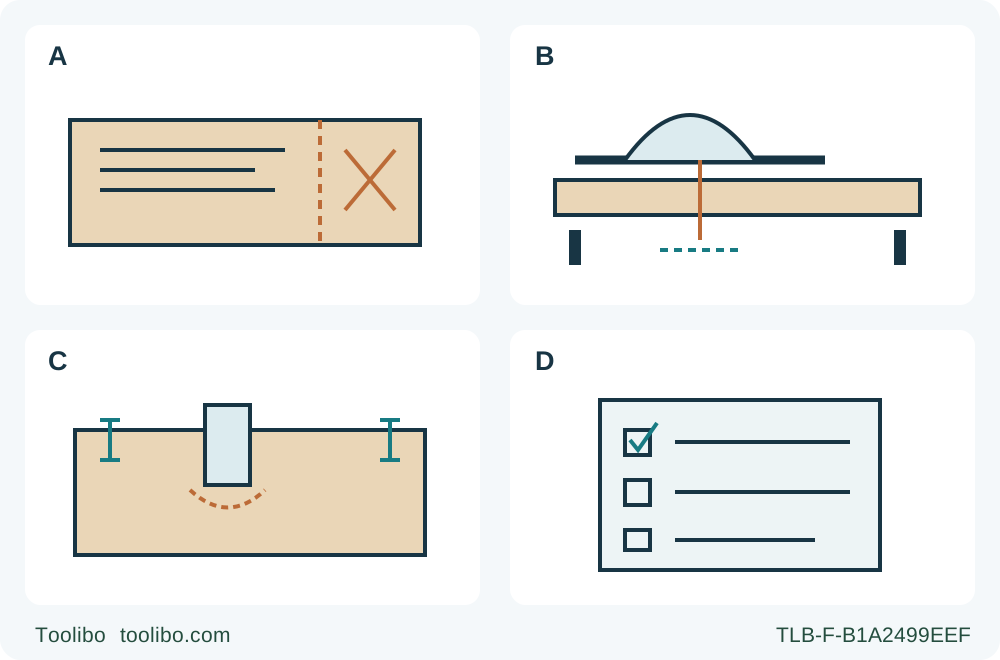
A · Define the result
Mark the retained boundary, waste and acceptance requirements before selecting a tool.
B · Qualify the whole-board route
Check continuous base support, blade clearance below, secure retained work and waste separation for the exact circular saw.
C · Qualify local access
Check approved accessory, full oscillating sweep, visible clearance and independent clamping; physical reach alone is insufficient.
D · Close the decision
Record one qualified route, two separately qualified stages or the precise evidence needed to lift a hold.
These are planning symbols, not scaled operating layouts. B represents the need to check the entire base and blade envelope, not a depth setting. C represents the full accessory sweep, not a prescribed cut or attachment procedure. D records a chosen qualified route or a hold, not a safety score.
A circular saw and an oscillating multi-tool can both cut wood, but that does not make them interchangeable ways to finish the same job. Choose the complete supported operation, not the tool that looks smaller or has the larger speed number. This guide produces a job-and-system decision sheet using the documented Makita 5007MG and FLEX FX4111. It does not authorize another model, a new accessory installation or a cut into an unknown installed structure.
The starting material is known, loose wood that can be inspected on every face and secured independently of the operator. Both candidate tools must already have their correct, qualified original or approved assembly. The FX4111 candidate uses the documented FLEX FA401002 HCS wood accessory and an already commissioned, explicitly listed power system with its complete separate instructions. An unidentified blade, battery pairing or altered guard is a hold, not a reason to improvise a comparison test.
1. Describe the finished job before selecting a tool
Draw the wanted boundary on a sketch, identify the retained piece and waste, and state the acceptance criteria. Is the outcome a whole straight severing cut through a loose board? Or is it a bounded local removal where the tool and approved accessory must reach a short defined area without cutting adjacent retained material? Record thickness, accessible faces, the required edge quality and any feature that must remain untouched. These are measured facts about your work, not universal size limits separating tool families.
For the first example, imagine a loose board needing one complete straight end cut. For the second, imagine a small local edge recess in a separate loose wood sample, with the underside visible and no fasteners or services. Neither example includes a door still hung, skirting fixed to a wall, a floor over concealed cables or an unsupported piece held in one hand. A convenient-looking access angle does not establish that hidden space is clear.
Write down what counts as success before cutting: the correct retained side, the boundary and dimensions within your stated tolerance, no unacceptable splitting or face damage, and no accidental cut beyond the intended removal. If a structural joint, installed shelf or building component needs additional design approval, that approval is outside this cutting choice.
2. Test whether the circular-saw operation actually fits
The 5007MG route is a supported, ordinary edge-entry wood cut with a qualified blade, automatic lower-guard operation and a continuous base-bearing surface. Its manual describes placing the base on the work without blade contact, holding the front grip and rear handle, reaching full speed before advancing and keeping the tool flat on a straight path. A circular blade also projects below the work. A top-side pencil line cannot establish underside clearance.
Plan support on both sides of the cut, outside the blade path, so the retained part carries the base and the waste can separate without closing the kerf. Secure the retained work to a stable platform; do not use your hand or leg as a clamp. A long rip requires a rip fence or straightedge under the manual’s rule. Calibrate the actual guide contact and cut position beforehand using the separate owner and offset workflows; do not import an oscillating-tool guide dimension.
Reject this route when the base would lose its bearing surface before completion, the guard cannot function automatically, a clamp blocks the motor or guard, the underside cannot be inspected, or the blade’s cutting envelope would damage adjacent retained material. Do not solve those problems by tying back the guard, twisting the saw toward a short boundary or inventing a pocket-cut procedure. This guide deliberately excludes internal-entry circular-saw cuts.
Before calling this candidate ready, the unplugged tool must pass its documented condition and guard checks, including free movement and immediate closure at all angles and depths. Its actual cord and supply must be qualified, with the cord clear throughout travel. An available outlet alone is not a complete operating system.
3. Test whether the localized oscillating operation fits
The FX4111 manual documents cutting wood and accessing localized areas with the appropriate accessory. That supports considering a local task; it does not prove every recess can be made safely or accurately. Identify the exact accessory and its material approval, required reach and entire oscillating sweep. The guide remains limited to the named FLEX wood accessory rather than treating a shared interface as universal approval.
For a bounded local removal, check the complete intended path and the space behind it. Clamp the loose sample so it cannot move and so neither hand must hold the material. There must be room for a secure two-handed grip and for the accessory’s full motion without striking clamps or retained features. A tool that physically fits an opening can still have an accessory that sweeps into something outside the desired cut.
The optional depth gauge is a documented blade-tip-to-gauge-tip setting, not a detector for concealed pipes or a guarantee against penetration. The edge-guide instructions likewise require the blade to remain fully engaged throughout its oscillation; partial engagement can let it jump. If those conditions cannot be established for the actual geometry, do not label the job ready merely because a guide can be attached. Use the complete FX4111 owner instructions for any permitted setup, not this comparison as an attachment recipe.
Record the existing speed setting and the setting required by the complete operation. This model remembers the last speed. Its manual restricts speed changes to OFF or no-load operation, not while cutting; its initial plunge instruction cannot be replaced by simply selecting maximum speed. This decision sheet does not teach a plunge sequence or authorize an installed-wall cut. If the selected local task needs a procedure you have not fully qualified, the correct result is hold for that missing instruction.
4. Compare complete systems, not unlike numbers
Motor RPM and accessory OPM describe different motions. They are not comparable promises of feed rate, edge finish or safety. Neither the smaller accessory nor cordless power eliminates a sharp moving edge, dust exposure, loss of control or the need for secure workholding. We have not timed these tools or tested their finish against one another.
For each candidate list the actual wood-approved assembly, available support, guide if required, protective equipment, dust arrangements, and power documentation. Apply the respective manuals’ eye protection and other task-appropriate hearing and respiratory precautions. Provide ventilation and any applicable dust/chip collection under the actual tool and collection equipment instructions. Do not transfer a vacuum connector or airflow threshold from another model, or assume that a dust mask makes every indoor workspace suitable.
The corded candidate needs a documented actual supply and cable route. The cordless candidate needs its already qualified battery/charger system and full separate instructions; absence of a cord does not prove commissioning. Before adjustment or inspection, switch OFF, wait for complete standstill, then unplug the 5007MG or remove the FX4111 battery. Only then inspect or adjust the isolated tool. An oscillating accessory can remain hot and sharp after it stops, while the circular saw needs both standstill and lower-guard coverage before setdown.
5. Close the choice with a usable decision sheet
For the straight board-end example, select the 5007MG only if the entire supported edge-entry route passes, including both-piece support and final separation. A tiny offcut or a difficult last portion is a layout problem to resolve before starting, not permission to finish unsupported. The oscillating tool is not automatically a better substitute because it can reach the line; its own complete route and finish requirements would still need evidence.
For the local edge-removal example, consider the FX4111 only if the approved accessory, complete documented operation, visible clearance and secure clamping all pass. If the circular saw’s base or blade envelope would intrude into retained material, mark that candidate unsuitable for this particular route. This is a geometry decision, not a claim that the oscillating tool is universally safer.
A two-tool sequence is possible only as two separately qualified operations. Stop completely and isolate the first tool, inspect the changed work and re-plan support before admitting the second. A piece left after the first cut may be too small to clamp or may have lost the reference edge. Do not pre-approve the second operation from the original board sketch.
Finish with one of three decisions: a named tool and qualified route; two independently qualified stages with an intermediate inspection; or hold, with the exact missing evidence listed. Include the chosen owner guide, actual assembly identity, workholding sketch and acceptance measurements. A hold might require a different layout, complete manufacturer instructions or qualified assistance—not necessarily a different purchase. The sheet is complete when it explains both why the chosen operation fits and why the rejected alternative does not, without pretending that selection itself certifies a safe cut.
Models referenced