
Four checks before selecting a system
A contrasts a conceptual movable lower cover with a blade enclosed by a raised-head housing. B separates KS depth lever 17 from KT depth button 13 and ordinary read-off edge 10. C shows eight versus seven indexed connector positions, each leading to a separate extractor. D is a five-column decision sheet.
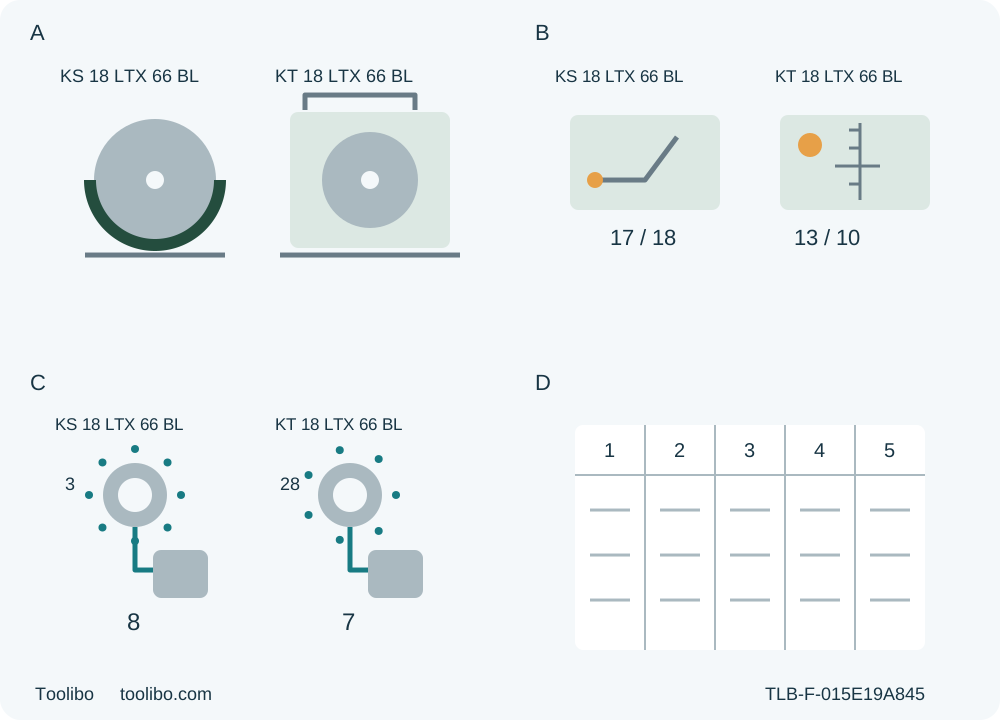
A · Match the entry and complete finish
KS is not designed for plunge cuts. The bounded KT route requires a supported full base and guarded upper head before lowering, plus a fully clear blade arc and stable support at the normal finish; neither diagram authorizes a live cut.
B · Keep depth references distinct
KS uses lever 17 and scale 18. KT uses button 13, ordinary edge 10 and fine adjustment 29, not rail reference 9. Both need actual through-cut depth with no more than half-tooth projection.
C · Qualify the actual extraction path
KS connector 3 has eight positions; KT connector 28 has seven. Each actual connection, extractor and full hose path must separately qualify; position count is not a performance claim.
D · Record a complete decision
Check identity, original assembly/power, job geometry, controls/dust and acceptance/unknowns. Select eligible, conditional or HOLD without averaging away a missing essential condition.
The symbols are conceptual and not to scale. A is architecture recognition, not an entry, lowering or removal sequence. B identifies ordinary isolated adjustment controls without teaching their operation; KT rail reference 9 is not ordinary edge 10. C compares indexed positions only, not extraction capacity or hose interchange. D records required evidence, not a numerical safety score.
The KS 18 LTX 66 BL and KT 18 LTX 66 BL can both appear to answer the same request: a cordless 165 mm saw for a straight cut in loose wood. Their names and maximum depth figures do not establish that either complete system suits the actual job. The important difference is how the supported tool presents its blade to the work and reaches a controlled, clear finish.
This comparison produces a written eligible / conditional / HOLD decision, not two operating tutorials. It compares the EU KS identity 11866000 with its 17027689_00_0526 instructions and the actual UK KT identity 01866001 with its supplied 17027886_00_0526 instructions. It does not equate markets, packages or every tool carrying a similar name. The complete matched owner instructions remain necessary before use.
1. Describe the job before choosing the architecture
Write down the material, measured thickness, proposed straight cut, retained piece, waste, entry, exit and intended surface quality. Keep this decision within known, clean, nail-free loose wood with a separately qualified original wood blade. Exclude hidden services, attached building fabric, metal, plastics and unknown coated or contaminated stock. A generic material word is not evidence that an unknown installed blade is suitable.
Next draw the supports, clamp positions, complete base path, both-hand reach and hose route. Both portions must remain independently supported outside the blade path; the retained work must be secured while waste can separate without closing the kerf. A helper’s hand is not a missing support. Neither a nominal depth rating nor a guide line makes a sagging, unstable or unreachable arrangement acceptable.
For each candidate, ask whether the actual sound tool can be assessed while isolated, beside or safely above the proposed path, with the blade guarded and no tooth contact. Do not force a projecting blade through uncut stock during a rehearsal. If the full support, control and clearance path cannot be established safely, record HOLD before comparing convenience.
2. The entry and finish are genuinely different
The KS is a conventional hand-held circular saw with a movable lower guard. Its specific intended-use section says it is not designed for plunge cuts. Generic safety language mentioning special cuts does not cancel that prohibition. The qualified ordinary route is edge-entry, with the lower guard operating automatically as the work enters. Do not choose it for an interior starting point merely because it has a depth adjustment or a rail groove.
The KT is a plunge-type design. In the bounded owner route compared here, the guide plate is supported on the work, the motor section starts in its upper guarded position and the tool is held with both hands. Its documented lowering architecture requires a stable base while the motor section moves. It is not a borrowed front-shoe-only KS entry technique. The comparison covers an open-ended straight sample, not an enclosed opening, blind plunge or newly commissioned rail system.
The KT instructions prohibit normal switching on or off while the blade touches the work and also prohibit removing the tool from the material with the blade turning. Consequently, its qualified normal finish needs the entire blade arc clear of the stock while stable full-base support and two-hand control remain available. The tool must then reach actual standstill before removal, with the motor section returning freely and the blade covered. A line that merely reaches the board edge does not prove that this complete finish fits the actual setup.
The KS likewise requires full speed before contact, no normal switching while touching the work, actual standstill before withdrawal or setdown and guard coverage. Do not solve either finish by pulling a running saw backwards. For binding or any interrupted cut, the immediate stop-and-hold rule takes priority: release the trigger and hold the saw motionless until the blade stops. Neither this decision sheet nor a protection indicator authorizes a restart or extraction of a trapped tool.
3. Similar dimensions do not approve an assembly exchange
Both exact manual tables list 165 mm diameter, 20 mm bore, 1–2 mm blade-body thickness and maximum 2.6 mm kerf. Both list 66 mm square-cut capacity and 43 mm at 45°. Those figures describe the documented tools; they are not proof that a given workpiece, installed blade, support arrangement or interchangeable flange is qualified.
Use only the already correctly established original assembly appropriate to the exact body, with genuine Metabo blade qualification, material suitability, speed suitability and EN 847-1 for wood. The KT owner scope identifies the original 628026000 assembly. The KS must independently retain its correct EU assembly. Do not infer that a matching nominal bore permits moving a blade between them, flipping a reversible flange or borrowing an undocumented part.
Both manuals advise no more than half a tooth below the work, alongside the general less-than-full-tooth requirement. A feasible through-cut must satisfy the actual projection requirement, not simply read a large number from a scale. Unknown blade condition, incorrect hardware, dullness, damage, binding or an uncertain assembly means qualified correction before operation, not a powered trial to find out.
This comparison assigns neither model an invented riving-knife system. It also makes no claim that one gives a stronger motor, smoother finish or safer result because its name includes “66”. Those outcomes depend on conditions not established by these documents.
4. Record the controls that the owner must actually recognize
On the KS, depth uses lever 17 and scale 18; the lever must lock fully down. Bevel uses screw 14. On the KT, depth uses locking button 13, ordinary read-off edge 10 and fine adjustment 29. Its separate rail reference 9 is not the ordinary depth edge. The KT has two bevel screws 5 and a glass guard 30 whose central position is specified for a square cut. These are different identification and verification duties, not interchangeable numbers.
The KS table gives 4800 rpm no-load speed. The cordless KT has a variable-speed table and recommends dial 12 for wood, corresponding to 5000 rpm; the corded KT 66 BL column uses different dial numbering and must not be copied. This is a source-specific control distinction, not a feed-rate or cutting-performance ranking. An owner who cannot identify the actual setting and matched column has a condition to resolve before operation.
Both current manuals describe kickback-related shutdown with three beeps and three flashes, but the KS uses tool LED 8 and the KT electronic signal indicator 20. Continuous warning signals have different context. None is a certificate that the work is safe, physical battery isolation or permission to resume. Do not choose a saw on the assumption that its electronics make support, sound blades or grip unnecessary; no deliberate protective-function test is included.
5. Qualify the complete power and dust systems separately
Both are 18 V cordless bodies, but a shared voltage or CAS label does not approve an arbitrary battery/charger combination. Retain the already commissioned, explicitly documented power system and its complete separate instructions. The bounded KT owner uses actual 625368000 with ASC 145. The KS candidate needs its own admitted listed-pack/approved-charger evidence. This is not a new battery purchase, charging or cross-system interchange tutorial.
Battery removal follows OFF and full standstill before inspection, adjustment or connection work. A display going dark is not isolation. Damaged, leaking, deformed or otherwise questionable packs are not candidates for a trial cut. Include the documented use and storage conditions in the actual system record rather than borrowing charging temperatures from another product.
The KS extraction connector 3 has eight indexed positions; the KT connector 28 has seven. Each uses its own documented push-in, rotate and pull-out locking arrangement. The count is not a hose compatibility or extraction-performance rating. The actual complete connection, secure orientation, material-appropriate extractor, activation and full hose path must qualify under both sets of instructions before cutting. No installation procedure is supplied here, and no Bosch pressure/flow number is imported.
Suitable eye, hearing and respiratory protection, ventilation and source collection remain necessary. Check the actual dust-control setup with the appropriate tool and extractor isolation during connections; operate the qualified extractor under its own instructions for cutting. Do not select a candidate merely because a dust bag is pictured. Keep the workplace dry, clear of explosive atmospheres and arranged so bystanders cannot enter the cutting or dust zone.
6. Finish the decision sheet, not a points ranking
Make one row per actual candidate with five evidence columns:
- Identity and documents: exact body, market, supplied revision and complete owner instructions.
- Original assembly and power: qualified blade/hardware, sound condition and already commissioned actual supply.
- Job geometry: material and thickness, entry architecture, retained support, independent waste, reach and complete clear finish.
- Controls and dust: recognized model-specific controls, correct ordinary depth reference, functioning guard through all angles and depths, active qualified extraction and unobstructed hose path.
- Acceptance and unresolved items: the intended sample’s size, straightness, square edge, both faces and absence of abnormal behavior, with no promised tolerance or cosmetic finish.
Mark eligible only when every essential condition is evidenced and the matched owner workflow can be followed. This means eligible to proceed under that full workflow, not that a physical setup has been certified by a drawing. Mark conditional when a specific missing document or qualified assessment can be obtained; list who or what must close it, and do not operate meanwhile. Mark HOLD for damage, unknown assembly, an unsuitable entry or finish, unresolved support, unqualified dust/power or an out-of-scope task.
For example, a known loose-board job with a fully qualified ordinary edge-entry path may make the KS eligible without making the KT eligible: the KT still needs its own full-base lowering and clear-arc finish evidence. Conversely, a documented KT setup does not permit a KS plunge. A rail-dependent or interior-opening job remains outside this comparison for both candidates until the complete separate system and task are established. Choosing neither is a complete result when the evidence does not close.
Models referenced