
Four questions before choosing either saw
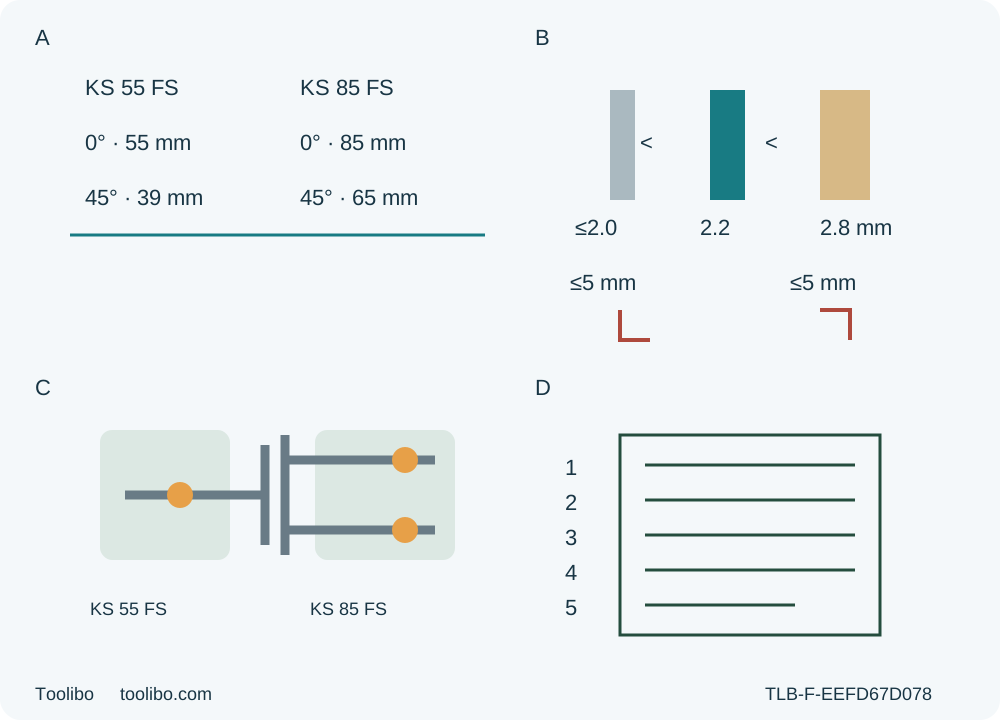
A separates documented 55/39 mm KS 55 FS and 85/65 mm KS 85 FS square/45-degree capacities. B shows KS 85 FS blade body at most 2.0 mm, knife 2.2 mm and cutting width 2.8 mm with two independent 5 mm maximum clearance symbols. C contrasts one and two fence locks. D collects the evidence into a decision sheet.
A · Define the actual depth need
Record measured stock and intended angle before using the documented 55/39 mm and 85/65 mm capacities. Do not infer a flip-cut method when capacity is insufficient.
B · Qualify the knife system
For the original KS 85 FS assembly, body thickness must be below knife thickness and cutting width above it; both distinct knife clearances must also qualify. Unknown alignment or gaps require competent correction, not eye adjustment.
C · Account for the actual guide
KS 55 FS uses its right-entering guide and one lock; KS 85 FS uses the double stop with front-then-rear locks and the appropriate edge-facing rail. Verify sample width and clearance rather than equating controls.
D · Choose or hold the complete system
Identity, original assembly, capacity, guard/knife condition and real supply/support/extraction all need evidence. No operating or service authorization is created by the comparison.
This is a non-scale decision aid, not a running-cut pose or maintenance drawing. A pairs each model’s square and 45° capacities; no feed-rate ranking follows. B represents KS 85 FS original assembly prerequisites, including two different clearances each at most 5 mm, not an adjustment recipe. C shows locking obligations only: the KS85 edge-following rail, not its transverse bars, is parallel to the blade. D has no score; an essential unknown holds that candidate.
Choosing between these two Metabo saws is not a contest to buy the larger number. A useful decision links the actual job to a documented blade assembly, enough cutting depth, a controllable support layout and maintenance obligations the owner can satisfy. The KS 55 FS and KS 85 FS share a brand and several operating principles, but the KS 85 FS adds a riving-knife system and a different double parallel stop. Those are ownership requirements, not a universal safety score.
This comparison concerns the admitted KS 55 FS service identity 00955000 and the EU KS 85 FS product 601085000/service 01085000, using their exact 0526 instructions and supplied general safety document. It assumes correctly installed original approved wood assemblies and ordinary rail-free edge-start wood tasks. It does not compare unverified KS 57/66 models, convert regional bores, install blades, adjust a knife, commission rails or teach plunge cutting. Both manuals expressly say the machines are not designed for plunge cuts.
Write the job specification before comparing capacities
Record actual stock thickness, material and condition, intended square or angled result, usable reference edge, finished dimension and tolerance, and where the work can be supported and clamped. Identify nails, embedded metal, unknown coatings or damaged stock as unresolved material conditions rather than extra power requirements. Keep the proposed work to known loose wood appropriate for the installed blade. Structural or hidden-material work needs a separate qualified plan.
For a concrete decision example, imagine a measured 38 mm thick loose board needing a square edge-start cut. Both documented maximum square depths exceed 38 mm, so depth alone does not select the KS 85 FS. Now imagine an actual 70 mm thick workpiece: that exceeds the KS 55 FS’s listed 55 mm square depth but is below the KS 85 FS’s listed 85 mm. The second statement only keeps the larger saw under consideration. It does not prove the original blade is suitable, that the knife can be qualified, or that the workpiece and saw can be controlled. These are hypothetical screening examples, not projects or support ratings.
Do not turn an inadequate depth into an improvised two-sided flip-cut procedure. If the selected owner’s documented method does not close the whole cut, choose another qualified method or obtain appropriate help. A complete decision may legitimately be “neither in this workspace.”
Separate blade size, depth and speed
The KS 55 FS manual table lists a 160 mm blade with 20 mm bore, 55 mm maximum depth at square and 39 mm at 45°. The KS 85 FS lists a 235 mm blade, 85 mm at square and 65 mm at 45°. Those are documented capacities, not the amount of blade to expose below every board. Both setting sections advise no more than half a tooth beneath the work; the actual owner checks and locked settings still apply to a much thinner piece.
The smaller saw’s table gives 5600 rpm no-load speed and the larger one’s 4500 rpm. That does not make the former universally faster in wood or the latter a torque winner. No-load speed is not measured feed rate, cut quality or stall resistance. Likewise, nameplate input power is not a hands-on productivity comparison. Select for the actual job and qualified assembly rather than treating any one specification as a performance ranking.
The KS 85 FS family manual shows 30 mm and 15.88 mm bore arrangements. This article retains only the already qualified original 30 mm assembly of the specified EU owner record. A reversible-flange passage in the service material is not permission to convert this saw or share blades with another regional version. Both existing blades must be sharp, undamaged, suitable for the no-load speed and actual wood, and conform to EN 847-1. A familiar outside diameter alone establishes none of those conditions.
Treat the KS 85 FS knife as a separate qualification
The KS 85 FS table identifies maximum blade-body thickness 2.0 mm, riving-knife thickness 2.2 mm and cutting width 2.8 mm. The governing relationship is blade body thinner than knife and cutting width wider than knife. A blade that appears to fit the spindle can still violate that relationship. This is why an unknown thin-kerf replacement is not automatically an acceptable way to make the larger saw “cut more easily.”
Two clearances matter separately: the knife’s inner curve must be no more than 5 mm from the toothed ring, and the blade’s lowest point must project no more than 5 mm below the knife’s lower edge. The first is not a substitute measurement for the second. The knife must be correctly installed, aligned, undamaged and freely returning; an uncertain gap or a bent knife holds the saw for competent correction under the complete instructions. This comparison does not tell the reader to loosen its screws or adjust it by eye.
The knife helps address wood closing behind the blade while it is engaged in the work. The manual also says it is ineffective in preventing kickback during short cuts. It therefore cannot certify an otherwise awkward small-piece layout, replace a working lower guard or justify pushing through a binding cut. The KS 55 FS comparison record does not acquire the KS 85 FS knife or its adjustment requirements simply because both carry “FS.” Conversely, the absence of that specific system is not a numerical safety ranking; the complete correct-use conditions still govern each saw.
A buyer or existing owner should be able to document the original assembly and, for the KS 85 FS, the knife relationship and both clearances. If that evidence is missing, record a hold with the exact missing item. Do not substitute a powered demonstration for documentary or isolated-condition checks.
Compare controls as work to learn, not features to count
Both saws have two bevel locking screws; their separate limit stops do not clamp the angle. The KS 55 FS has a 47° extended stop and the KS 85 FS a 48° stop. That one-degree difference is not a reason to improvise a high-angle project. For the square task considered here, the relevant owner outcome is a verified zero relationship with both clamps secured, plus independently locked cutting depth.
The parallel guides differ more meaningfully. The KS 55 FS guide enters from the right, its width is read at marking 15 and its locking screw 16 must secure it. The KS 85 FS double stop can enter from either side and has front and rear locking screws, tightened front first, then rear. Its edge-following stop rail must stay parallel to the blade; the transverse support bars are not supposed to point along the blade. For an outside straight workpiece edge, the KS 85 FS stop rail faces down. Its other fence orientation is a separately described arrangement, not a reason to swap orientation mid-cut.
For either guide, a scale setting still needs an appropriate supported sample to establish the actual finished width. Check whether the intended guide face can stay against a straight reference for the whole cut while clamps, the housing, guard and hands remain clear. If the available board is too narrow or the guide arrangement cannot maintain support, the model with the greater capacity is not automatically the workable choice.
Qualify the workplace and extraction independently
Both manuals require actual nameplate voltage and frequency to match the supply and an upstream RCD with maximum 30 mA trip current. This is a supply prerequisite, not a wiring tutorial. An uncertain outlet, damaged cable or unsuitable extension arrangement is a hold for either model. A shared plug shape does not establish an identical regional electrical system.
The extraction hardware also differs. KS 55 FS uses an adapter secured by a socket-head screw and a suitable extraction unit/hose; the manual says to remove that adapter when not extracting. KS 85 FS has a connector that is pushed in, rotated and pulled out into indexed positions, with a suitable extractor and hose for extraction. Knowing these differences prevents assuming that a nozzle resting loosely between positions is locked or that an adapter from the other saw is interchangeable. Existing complete qualified dust control must be available for the intended wood and workplace; no numerical Bosch extractor threshold is imported into these Metabo instructions.
Assess actual handling with the saw unplugged, guarded and safely supported—not running. Can the operator use both prescribed grips, stay out of the blade line and follow the route without overreaching? Can the work be securely clamped, both portions supported outside the blade path and the waste allowed to separate without closing the kerf? Does the hose or cable catch at the exit? The assessment concerns the real saw, guide and supports; no claimed universal bench size, lifting ability or support span follows from a catalog figure.
The complete owner instructions retain eye, hearing and appropriate dust protection, all-angle/all-depth guard clearance and free immediate return, and the applicable knife checks. An isolated viewing limitation does not authorize operation: any required check that cannot be completed remains unverified. Do not conduct live fault tests to settle the choice.
Finish with a recorded choice or hold
Create one row for each saw and record the evidence for five questions: exact identity and supply; original blade and material qualification; actual depth at the intended angle; complete guard/knife and guide condition; and feasible support, reach and extraction. Mark each question accepted, unresolved or outside scope. Do not average them into a score: one unresolved essential condition can stop that candidate even if every other specification is attractive.
Choose the KS 55 FS for the defined task only if its actual assembly, capacity and complete workspace plan qualify; it need not lose merely because another saw cuts deeper. Keep the KS 85 FS in consideration when its additional capacity is actually needed or otherwise justified, but only with its original regional assembly, knife, double-stop and handling obligations closed. Hold both if neither complete system can be established. Record what evidence or qualified assistance would resolve each hold rather than buying another accessory speculatively.
Once a candidate is chosen, use its separate complete owner workflow for an ordinary supported sample and evaluate dimension, square edge and process stability before valuable work. This decision sheet itself is not a new operating, fitting or maintenance procedure. Its finished result is a justified model-and-workspace choice with explicit reasons and unresolved items, not a claim of tested superiority.
Models referenced