
Four parts of a complete system decision
A contrasts a disconnected cord with a detached DCB606 battery. B separates DWS520 minimum 2.2 mm kerf and DCS520 minimum 1.8 mm kerf, both using a 1.7 mm knife and blade body at most 1.6 mm. C separates lettered A/B and numbered 1/2 controls plus wood dial ranges 3–5 and 3–7. D represents a five-column evidence worksheet.
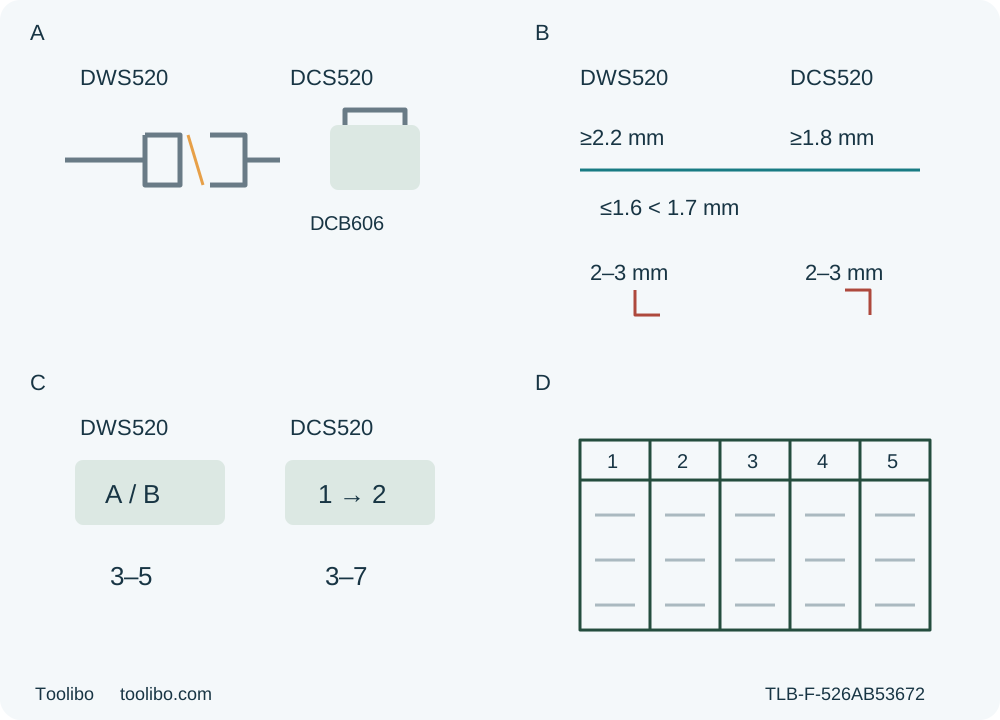
A · Qualify actual power
DWS520 needs its actual sound nameplate supply and cable path; DCS520 needs the already commissioned actual DCB606/DCB118 system. Both still need qualified active extraction.
B · Keep assembly limits separate
For original DWS520 use at least 2.2 mm kerf; for original DCS520 at least 1.8 mm. Both retain the 1.7 mm knife, at most 1.6 mm blade body and two distinct 2–3 mm knife gaps; no blade interchange or adjustment is taught.
C · Identify the controls
Document the exact A/B or 1/2 controls, both bevel locks and actual depth/indicator requirements. Solid-wood dial 3–5 versus 3–7 is model-specific, not a power or feed-rate ranking.
D · Choose, condition or hold
Record identity, original assembly, job/control fit, supply and support/extraction evidence. An essential unknown prevents operation; a rail-dependent job needs separately complete rail-system qualification.
Conceptual symbols are not to scale and depict no operating or fitting sequence. A represents different physical isolation and supply prerequisites, not charging permission. B compares original assembly limits; both independent 2–3 mm knife gaps must already qualify. C does not prescribe a DWS520 A-then-B choreography: its complete matched instructions govern, while the DCS520 cutting section explicitly places 1 before 2. The two wood dial ranges are not equal rpm settings. D is a decision record, not a numerical safety score.
A corded DWS520 and a cordless DCS520 can both look like a solution to the same cut. The useful question is not which motor label wins: it is which complete, documented system can perform your actual job without an unresolved supply, assembly, extraction or handling condition. This comparison produces a written choice or hold, not two abbreviated operating tutorials.
The candidates are the Canadian DWS520 Type 3 under N394705 MAR14 and the Canadian DCS520 Type 1 under N486591 FEB17. The current Canadian product pages link those exact documents. That establishes the document route, not that every saw with a similar name, every region or every later kit has the same instructions. Match the physical type, controls and supplied instructions first. The comparison retains existing correctly qualified original wood-cutting assemblies; it does not authorize changing blades or adjusting a riving knife.
Define one job before comparing the systems
Write down the actual material, measured thickness, required cut direction, finished dimensions and appearance face. For the bounded decision here, use known clean, dry solid wood, an ordinary square edge-entry crosscut and a clear exit. Inspect for nails and other foreign material. An interior opening, a wall cut, an unknown composite or an installed component changes the task and falls outside this decision.
Then describe the real workholding: retained work securely clamped, both portions supported outside the blade path, waste free to separate without closing the kerf, and the saw’s base supported throughout. Include the positions of the guide, clamps, extractor and operator. A small offcut is not permission to hold the stock by hand, and a nominally portable saw does not make an awkward reach acceptable. If neither actual saw can complete the route with its two designated grips and safe footing, hold the job before comparing power sources.
Both source systems distinguish rail-free and rail-assisted arrangements. This decision considers only the separately qualified edge-entry owner routes. It does not turn a rail-free crosscut into permission for an interior plunge or assume that an accessory rail is already commissioned.
Make supply a pass/fail condition, not a preference score
For the DWS520, qualify the actual nameplate supply, sound plug and cable, and any required extension arrangement under its complete instructions. Route the cable away from the cutting area and throughout the exit. An accessible socket is not enough if its supply is uncertain or the cable will catch on a clamp. A damaged switch, lead or plug is a service hold, not a reason to try the saw briefly. This comparison gives no wiring, plug replacement or electrical diagnosis procedure.
For the DCS520, the bounded owner system is an already commissioned actual DCB606 battery with DCB118 charger and their complete matching instructions. The manual’s final battery/charger table identifies that pairing. This is not a claim that a current carton includes either item, nor permission to pool other packs because they share a brand or voltage label. Actual pack condition, secure retention, charge readiness and the existing qualified charging arrangement must be known. A dropped or damaged battery or charger, or uncertainty about the system, holds the candidate; a gauge display does not clear a fault.
The DCS520 removes the saw’s mains lead from the cutting route, but not the extraction hose, support needs or obligations associated with its battery system. An electrically powered extractor may still need its own supply. Conversely, the DWS520 needs no saw battery for this task but still needs a qualified cable route and supply. Neither distinction establishes runtime, feed rate, torque or cut quality.
Isolation is also different evidence on the worksheet. Switch off and wait for complete standstill; unplug the DWS520 or remove the DCS520 battery before adjustment or inspection. A released trigger is not physical isolation. Do not use a powered fault demonstration to settle a buying or ownership question.
The shared blade diameter hides a consequential difference
Both documented systems use 165 mm blades with a 20 mm bore, and the retained original blade must meet the applicable speed and material requirements. The manuals specify blades rated for at least 6000 rpm; the DWS520 owner qualification also retains the requirement to exceed the tool’s speed. Matching diameter and hole size does not establish compatibility.
Both knives are 1.7 mm thick, and both documented blade-body limits are at most 1.6 mm. The minimum cutting widths differ: DWS520 requires at least 2.2 mm kerf; DCS520 requires at least 1.8 mm kerf. The knife must remain thicker than the blade body and thinner than the cut. A blade acceptable under one minimum is therefore not automatically acceptable in the other saw. Do not exchange blades or infer part equivalence from these numbers.
Both original knife assemblies must already have the two distinct 2–3 mm clearances correctly established. One clearance follows the blade’s toothed perimeter; the other concerns the lower blade/knife relationship. One satisfactory gap cannot stand in for both. The installed knife must also be aligned, undamaged and functioning as required by the matched instructions. Unknown assembly history, loose hardware, dull or damaged blade, incorrect washers or unexplained contact is a hold for qualified correction. This is a documentary and isolated-condition qualification, not a knife-setting recipe.
The same principle applies to the guarding system. Its free return, spring action and clearance at all documented angles and depths must be verified under the complete owner instructions before use. A plunge head is not a pendulum-guard saw to which another model’s lever test can be transferred. Do not defeat the guard or operate a suspect saw to see whether it improves.
Compare the actual controls you must understand
The DWS520 uses lettered controls: both bevel knobs E, depth knob F, main handle C and front handle H. Its general starting section describes operating plunge trigger A and switch B; the cutting section presents the controls differently. The qualified owner route preserves the supported state—front base supported, blade clear, familiar matched controls and full speed before contact—without inventing a release-and-repress choreography. An owner who cannot resolve the actual controls against the complete instructions must hold the task and obtain qualified clarification.
The DCS520 uses both bevel knobs 7, depth knob 8, front handle 11 and main handle 3. Its cutting section explicitly moves plunge trigger 1 forward before pressing switch 2. Its rail-free cutting-line indicator 27 is not the full-plunge blade-position indicator 29. Familiarity with the corded saw does not identify these parts automatically. Neither a lock-off feature nor a depth stop substitutes for secured settings and physical isolation while preparing them.
The documented solid-wood speed settings also differ: DWS520 lists 3–5 within its 1750–4200/min range; DCS520 lists 3–7 within 2500–4200 rpm. These are each model’s own settings, not equivalent dial positions or a measured performance comparison. There is no basis here for assigning a specific intermediate rpm to every number or saying that one saw cuts faster.
Actual depth must be suitable for the stock and retained original blade. The DWS520 owner route uses actual half-tooth projection within the general less-than-full-tooth limit. The DCS520 route requires a through-cut while retaining less than a full tooth below the work. An approximately 3 mm note in either document does not override those conditions or establish a universal scale setting. Product on-track 54 mm claims and manual 55 mm on-track figures are retained as differing source statements, not averaged into a new capacity. A job near an unresolved limit is not cleared by this comparison.
Extraction and the workspace remain mandatory
Both manuals require connection to a dust extractor designed in accordance with relevant dust-emission requirements. Verify the actual extractor’s documents, suitability for the wood and workplace, hose connection and operation. A port-size claim or a marketing collection percentage does not certify the installed system. No numerical Bosch pressure/flow threshold is imported into these DEWALT instructions.
The DWS520 additionally requires its exhaust nozzle to be forward or closed to avoid flying dust; that actual instruction remains part of its existing extraction qualification. It is not an invitation to improvise a nozzle arrangement. The DCS520 describes a 1-1/4 in hose connection, requires a tight connection and warns of static charge without an antistatic suction hose. Neither statement proves an unspecified adapter or another model’s nozzle equivalent.
For both candidates, establish that extraction is active under its own instructions and that the hose will not pull the saw off line, foul the guard or snag a clamp. Account for appropriate eye, hearing and respiratory protection and ventilation under the matched instructions. Use a dry, uncluttered workplace without flammable liquids or gases. Plan the appearance face down, without promising that both faces will be splinter-free. Actual sample finish still needs inspection.
Normal completion is not interchangeable with an interrupted cut. The complete owner routes require trigger release and actual blade standstill before moving or lifting the saw, verified guard coverage before safe setdown, then physical isolation before inspection. Binding requires release and a motionless hold until the blade stops, not pulling a running blade out or forcing it back onto a line. This comparison supplies no restart, trapped-tool extraction or anti-kickback reset procedure.
Keep a future rail system as a separate unresolved item
A product described as a track saw is not evidence that your actual rail, clamps, clearance adjustment and splinter strip are ready. Both manuals require complete track-system instructions for commissioning the strip and describe rail-specific adjustment. Their rail procedures, plunge protection and indicators are not automatically available during off-rail use. Nor does a shared manufacturer name establish compatibility with an unidentified rail.
If the real job depends on a rail, record the exact rail and accessory identities and obtain the complete matching instructions before deciding that the system is eligible. Do not perform an improvised first strip cut using a setting borrowed from the other manual. For the bounded rail-free job, leave rail commissioning explicitly outside the decision rather than treating its unresolved status as a secretly completed step.
Finish the worksheet with an actionable result
Create one row per exact candidate and five evidence columns: identity and instructions; original blade/knife/guard condition; actual job and controls; supply or commissioned battery system; and support/extraction/exit. Mark each column established, unresolved or outside the proposed scope. Do not add points: an essential unknown cannot be cancelled by several attractive specifications.
Eligible for the separate owner workflow means every essential condition is established for that particular edge-entry task, including actual depth and clearances. Conditional means a named, non-operating prerequisite still needs evidence, such as confirming the extractor documents or obtaining qualified supply confirmation; it is not permission to cut meanwhile. Hold means a safety-critical fault, unknown original assembly, incompatible identity, unclear controls or infeasible workholding prevents proceeding.
For example, a fully documented DWS520 may be the usable candidate when its actual supply and cable route qualify but the DCS520 battery history is unknown. A commissioned DCS520 may remain eligible when the corded route cannot be arranged safely, provided its own extraction supply and hose path still qualify. If neither can support the planned work and free waste safely, hold both rather than buy an accessory on speculation. These are decision examples, not claims of tested superiority.
Record the selected model, accepted evidence, unresolved items and the next responsible action. Then use that model’s separate complete owner workflow for a supported sample and verify dimensions, square edge, surface condition and stable process before valuable work. The completed result here is a justified system choice with clear stop conditions—not a new operating license, a kit recommendation or a guarantee of performance.
Models referenced