
Same reach, different controls
Same reach, different controls — numbered controls and physical routes explained by the legend.
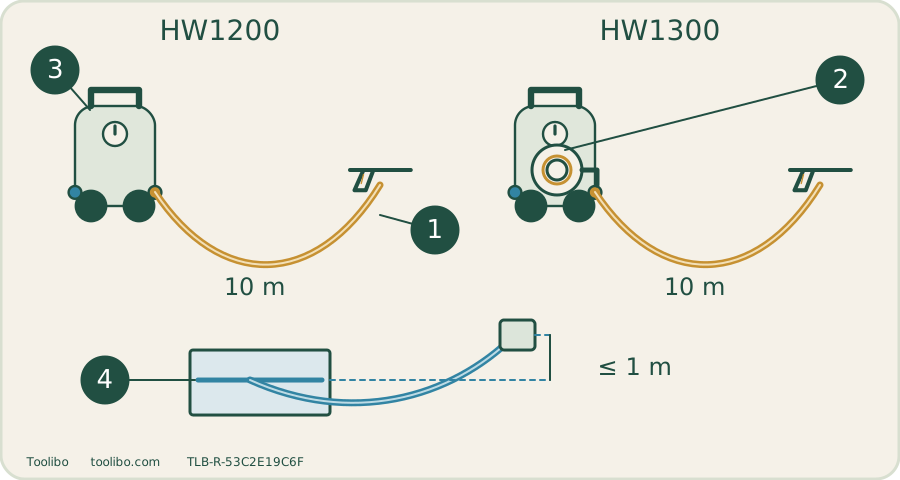
HW1200
- Working 100 bar; maximum permissible 120 bar.
- 10 m hose; detachable machine-end hose and on/off switch, no reel.
HW1300
- Working 80 bar low/110 bar high; maximum permissible 130 bar.
- 10 m hose with reel; fully unwind. Separate low/off/high motor selector and Vario-Power lance adjustment.
Reach
Both listed with 10 m hose
Control
HW1300 adds low motor mode
Storage
Reel versus detachable hose
Tank option
Approved suction set; inlet-to-water height at most 1 m.
Original explanatory diagram; not a dimensioned service drawing.
Compare the matched version, not just the name
This comparison uses the ENEU HW1200/HW1300 manual. It is not a comparison of similarly named North American or Japanese versions. Match the actual rating plate before buying an import. Regional promotional pages disagree on HW1200 power and sometimes describe a reel; those disputed claims are not a reason to pay more.
The verified difference is straightforward: HW1200 has an on/off switch, while HW1300 adds a low-pressure motor mode and a hose reel. Both use a Vario-Power lance for nozzle-level adjustment. A low motor mode and an adjustable lance are therefore separate controls, not competing descriptions of the same feature.
Put like-for-like figures side by side
Swipe or scroll horizontally to see all columns.
| ENEU specification | HW1200 | HW1300 |
|---|---|---|
| Working pressure | 100 bar | 110 bar high / 80 bar low |
| Maximum permissible pressure | 120 bar | 130 bar |
| Water flow rate | 5.5 L/min | 6.0 L/min |
| Maximum feed volume | 7.0 L/min | 7.5 L/min |
| High-pressure hose in regional catalogue | 10 m | 10 m |
| Hose reel in matched manual | No | Yes |
The maximum figures are not guaranteed simultaneous operating values. The tap-connection section separately requires supply greater than maximum feed volume: more than 7.0 L/min for HW1200 and more than 7.5 L/min for HW1300. Do not use the lower rated output figures as supply requirements. Do not diagnose a fault by expecting the maximum number continuously at the gun.
Scenario one: a car and a few chairs
Suppose both machines reach the entire work area without hose tension, and storage is easy. HW1200 is a reasonable shortlist choice: paying for HW1300 does not buy a longer factory hose in this comparison. Spend the remaining decision effort on the correct attachments, suitable supply and practical storage position.
HW1300 becomes more attractive if the separate lower motor setting is useful in your routine. It does not make every surface safe. For both machines, exclude the dirt blaster from car bodies and windows; use a suitable controlled spray and test the surface. Choosing the lower switch setting cannot turn an unsuitable nozzle into the right one.
Scenario two: packing away repeatedly
Imagine cleaning in several short sessions, with the machine returned to a cupboard each time. HW1300’s reel may be worth more to you than its extra headline pressure. Its hose must still be fully unreeled for work. Check that the storage location leaves room to operate the reel handle, rather than comparing only the parked footprint.
HW1200 uses a detachable machine-end pressure hose. That can suit a user who prefers to store the hose separately, but it creates another connection to inspect when setting up. The useful question is which arrangement you will handle consistently without kinks, grit or pulling the machine—not which product photograph looks tidier.
Scenario three: drawing from a clean-water tank
Do not choose HW1300 on the assumption that only the larger model can use tank water. The matched manual covers optional Makita suction equipment for both, with a maximum 1 m difference between the machine inlet and water surface. The filter and approved suction arrangement matter more than the reel.
Before buying either, sketch the tank, inlet height and hose route. If the water surface will fall too far below the inlet during the job, the initial full-tank measurement is misleading. If your supply arrangement cannot satisfy the approved setup, choose neither until it is corrected. A larger model is not a workaround for an unverified suction installation.
A decision you can check before paying
Write down three answers: whether 10 m actually reaches your work, whether you need the separate low motor setting, and whether the reel improves your real storage routine. If only reach matters and both routes work, the reel and control—not 120 versus 130 bar—should decide the shortlist. If none of those differences solves a real problem, choose by complete local kit cost, service access and verified regional compatibility rather than an unsupported speed claim.
Models referenced