
Keep inlet, operating and maximum figures separate
Water moves from a measured supply through a pump to a fan nozzle, with an operating gauge separate from the maximum-rating label.
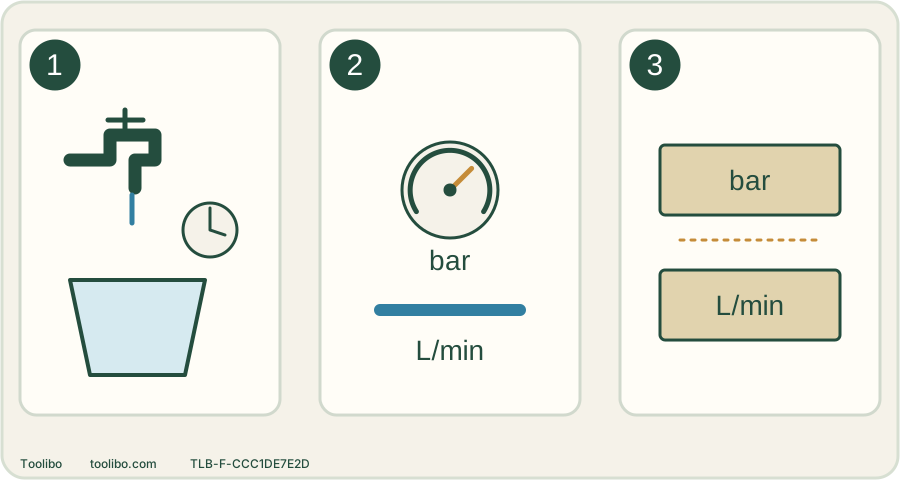
Inlet
Measure available supply at the end of the intended hose.
Rating
Read the operating pressure and flow under their original labels.
Maximum
Keep advertised maxima separate from an operating pair.
The supply requirement and the rated nozzle flow answer different questions; do not merge their arrows into one value. Conceptual schematic, not a product image or scale drawing.
Four figures, four different questions
Maximum or allowable pressure describes a limit under the manufacturer’s stated definition. Rated operating pressure describes the documented operating rating. Flow describes a volume over time, but it still needs its label: maximum flow and rated flow are not interchangeable. Minimum inlet flow tells you how much water the supply must be able to provide; it is not a promise that all that volume leaves the nozzle under the rated pressure.
Keep input electrical power separate too. A 1.9 kW motor input is not 1.9 kW of useful water power at the surface. Losses and operating conditions matter. A larger wattage alone cannot establish how much faster one machine will clean.
Work through a real example
For the UK UniversalAquatak 135, the product page lists maximum pressure of 135 bar and maximum flow of 7.5 L/min. The matched manual lists rated pressure of 9.2 MPa, rated flow of 6.4 L/min and minimum supply of 7.5 L/min. Thus 92 bar is the rated-pressure figure, while 135 bar belongs in a different column.
The EasyAquatak 120 example likewise has separate published maximum and rated figures. Comparing the Universal’s maximum against the Easy’s rated pressure would exaggerate their difference. Neither machine should be judged faulty merely because a working measurement is below the advertised maximum.
Convert units before comparing
One MPa equals 10 bar. A flow in L/min becomes L/h when multiplied by 60: 6.4 L/min is 384 L/h. Divide L/h by 60 to go the other way. Carry the original label through the conversion: converting maximum flow does not turn it into rated flow.
If a listing says only “pressure” or “flow,” leave that cell unresolved until the exact product specification or manual identifies it. Do not fill the gap using a similarly named machine from another country. Voltage versions and revisions can change the data.
Check whether the supply can support the machine
Check flow at the end of the garden hose you plan to use, with the washer disconnected. Collect a known volume in a suitable container and time it; litres divided by minutes gives the observed flow. Keep this separate from the pressure-washer test itself, and do not restrict the outlet to make it look like a spray nozzle.
Repeat if the tap supply varies or another household outlet is commonly used at the same time. A measurement below the manual’s minimum means the setup needs correction before operation. A measurement just above it is not a guarantee against variation, restrictions or leaks. Also check inlet-pressure and temperature limits: flow alone does not establish a suitable water supply.
Turn the numbers into a sensible buying decision
Pressure helps describe the intensity available; flow helps describe how much water can carry loosened dirt away. Nozzle geometry, distance, surface condition and technique determine what reaches the work. A higher-pressure machine with the wrong nozzle can damage a surface rather than clean it well.
Keep a comparison sheet with exact model, market, maximum pressure, rated pressure, labelled flow, minimum inlet supply and included nozzle. Mark absent data as absent. Choose a machine that fits the job and water supply, not the biggest result from multiplying two unrelated maxima.