
Choose controllable contact, not a diameter strength ranking
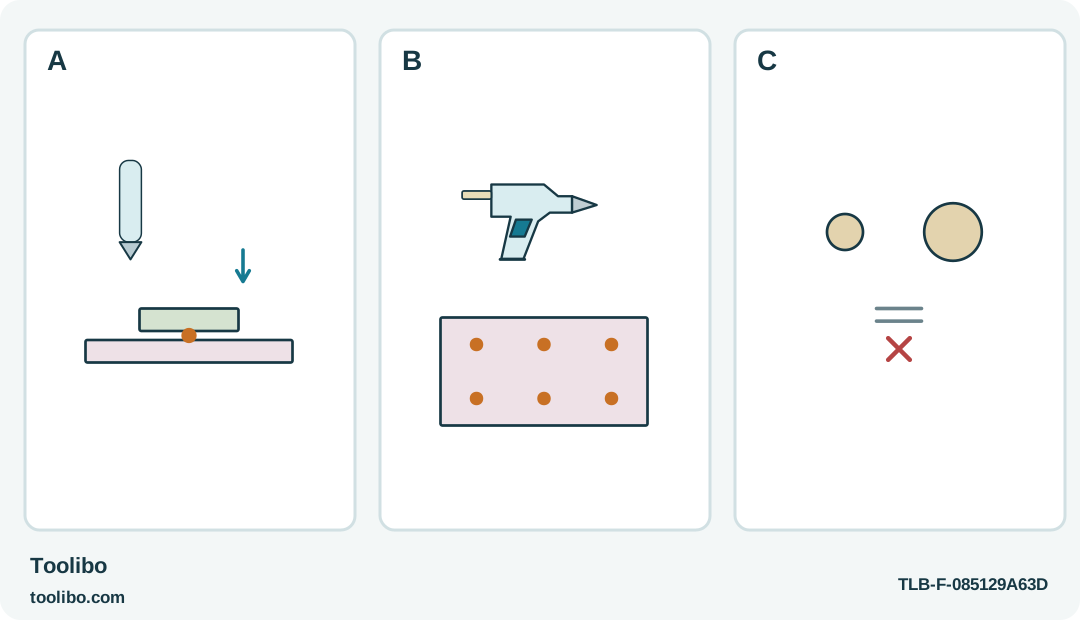
A small label over one modest deposit, a broad panel with separated points and crossed diameter equivalence show task-based selection.
A
A small label needs a modest hidden deposit, matched adhesive and support; a compact tool does not remove the burn risk.
B
A broad panel needs a pattern that can be joined promptly, rather than a long cooling perimeter bead.
C
Mini and full-size stick diameters identify different systems, not stronger and weaker grades. Test the exact material and controlled application.
The amount you can place and assemble cleanly matters more than whether the stick is called mini or full-size.
Choose by the joint, not the diameter badge
A mini glue tool and a full-size gun solve different handling problems, but stick diameter is not a strength rating. For a small dry household decoration, the useful question is whether you can deliver an appropriate amount, position the parts promptly and keep your hands outside the hot zone. A larger bead is not automatically a better bond, and a smaller tool is not automatically safer.
Consider two ordinary tasks: retaining a paper label on a desk organizer and attaching a broad decorative cardboard panel. The label may need only a small controlled application. The panel needs a layout that can be assembled before the first glue cools. Neither task becomes structural simply because you use a larger gun. If the panel is warped or the label material is unsuitable, changing tool size does not solve the underlying problem.
Lay out the actual parts and rehearse the movement before selecting a tool. Measure available access around the joint, identify where the hot gun will rest and decide whether a cord or battery pack interferes with the approach. Judge the complete setup, not just the nozzle seen in a product photograph.
Compare these three systems accurately
The identified Bosch GluePen uses a recommended 7 mm stick and an integrated battery. It suits a compact hand position, but requires the correct adhesive and charging arrangement. The Bosch PKP 18 E uses 11 mm sticks and mains power. The North American Worx WX045L specifies 7/16 inch (11 mm) sticks and its designated removable battery system. These are separate tool-and-consumable combinations, not interchangeable ways to melt any household stick.
The PKP 18 E and WX045L both list approximately 200 °C gluing temperature in their respective manuals; that does not make every 11 mm formula suitable for both. The GluePen’s own recommendations likewise take precedence over a bag marked simply “mini.” Check the manufacturer-approved adhesive, its working temperature and the intended material before considering the convenience of a larger package.
Do not shave a full-size stick down, bundle small sticks together or push a loose-fitting stick with a second tool. An adhesive that appears to fit the inlet may still have the wrong melting requirements. Keep the packaging with the sticks so that the decision can be repeated correctly next time.
Test control on the actual materials
- Put matching offcuts on a heatproof silicone mat and support them without fingers behind the receiving area.
- Set up the selected gun according to its own manual. Allow its specified heating sequence; do not borrow a faster warm-up time from another model.
- Apply a small amount under moderate, controlled pressure. Observe whether you can stop cleanly without leaving an oversized pool.
- Join the scraps promptly through cool edges and leave them undisturbed until cooled.
- Inspect the visible face and the cold joint for distortion, bleed-through, rocking or separation.
For the small label, excess glue may show as a raised bump or stain. For the broad panel, a continuous perimeter bead may cool at its starting point before you reach the end. The useful adjustment is often less adhesive or a smaller working section, not a more powerful tool. Repeat the trial only with a change you can describe, such as fewer attachment points or better access.
Reject a combination that melts the substrate, releases from its coating or needs constant pressure to stay flat. No amount of practice with the trigger establishes compatibility with an unknown plastic or finish. Choose another attachment method if the actual material cannot be tested without damaging the object.
Make the whole session manageable
A mains-powered PKP 18 E needs a safe cable route and its support bracket between applications. The battery-equipped WX045L needs stable placement and the correct battery handling; never lay the hot gun on its side. The GluePen needs a safe resting and cooling place even though its small shape resembles an ordinary pen. None belongs loose among paper scraps.
For a repeated batch, prepare components in small groups so the gluing interval matches the time required to position them. Pause when flow becomes poor instead of squeezing harder. A tool that produces more adhesive than you can place neatly is not improving the process. Likewise, repeatedly exhausting a small tool’s practical flow on an oversized assembly is a sign to revise the job rather than force the feed.
After the trial succeeds, use the same materials and layout on the real piece. Disconnect or switch off according to the exact model and let everything cool completely before storage. Check the finished attachment cold under its ordinary decorative handling. Your selection is justified by controlled application and an acceptable joint—not by treating 7 mm and 11 mm as competing grades of strength.
Models referenced