
Two operating points are not one larger specification
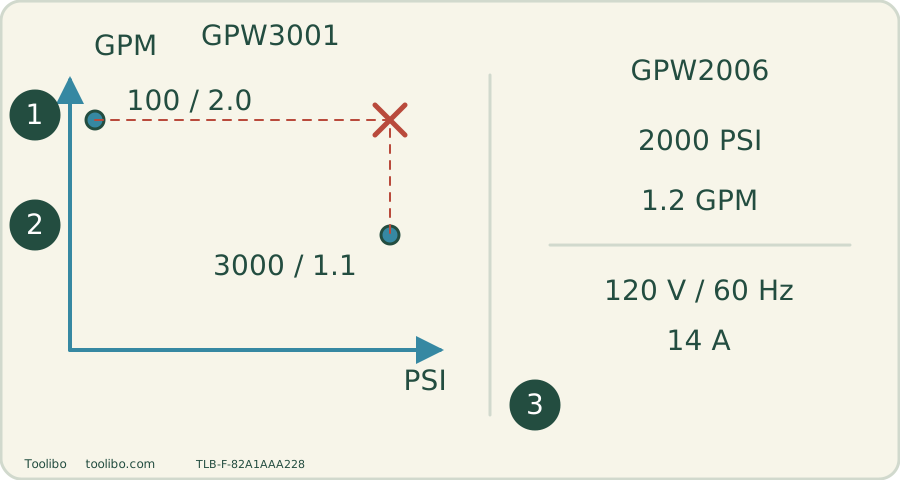
Two separate GPW3001 pressure-flow points with the unsupported 3000 PSI and 2.0 GPM pairing crossed out; regional GPW2006 specifications shown separately.
GPW2006
- 2000 PSI maximum pressure.
- 1.2 GPM rated flow in the matched manual; maximum inlet temperature 40°C. Water-main supply only; at least 3 m of free inlet hose.
GPW3001
- 3000 PSI maximum pressure.
- 1.1 GPM rated flow. Explicit product points: 3000 PSI at 1.1 GPM, versus 100 PSI at 2.0 GPM; never combine 3000 PSI with 2.0 GPM. Maximum inlet temperature 40°C.
High-pressure point
GPW3001: 3000 PSI at 1.1 GPM.
Low-pressure point
GPW3001: 100 PSI at 2.0 GPM; do not move this flow value to the high-pressure point.
Regional comparison
GPW2006 Canada: 2000 PSI maximum and 1.2 GPM rated. GPW3001 here is a specific US bundle.
Only GPW3001 has the two explicitly paired points used here. Bundle extras belong to the named US SKU, not every GPW3001. The plotted points are two documented nozzle-conditioned operating points, not a measured continuous performance curve.
A regional specification comparison, not a shopping shortlist
These are two different documented configurations: GPW2006, Canadian SKU 5107402CAVT, and GPW3001, US bundle SKU 5125602-VK, specifically the package with a 15-inch surface cleaner and 12-inch wand extension. The comparison helps an owner understand what changes between them. It does not establish that both are offered in your country, that an imported unit receives local service, or that their accessories interchange.
The Canadian listing was unavailable for purchase when checked. The US bundle is not evidence of a matching Canadian package. Before a purchase, obtain the local model, voltage/frequency marking, package contents and service terms rather than using this table as a cross-border order instruction.
Compare operating points, not the biggest two numbers
Swipe or scroll horizontally to see all columns.
| Documented item | GPW2006 — Canada | GPW3001 — named US bundle |
|---|---|---|
| Maximum pressure | 2000 PSI | 3000 PSI |
| Rated flow in matched manual | 1.2 GPM | 1.1 GPM |
| Additional published operating point | Not established here | 2.0 GPM at 100 PSI |
| Electrical requirements | 120 V AC, 60 Hz, 14 A | 120 V AC, 60 Hz, 14 A |
| Motor description | Universal motor | Brushless motor |
| Product-described trigger-release behavior | Start/stop system switches the motor off | Continuous-run design with thermal relief |
| Supplied hose / cord | 25 ft / 35 ft | 25 ft / 35 ft |
| Maximum inlet water temperature | 40°C | 40°C |
The GPW3001 does not deliver its advertised 2.0 GPM at 3000 PSI. Its listing explicitly pairs 3000 PSI with 1.1 GPM and 2.0 GPM with 100 PSI. The low-pressure flow point can describe a different part of the machine’s operation; it cannot be moved into the high-pressure column to make a larger combined score.
GPW2006’s manual labels 1.2 GPM rated, although its product table uses “maximum.” The same page has a 14 A headline but a 13 A structured field. The matched PWA113 manual cover identifies GPW2006 and its technical table gives 14 A; that is the electrical value used here. Do not use the inconsistent web field to select a smaller supply or an extension lead.
Trigger release means different things
The GPW2006 product description says the motor switches off when the spray wand is not engaged. This is an operating feature, not electrical isolation: the plug is still connected and the pressurized hose may retain energy. Releasing the trigger is not sufficient preparation for changing a fitting.
The GPW3001 product description instead identifies a continuous-run motor and thermal-relief valves. Therefore, hearing its motor continue after releasing the trigger is not by itself proof that the trigger switch has failed. Nor does the presence of a thermal-relief valve make it sensible to leave the machine running unattended or to invent a safe idle duration.
For either machine, the practical decision is the same when a pause becomes a stop: use the power switch, disconnect the electrical supply as directed, shut the water and discharge residual pressure safely. Use the exact manual’s sequence before removing an accessory. Do not hold a trigger open with a tie or block a relief outlet to change the machine’s behavior.
Separate the washer from the bundle extras
Both documented configurations use a 25 ft high-pressure hose and a 35 ft cord. If your problem is that the hose cannot pass around a vehicle or reach a back corner without pulling the machine, moving from this GPW2006 configuration to this GPW3001 bundle does not automatically add hose length.
The Canadian GPW2006 listing includes 25°, 40°, turbo and soap tips, plus a 2 L onboard detergent tank. Its manual specifies the black 75° soap tip for detergent application. The named US GPW3001 bundle lists 15°, 25°, 40°, soap and turbo tips and adds the 15-inch surface cleaner and 12-inch extension. Those last two items are bundle contents, not universal GPW3001 equipment.
A surface cleaner introduces a different workflow: a guarded rotating spray works over a suitable flat surface, while edges and awkward shapes may still need the wand. Its presence does not establish a cleaning-time saving or permission to use it on every paving material. Check the actual cleaner’s instructions and the machine’s assembly procedure before installation; switch off, disconnect electricity, shut water and release residual pressure before changing from wand to cleaner.
A matching 1/4-inch nozzle connection is only one interface. It does not establish identical gun inlets, hose seals, thread sizes, nozzle orifices or permitted accessory loads. Do not order a replacement hose merely because both packages say Greenworks and 25 ft.
Work through a real decision without inventing a winner
Example: an existing GPW2006 owner wants easier routine rinsing. First identify the current bottleneck. If it is reach, these documented hose lengths are the same. If it is frequent start/stop handling, the motor behavior differs and the owner must be comfortable with a continuous-run design. If it is a wide flat area, a locally approved surface-cleaning attachment may change the method—but the US bundle alone does not prove compatibility or availability for the Canadian machine.
The GPW3001’s 2.0 GPM at 100 PSI is relevant to understanding its low-pressure operating capability, not proof that it will wash a car faster at every tip. Conversely, the GPW2006’s 1.2 rated GPM does not establish that it is a better rinsing machine across all settings. Decide which task and operating condition matter before reading the larger number as an upgrade.
Choose neither documented package yet if local electrical suitability or service is unresolved, the hose route cannot be laid out safely, or the surface requires a gentler method than pressure washing. GPW2006’s manual requires a water-main supply and excludes ponds and lakes; a shared 40°C inlet ceiling is not evidence that either machine can draw from a bucket. Solve the source-water question before comparing motors.
What to verify on the machine in front of you
- Read the complete model and SKU. A GPW3001 label alone does not identify which optional bundle items were supplied.
- Match its regional rating plate and manual. For GPW2006, the verified manual identifier is PWA113; for the inspected GPW3001/GPW3001-SK manual it is PWA212.
- Lay out the actual hose and cord, inspect fittings and confirm the required water supply before energizing. A printed length is not usable reach through walls, doors or trip hazards.
- Check the included tips and any cleaner separately. Missing, damaged or unsuitable accessories are a reason to pause, not to substitute a superficially similar pressure part.
The useful distinction is a different motor/control design and a different documented package—not a proven universal quality ranking. Keep regional identity, pressure-flow labels and bundle contents separate and the comparison remains helpful even when local stock changes.
Models referenced