
Four places where compatibility must be checked
A schematic separates the low-pressure inlet, pump-to-hose joint, hose-to-gun joint and gun-to-lance fitting, each with a different connector outline.
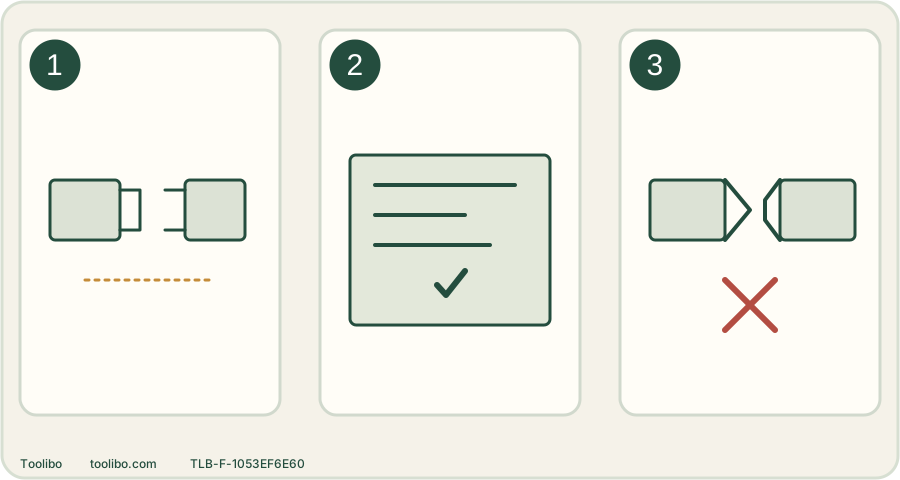
Identify
Record both relevant connector ends and the exact model.
Verify
Match the accessory code and permitted operating conditions.
Reject
Do not force, modify or improvise a nearly matching connection.
Name the connection location first. A similar shape at another point in the water route is not proof of interchangeability. Conceptual schematic, not a product image or scale drawing.
Identify which connection you are replacing
Draw the water route: tap to inlet, pump to high-pressure hose, hose to gun, gun to lance or cleaning attachment. Photograph the relevant ends only after the machine has been shut down, unplugged and depressurized as instructed. Do not identify a fitting while it is pressurized or release it to “see which type it is.”
A garden-hose connector is not a high-pressure gun connector. A replacement hose can also have different ends on its two sides. Note both ends and whether the machine has a reel; one compatible-looking end cannot establish that the complete hose will fit.
Use identifiers before connector names
Record the full machine product number, market and accessory part number. Then check the manufacturer’s compatibility list or instructions for that combination. Broad labels such as “quick connect,” “bayonet” or “fits K series” omit generations and exclusions.
Kärcher’s US hose and gun compatibility resources, for example, distinguish specific models and reel arrangements. They illustrate why an exact match is needed; they are not permission to transfer US accessory selections to a UK machine. Bosch also distinguishes a replacement high-pressure hose from an extension, even when both belong to the same broad product family.
Check more than physical attachment
A fitting must lock and seal correctly, but the accessory also has to be appropriate for the machine’s allowed pressure, flow and intended application. A surface cleaner with the wrong nozzle specification may fit yet work poorly. Do not infer suitability from thread diameter or the fact that water passes through it.
Check material and cleaning-agent limits as well. A detergent bottle, brush and rotary nozzle do different jobs. An accessory suitable for a robust surface does not become suitable for vehicle paint simply because its connector matches your gun.
Inspect the supplied sealing and locking parts
With the system safely isolated, compare the supplied seals, locking clips and instructions. Look for missing seals, damaged grooves, cracks or a coupling that does not reach its normal locked position. Do not compensate with extra tape, stacked seals, filing, drilling or force.
If the manufacturer’s instructions require an adapter, use the specified adapter for the identified combination. An unlisted chain of adapters adds uncertainty rather than solving it. If the match cannot be established, return to a confirmed accessory rather than trying a powered experiment.
Keep the evidence with the purchase
Save the exact part number and the list showing your machine’s applicability. On arrival, check the package and actual connector against what was ordered before fitting it. A marketplace title can cover several selectable versions; the delivered selection is what matters.
After correct installation, follow the machine’s normal startup and external leak check from a safe position. Stop if the joint leaks or fails to lock normally; never use your hand to locate a high-pressure leak. A successful initial connection is not a reason to ignore later damage or wear.