
Two footprints, two paper workflows
Original side-by-side diagram compares a circular eight-hole disc with a rectangular sheet whose ends fold into clamps, and shows their separate supported work areas.
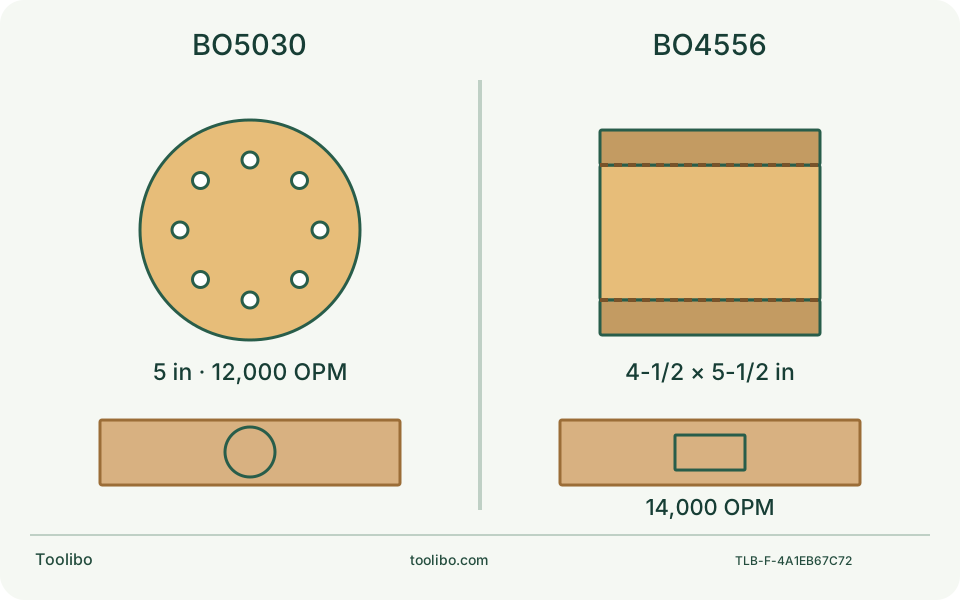
BO5030
- Fixed 12,000 OPM; no speed dial.
- US product: 5-inch, eight-hole hook-and-loop abrasive.
BO4556
- Fixed 14,000 OPM; clamped quarter-sheet paper.
- Abrasive paper 4-1/2 × 5-1/2 inches; punch plate 450066-4.
Round
Allow full support for the BO5030 disc.
Rectangular
Allow sheet length for BO4556 clamps.
Decide
Choose by the actual work and collection plan.
The geometry compares access and attachment, not measured removal speed or a universal ranking.
Define the job before comparing specifications
A broad bare-wood panel and the flat strip next to an assembled frame ask different questions. For the panel, consider uninterrupted contact and a consistent sanding pattern. Near the frame, consider whether the tool can stay flat without striking the neighbouring finished rail. Neither machine becomes a detail sander simply because only a small corner of its abrasive fits the gap.
This comparison concerns the US corded BO5030 and BO4556. It does not compare regional voltage variants, case bundles or aftermarket conversions. Record the exact body and intended material first. If the surface is unknown paint, thin veneer of uncertain condition or a hazardous material, identifying the tool is not enough to approve sanding.
Compare quantities that describe the same thing
Swipe or scroll horizontally to see all columns.
| Check | BO5030 US | BO4556 US |
|---|---|---|
| Working format | Circular random-orbit | Rectangular quarter-sheet finishing |
| Listed abrasive | 5-inch, eight-hole hook-and-loop disc | 4-1/2 × 5-1/2-inch clamped sheet |
| Listed motion rate | 12,000 OPM | 14,000 OPM |
| Speed dial | No | No |
| Input listing | 3 A | 2 A |
Different motion and abrasive formats prevent a simple productivity ranking from these numbers. Input current is not output power, and the extra motion count is not a promise of better finish. No timed test, dust measurement or lifespan result is claimed here. Decide whether the format solves your access and consumable problem before debating small specification differences.
Where BO5030 makes a practical case
Consider BO5030 when the work gives a round pad adequate support and you want the standard listed disc workflow. Changing grades can be straightforward when the correct pattern and fastening are already on hand. Still inspect alignment and contamination every time: easy attachment is not protection from an embedded particle making repeated scratches.
Its circular footprint cannot reach the apex of a square internal corner. Tilting onto the rim to force access risks altering the surface. Leave an appropriate hand-finishing task or choose a different method instead. The fixed speed also means that a recipe requiring a particular dial setting cannot be followed on this body.
Where BO4556 makes a practical case
Consider BO4556 for a suitable flat finishing area where a rectangular base and ordinary clamp paper fit your workflow. Its paper extends beyond the pad to enter both clamps. Buying by the visible base size can produce sheets that look sufficient but will not grip correctly. The fitting process also includes making the proper dust holes with the matched punch when using the collection arrangement.
A rectangular edge offers access, not unlimited clearance. Leave room for the vibrating paper and body near adjacent surfaces; do not wedge the tool between rails. Slipping paper or a partially closed clamp can spoil the scratch pattern even when the motor sounds normal. Stop and inspect attachment rather than pushing harder.
Two manual pitfalls change the buying checklist
The BO5030 product page specifies hook-and-loop, but its linked shared manual describes an adhesive-backed fitting procedure. Do not merge those instructions or buy paper only from the PDF wording. Resolve any difference between your pad, packaging and instructions before fitting. BO4556 shares a manual with BO4555, whose hook-and-loop subsection is explicitly model-specific; it is not an upgrade instruction for BO4556.
BO4556 also has conflicting pad-width descriptions between its product page and manual. Its full paper size remains separately identified. That is why this comparison does not treat a pad outline or a shared brand as replacement-part compatibility. Pads, punches and attachments need their own exact applicability checks.
Run a fair small sample, not a race
If both tools are available, compare on matching, known material with the same preparation goal, appropriate equivalent abrasive stages and each tool’s correct collection. Record the abrasive system and condition, setup time, access limits and observed surface under the same light. Do not declare a winner after using fresh paper on one and a worn sheet on the other.
Keep pressure controlled, the work clamped and the full base supported. Inspect after short passes rather than promising a number of seconds. Stop for edge rounding, repeated isolated scratches, paper movement, abnormal heat or vibration. A defect tells you what to correct; extending the trial can remove the opportunity to correct it.
Choose what you can support and maintain
Allow for matching paper, a suitable collector, replacement-pad availability and safe workholding, not just the bare machine. Neither an attached bag nor a household vacuum hose makes hazardous dust acceptable. Both tools require dry-use boundaries and qualified service for electrical faults.
Choose BO5030 if its supported circular workflow matches the job; choose BO4556 if its clamped-sheet workflow and rectangular access offer a real advantage. If neither can keep full support, clear the surrounding surfaces or meet the material controls, choose neither for that operation.
Models referenced