
Identity and motion are different checks
Original diagram separates retail order and service label, paired motion-rate bands, a 125 mm disc and a flat supported workpiece.
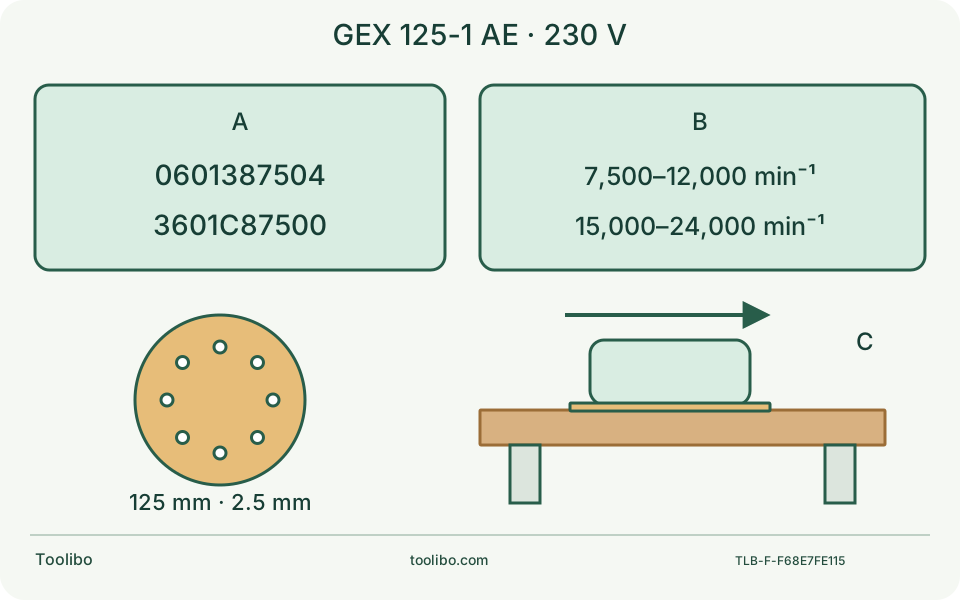
Identify
Match 0601387504 and the actual service label.
Read
Keep speed and stroke-rate labels separate.
Support
Maintain flat contact on a secured sample.
7,500–12,000 min⁻¹ is no-load rotational speed; 15,000–24,000 min⁻¹ is orbital stroke rate. 125 mm is pad diameter; 2.5 mm is orbit diameter. These manufacturer figures are not measured removal rates, and the diagram does not establish cross-model part compatibility.
Keep the purchase order and service identity separate
The German listing identifies order 0601387504. Its spare-parts section shows 3601C87500, while the shared manual uses the family pattern 3 601 C87 5.. for GEX 125-1 AE. These identifiers perform different jobs. Record the full number from your actual machine when requesting service; do not overwrite it with the store’s order number.
This is the 230 V German configuration. GEX 125, GEX 125-1 A, a cordless GEX and the US ROS20VS are not interchangeable identities. A similar shape or a shared nominal disc diameter does not establish matching electronics, pads, dust boxes or regional instructions. The AE control is important because the A variant in the same manual lacks its preselection thumbwheel.
Read the numbers as separate quantities
The product table gives 250 W input, a 125 mm pad and 2.5 mm orbit diameter. It separately lists 7,500–12,000 min⁻¹ no-load speed and 15,000–24,000 min⁻¹ orbital stroke rate. Do not place one label beside another manufacturer’s OPM number and declare the higher value a faster finish. They are differently named entries for the same tool, not two selectable motor modes.
The thumbwheel offers levels 1–2, 3–4 and 5–6 as low, medium and high ranges in the manual. These are not grit numbers or a guaranteed surface temperature. Select and verify a suitable combination on identified material, following the abrasive and finish requirements. Increasing pressure is not a substitute for choosing an appropriate setting.
Assemble a complete sanding system
Unplug before inspecting the pad or changing paper. Match the 125 mm hook-and-loop abrasive to the pad and extraction-hole arrangement. Remove contamination from the attachment face, centre the sheet and check that it lies flat. A disc sticking securely over blocked extraction holes is still an incomplete setup.
Inspect the pad for damage and choose only an applicable replacement hardness and identity. Do not assume every Bosch 125 mm pad fits. The manual distinguishes pad replacement from brake service; a worn brake belongs with authorised service. A drawing of four fixing screws is not permission to guess torque or fit a cross-model pad.
Arrange a repeatable board sample
Secure a known, uncoated solid-wood sample with the entire working area supported. Keep clamps outside the planned pad path and leave space for the dust box or hose. Confirm that the surface is not thin veneer, an unknown finish or a hazardous composite before deciding that power sanding is appropriate.
Fit the planned collection and personal protection. Switch on, place the whole sanding face flat against the work and move consistently with controlled pressure. Stop to inspect under grazing light before repeating a pass. A circular mark, a softened edge or local thinning is information to reconsider the process, not a reason to lean harder on the same spot.
Inspect the collector and the motion separately
The transparent Microfilter box allows visual filling checks and must latch onto the outlet. Empty and clean it according to its instructions with the machine unplugged. Alternatively, establish the complete suitable external extraction connection. Neither a Microfilter name nor a tight hose connection certifies protection against every hazardous dust.
A gradually increasing no-load motion is treated in the manual as a possible pad or brake problem. Do not diagnose it by touching the moving pad or reproduce it repeatedly for a video. Record when it started, the fitted pad and abrasive, and whether there is abnormal noise or visible damage. Qualified assessment is safer than disabling the brake to make a replacement pad work.
Know when this model is the wrong method
The sander is not for bench-mounted use: do not clamp the body in a vice to make a stationary disc machine. It is a dry-sanding tool, not a way to suppress unknown dust with added water. Low-speed capability is not blanket permission to polish an unfamiliar coating or work through thin veneer.
Stop for damaged wiring, unreliable switching, cracked pads, persistent overheating or abnormal vibration. Preserve the nameplate, pad and abrasive information for service. If the material, thickness allowance or extraction requirement remains uncertain, pause the job before choosing another speed.
Models referenced