
Shared paper size does not join the systems
Original diagram starts from the common sheet rectangle, then splits into Makita opposite levers and DEWALT front button plus two rear latches, with separate bag connectors.
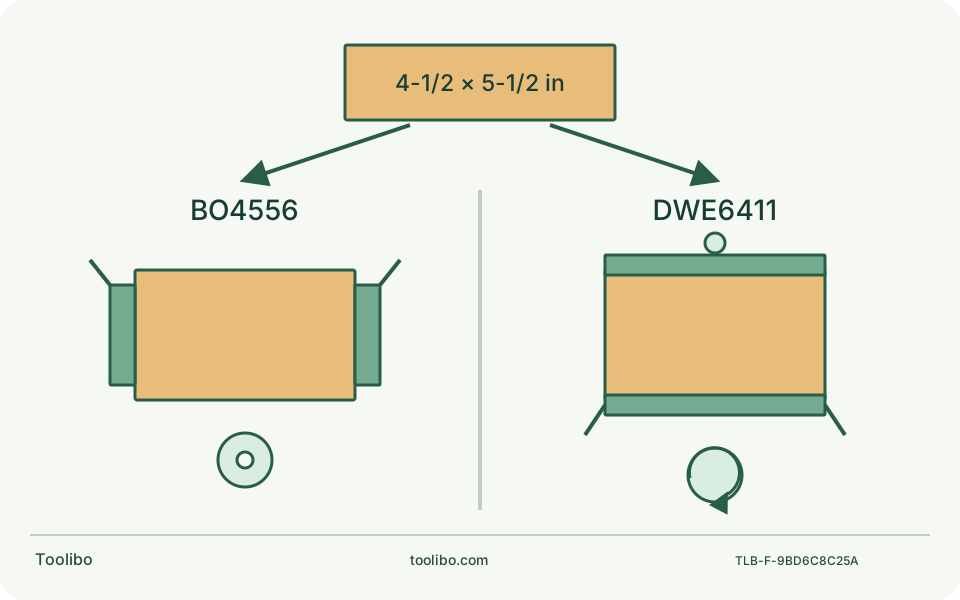
BO4556
- Fixed 14,000 OPM; clamped quarter-sheet paper.
- Abrasive paper 4-1/2 × 5-1/2 inches; punch plate 450066-4.
DWE6411
- 14,000 OPM; front button and rear side-clamp levers.
- 4-1/2 × 5-1/2-inch paper; eight-point punch and locking dust bag.
Common
Check the complete sheet dimensions.
Different
Identify the actual clamp controls.
Separate
Match each punch and collector to its tool.
Only the paper size is shared here; the separate paths deliberately avoid any implication of interchangeable punches, bags or bases.
Keep the two market identities visible
The Makita evidence is the US BO4556 listing and its BO4555/BO4556 manual. The DEWALT evidence is the Canadian DWE6411 listing and its Type 2 North American manual NA494662. These are the exact documented configurations, not all machines bearing a similar name. Check the actual electrical nameplate and service identity before considering a purchase or replacement part.
A cross-market comparison can explain a mechanism without proving local availability, warranty coverage or import suitability. This guide does not assess prices or declare a sales winner. If buying in another country, ask for the corresponding local body, manual and support terms rather than assuming this comparison supplies them.
The common specification is only the starting point
Swipe or scroll horizontally to see all columns.
| Decision item | BO4556 US | DWE6411 Canada Type 2 |
|---|---|---|
| Full abrasive sheet | 4-1/2 × 5-1/2 inches | 4-1/2 × 5-1/2 inches |
| Published motion rate | 14,000 OPM | 14,000 OPM |
| Front attachment | Clamp lever | Front clamp button and limiting ribs |
| Rear attachment | Opposite clamp lever | Rear clamp with two side locking levers |
| Bag retention | Inlet hole locates over outlet protrusion | Collar turns to lock on the outlet |
Equal paper dimensions do not prove equal pad dimensions or hole positions. A punch is an alignment tool for its own base, not a universal quarter-sheet stencil. Likewise, a bag that can be pushed onto an outlet may fail to retain or seal as intended. Check exact accessory applicability instead of forcing a visually similar part.
Decide whether the clamp workflow suits your hands
With either tool unplugged, identify how the paper is released, inserted and retained. On BO4556 the sheet is secured at opposite lever-operated ends, with square alignment and tension across the base. On DWE6411 the front end is inserted to its stops while holding the front button, then the rear clamp is locked with both side levers. Forgetting one rear latch is not equivalent to simply having a dull abrasive.
If you often change grades, assess the complete safe routine, including dust-hole preparation and paper inspection. Do not judge ease of use from a shop-floor squeeze while the tool is connected. A damaged latch, inaccessible control or uncertain paper length should be resolved before any powered test.
Compare collection as a complete arrangement
Makita’s manual explains the locating protrusion and the bag’s matching entry hole. DEWALT Type 2 uses an AirLock outlet and a locking collar. These are specific retention schemes. Existing vacuum ownership may influence the total setup, but measure and confirm the approved connector path rather than assuming “universal” means every hose.
Neither manual’s bag description certifies hazardous-dust collection. Identify the material, collector and filtration requirement first. Fine dust leaking from a connection, a rapidly loading bag or blocked paper holes needs correction before more sanding. A cleaner-looking surface is not a measurement of airborne exposure.
Use one real task to judge the difference
Consider a securely supported, known bare-wood shelf needing preparation for a specified finish. Lay out the intended path and check base support, clamp clearance, cord routing and room for the collector. Choose an appropriate abrasive stage for the actual condition; do not start coarse merely because a sample sheet came in the box.
During a controlled scrap trial, record paper seating, access near edges, any repeated scratch pattern and how easily the whole base stays flat. Apply consistent light pressure and inspect frequently. Do not compare tools using different paper condition or turn the exercise into a race to remove the most wood. There are no measured removal or vibration results in this comparison.
Understand the non-overlapping limits
DWE6411’s matched manual expressly says not to use it for drywall. This exclusion is not erased by the same sheet size as another sander. BO4556’s shared manual includes a BO4555-only hook-and-loop section; it does not convert BO4556 to that fastening system. Both details matter more than a broad retailer category labelled “palm sander.”
For either tool, unknown old coatings, wet sanding and electrical faults are outside this guide. Stop for recurring paper release after correct fitting, unusual vibration, a damaged cord or a switch that will not operate reliably. Keep the failed paper and photos of the disconnected setup for service.
Make the purchase decision conditional
Choose the documented model whose controls, consumable supply and confirmed collector arrangement fit the task and your local support. Buy the correct punch and bag if missing; do not count an unverified accessory pile as added value. If a seller cannot establish body type, supply rating or accessory identity, postpone that purchase rather than resolving uncertainty by trial.
Models referenced