
The same patio, two hose routes
The same patio, two hose routes — numbered controls and physical routes explained by the legend.
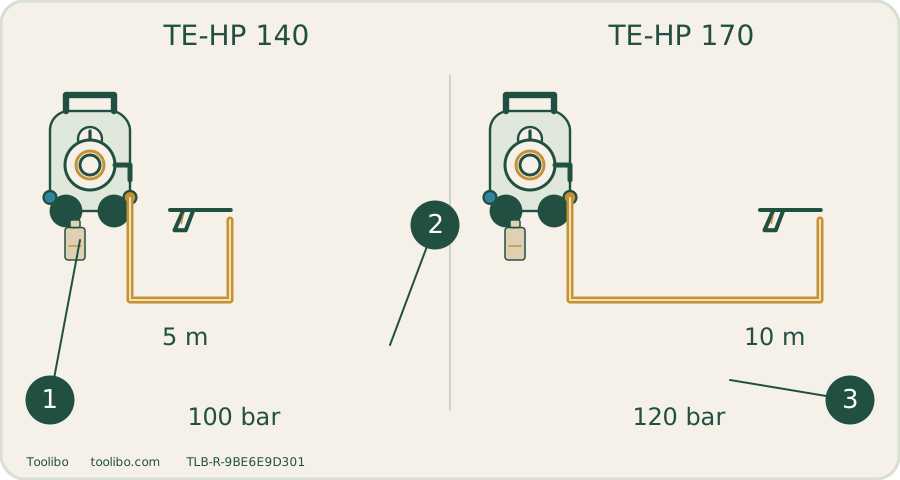
TE-HP 140
- Rated 100 bar; maximum permissible 140 bar.
- 5 m pressure hose and reel. Variable lance, rotating nozzle, brush, foam attachment and patio cleaner; machine low-pressure detergent tank differs from patio/foam containers.
TE-HP 170
- Rated 120 bar; maximum permissible 170 bar.
- 10 m pressure hose and reel. Variable lance, rotating nozzle, brush, foam attachment and patio cleaner; machine low-pressure detergent tank differs from patio/foam containers.
Shared
Reel and detergent tank on both
Reach
5 m versus 10 m route
Ratings
Compare rated 100/120 bar, not mixed maxima
Original explanatory diagram; not a dimensioned service drawing.
The comparison is 140 versus 170, but the work is 5 m versus 10 m
These are German/EU TE-HP 140 article 4140760 and TE-HP 170 article 4140770. Both have reels and built-in detergent tanks, plus variable lance, rotating nozzle, brush, foam attachment and patio cleaner in the verified packages. The useful starting question is how far the gun must travel from a safe machine position.
TE-HP 140 has a 5 m pressure hose; TE-HP 170 has 10 m. Measure the routed distance around obstacles, not the direct line across the area. Neither reel should be treated as proof that arbitrary extensions or another model’s hose will fit.
Compare the correct columns
Swipe or scroll horizontally to see all columns.
| Specification | TE-HP 140 | TE-HP 170 |
|---|---|---|
| Rated pressure | 100 bar | 120 bar |
| Maximum permissible pressure | 140 bar | 170 bar |
| Rated flow | 5.8 L/min | 6.0 L/min |
| Maximum delivery | 420 L/h | 440 L/h |
| Input | 1900 W | 2300 W |
| High-pressure hose | 5 m | 10 m |
The rated-flow difference is 0.2 L/min, while the hose length doubles. That does not translate into a measured percentage improvement in cleaning time. A table can identify a difference without proving that it matters for your task. Product and manual weights also differ in presentation, so they are not used here to decide portability.
Scenario one: a small work area beside the tap
Imagine washing a few tools and chairs on a compact paved patch. If the 5 m route covers the entire area without pulling the machine, the TE-HP 140 already provides the relevant attachment types. Paying for 170 solely to acquire a detergent tank or reel would misunderstand the packages: both have those features.
Check the total setup instead. Will the attachments fit in your storage space? Does the chosen position keep electrical connections out of runoff? Is the required inlet hose available? If those practical questions are answered, the smaller option may satisfy the job without making extra hose management worthwhile.
Scenario two: a longer patio with awkward access
If a stable machine position near the supply leaves the far end outside 5 m but within a safe 10 m route, TE-HP 170 offers a concrete benefit. Sketch the hose around tables and steps. If 10 m still fails because the route crosses a doorway or sharp edge, the bigger number has not solved the layout; plan a stopped, depressurized move instead.
Its higher rated pressure is a capability difference, not a requirement to use an aggressive jet. A fragile joint or painted surface may call for a gentler method with either model. Buy extra reach to reduce awkward positioning, not extra pressure to compensate for uncertain surface suitability.
Detergent convenience is largely shared
Both machines distinguish the machine’s low-pressure detergent route from the patio cleaner’s own reservoir and the foam attachment. Neither has a magical all-mode detergent feed. If your real frustration is a tank that appears not to draw, check the attachment and low-pressure mode before replacing the washer.
Likewise, do not assume two supplied patio cleaners have identical construction just because the accessory category is shared. Confirm the exact replacement part and coupling when ordering. Package inclusion and universal compatibility are different claims.
When neither is the right choice
Both need suitable clean water, an appropriate electrical arrangement and a stable working area. Their inlet-pressure limit is 7 bar and water-temperature limit 40 °C. These are not permissions to use an unverified tank-suction setup or hot-water line. An unresolved supply or unsafe surface is a reason to fix the plan, not choose 170 by default.
A useful final decision reads: “I need 10 m to reach this corner without pulling,” or “5 m covers my route and the 140 kit contains the attachments I will use.” That is stronger than “170 must be faster.” Compare complete local cost, required accessories and service access only after those practical choices are clear.
Models referenced