
A routed hose, not a straight-line radius
A routed hose, not a straight-line radius — numbered controls and physical routes explained by the legend.
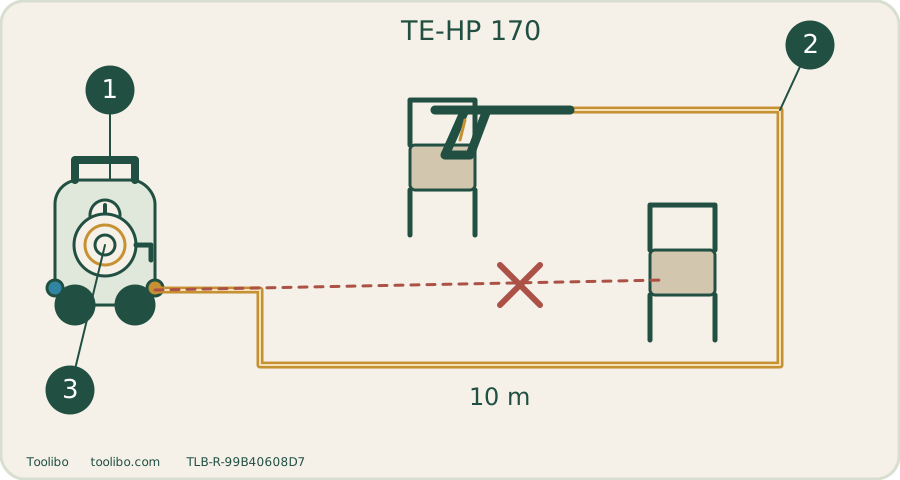
Position
Stable machine outside runoff
Route
10 m hose around obstacles
Reel
Unwind fully before work; isolate before packing
Original explanatory diagram; not a dimensioned service drawing.
Start with the job route, not 170 on the label
TE-HP 170 article 4140770 is the German/EU configuration with a 10 m high-pressure hose, reel and telescopic transport handle. The long hose is its most useful distinction for a patio that cannot be reached conveniently from one side. Keep the machine stationary on a stable surface and lay the hose around the working area without trapping it beneath furniture.
For example, a narrow side passage may require more hose than its straight-line distance suggests. Walk the whole route, including corners. If the last section pulls the machine or places the hose across a doorway, split the work into zones. A longer hose reduces some repositioning; it does not eliminate trip hazards or make a remote water source adequate.
Know the rating and the attachments
The machine is rated at 2300 W, with working pressure 120 bar and maximum permissible pressure 170 bar. Rated flow is 6 L/min, equivalent to 360 L/h; maximum delivery on the product page is 440 L/h. Do not treat those maximum figures as a simultaneous cleaning measurement or as a minimum inlet-flow instruction.
The verified package includes the variable lance, rotating nozzle, washing brush, foam attachment and patio cleaner. Before purchasing another surface attachment, check what is already in the exact carton. A listed compatible accessory is not automatically supplied, and matching the brand name alone is insufficient to match the connector.
Prepare a continuous water path
- Switch off and unplug. Fully unwind the pressure hose, connect the gun and lock the chosen attachment. Keep the water inlet filter fitted.
- Connect the reinforced supply hose specified by the manual: at least 6 m long and at least 1/2 inch internal diameter. Provide the required backflow protection; do not substitute a pressure-hose extension for an inlet hose.
- Open the water and operate the unlocked trigger to purge air before switching on. If the stream remains interrupted, keep the motor off and check the tap, hose bends and inlet filter. Water must be clean, no hotter than 40 °C, and no higher than 7 bar at the inlet.
- Match the electrical rating plate, arrange suitable outdoor electrical protection, connect the plug with the switch off, then start. Test a small area with the variable fan before committing to a whole surface.
Work in sections, not by staying on one mark
On sound paving, establish a repeatable test strip and inspect it before proceeding. If a joint starts losing material, stop and change the cleaning approach; a rotating nozzle is not the automatic answer to every dark patch. Keep the cleaner supported on the surface when using its patio attachment rather than exposing the moving spray underneath.
The built-in detergent tank feeds the low-pressure lance or washing brush. The patio cleaner has a separate detergent container and adjustment. If detergent is absent, identify which container should supply the attachment and check the mode before adding concentrate. Use a suitable product at its labelled dilution; keep chemicals out of the clean-water inlet.
Pack the hose without storing a fault
Switch off, unplug, close the water supply and release retained pressure before removing attachments or disconnecting hoses. Disconnect the gun before winding the pressure hose evenly onto the reel. A visible nick, bulge or damaged connector is a reason to stop using that hose, not a reason to hide it inside the reel.
Inspect and rinse the inlet sieve as needed, wipe the housing and keep ventilation clear. Follow the exact machine’s draining procedure and store dry above freezing. If supply checks do not restore stable operation, or a cable or gun is damaged, seek qualified service rather than opening the pump or electrical housing.
This model earns its place when the 10 m route and included attachments solve real household tasks. If the work is only beside a tap and extra reach adds no value, the smaller TE-HP 140 deserves comparison; neither is a safe purchase workaround for unsuitable surfaces or an unresolved power supply.
Models referenced