
Mechanical contact versus electronic commutation
Left schematic shows two brushes touching a commutator; right shows a controller linked to a brushless motor.
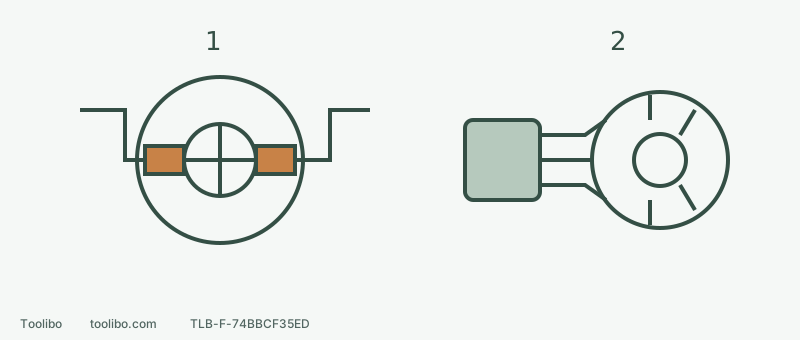
1 · Brushes and commutator
Contact supplies the rotating windings and introduces friction and brush wear.
2 · Controller and windings
Electronics energize phases in sequence; removing brushes does not remove bearings, gears or possible faults.
Simplified operating principles only: not a wiring diagram, model-specific circuit or repair instruction.
What are the brushes?
A brushed DC motor uses brushes contacting a commutator to supply the rotating windings as needed. That contact involves friction and losses, and the brushes gradually wear. These are electrical contact components inside the motor, not cleaning brushes.
A brushless motor uses electronic commutation to energize its windings in the correct sequence instead of relying on that brush/commutator contact. Designs can use position sensors or sensorless control; the word brushless does not establish that a particular sensor is fitted.
This explains potential efficiency benefits and one less wear-maintenance item, not the performance of an entire drill. Battery, controller, transmission, cooling and accessories still matter. A brushless label does not compensate for a depleted battery, dull bit or wrong gear.
Four differences and what they affect
Swipe or scroll horizontally to see all columns.
| Issue | Brushed design | Brushless design |
|---|---|---|
| Losses and runtime | Brush contact and friction create losses | Removes those losses, not a guaranteed percentage improvement on every task |
| Wear and maintenance | Brushes can wear; separate replacement depends on the design | No such brushes to replace, but bearings, switches and gears still wear |
| Control system | Can also have electronic speed control and protection | Requires electronic commutation; actual speed and protection features remain model-specific |
| Faults | Sparking or failure to run does not prove new brushes will fix it | Motor or controller faults remain possible; not maintenance-free |
Motor-level life or efficiency claims need not be matched tests of two finished drills with the same battery and job. Without comparable results, do not conclude every brushless drill lasts twice as long. Equally, a brushed drill is not automatically unfit for home use.
Judge the premium against your workload
Suppose you assemble furniture a few times a year and occasionally drill small permitted holes. If both candidates do the work, fit with the battery installed and are manageable, complete kit cost and compatibility deserve early attention. Replacing a healthy existing system solely for the word brushless may solve no actual problem.
For repeated drilling or many work sessions each day, battery efficiency and avoiding brush wear deserve closer examination. Ask for the exact model’s task conditions and battery configuration rather than applying a maximum advertised improvement to your material. Also check grip, low-speed control, permitted accessories and spare-battery arrangements.
There is no fixed boundary between these users. Short work can mean small screws or a demanding large hole. Confirm capability first, then decide whether extra spending on efficiency, dimensions or maintenance arrangements will be useful.
Compare two packages in this order
- List usual materials, hole sizes and screw specifications. Exclude uses the manual does not permit; motor type does not expand rated capacity.
- Align package contents and record exact battery and charger models. Do not compare a two-battery brushed kit directly with a brushless bare-tool price.
- Check size and grip with the intended battery. Do not power the tool during a static check; remove the battery as instructed before changing accessories.
- Check actual low-speed ranges, gears, clutch settings, braking and protective features. Count only listed functions, not everything you associate with brushless.
- Check warranty, local repair channels and parts support. If a motor is supplied as an assembly, a pair-of-brushes allowance cannot cover every possible repair.
A permitted staff-supervised demonstration may help you judge control on the same small allowed task. It is not a durability or runtime test. Without a demonstration, leave unknowns unresolved instead of filling them from advertising.
Should you replace a working brushed drill?
Name the real problem first: inadequate battery coverage, poor access, insufficient permitted capability or a fault. If none applies, keeping a sound, suitable tool is reasonable. If a problem exists, compare specific remedies; replacing the entire system with brushless is not the only possible answer.
Stop for abnormal smells, clearly abnormal sparking, smoke, faulty switching or housing damage and arrange inspection as instructed. Do not run the tool with its housing open or dismiss every abnormality as normal brushed behavior. Brushless tools also stop or misbehave because of battery, contact, protection or internal faults; do not bypass a controller to investigate.
Finish the choice with a specific reason: this extra spending improves a verified problem on my jobs. If only the motor label changes while tasks, compatibility and complete cost remain unexamined, wait before replacing the tool.