
Three conditions behind the 80-hole claim
Battery capacity, bit size and nominal lumber size are shown separately instead of treating the hole count as universal.
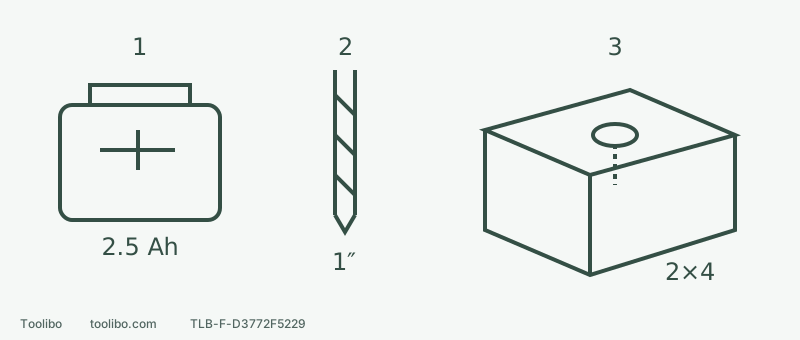
1 · Included battery
The described pack is 2.5 Ah; do not silently compare a different battery.
2 · Bit dimension
One inch describes the bit, not a stated hole depth.
3 · Lumber designation
2×4 alone does not supply species, moisture or actual penetration depth.
Generic symbols, not product geometry. Bit shape and drilling direction are illustrative and were not specified by the claim.
Turn the headline into a complete record
“80 holes” leaves out essential conditions. The FLEX FX1131 product page describes up to 80 holes using a 1-inch bit in 2×4 lumber with the included 2.5 Ah battery. Up to is an upper-bound style manufacturer claim, not a minimum guaranteed on every job.
The 1-inch dimension describes the bit, not the hole depth. Likewise, 2×4 names the lumber size; without more information it does not establish the thickness drilled through. The FX1131-1A kit lists an FX0111 2.5 Ah battery and FX0411 160 W charger. Read the exact package contents rather than assuming identical batteries from similar tool pictures.
Separate known conditions from missing ones
Swipe or scroll horizontally to see all columns.
| Condition | What the description supplies | What it does not establish |
|---|---|---|
| Tool and battery | FX1131, included 2.5 Ah battery | Battery age and temperature during the test |
| Bit | 1 inch | Bit design, edge condition and exact model |
| Material | 2×4 lumber | Species, moisture, drilling direction and actual penetration depth |
| Result | Up to 80 holes | Time per hole, feed, breaks and completion criterion |
Missing details do not establish a defective product; they limit the conclusions available. The claim is plainly not 80 holes in any material. Nor can a competing 90-hole result automatically beat it when the wood or bit differs.
Use a filled comparison to choose the next step
Suppose your actual work involves smaller wood holes. B below is a fictional advertisement used to explain the method, not a real competing product.
Swipe or scroll horizontally to see all columns.
| Comparison | Existing FLEX description | Hypothetical B advertisement |
|---|---|---|
| Hole count | Up to 80 | Up to 90 |
| Battery | Included 2.5 Ah | Not stated |
| Bit and material | 1 inch, 2×4 lumber | Only says wood |
| Decision now | A defined but incomplete set of conditions | Insufficient information to infer longer runtime per charge |
Ask for B’s complete test conditions or find a reproducible comparison under matched conditions. If neither is available, record runtime as not directly comparable. Then check permitted hole size, battery compatibility and whether you need an extra pack. Do not invent matching conditions to produce a ranking.
Ah and Wh help with energy, not hole counts
Ah describes charge capacity; Wh describes energy. Rated Ah multiplied by nominal voltage gives rated energy. For a hypothetical pair both nominally 18 V, 2 Ah corresponds to 36 Wh and 4 Ah to 72 Wh. Use nominal voltage, not a different maximum-voltage label chosen to inflate the result.
The second battery has twice the rated energy in this example, not necessarily twice the actual holes. Load, material, bit sharpness, temperature, protection responses and battery condition affect the work. Do not rank different voltage platforms by Ah alone, or interchange their batteries because their calculated Wh values are close.
A 160 W charger label also does not promise an exact full-charge time. Charging depends on the specific battery/charger pairing and conditions such as temperature. For repeated work, consult the instructions for that pairing rather than dividing energy by a nameplate power figure.
Check your normal workflow after purchase
Charge and prepare the equipment as instructed, first verifying that material, bit and hole size are allowed. Use suitable consistent scrap, clamp it securely, and record the actual battery, hole dimensions, completed count and ordinary breaks. The aim is to see whether a normal work segment goes smoothly, not to force the battery into protective shutdown.
Stop for abnormal heat, smell, smoke or obvious malfunction and follow the relevant safety instructions. Do not press harder or repeatedly restart to reach 80. Do not approach, touch, remove or charge a smoking or severely abnormal battery.
If one pack already covers your usual short task, a small advertised count difference may not justify switching platforms. If you frequently wait for charging, compare explicitly compatible spare batteries, charging arrangements and complete cost. Match runtime to your work pattern rather than treating a conditional hole count as a guarantee.