
Two different changeovers and rating conditions
Handle-mounted bottle versus tank-and-soap-tip system, with 40° and 15° rating conditions shown separately.
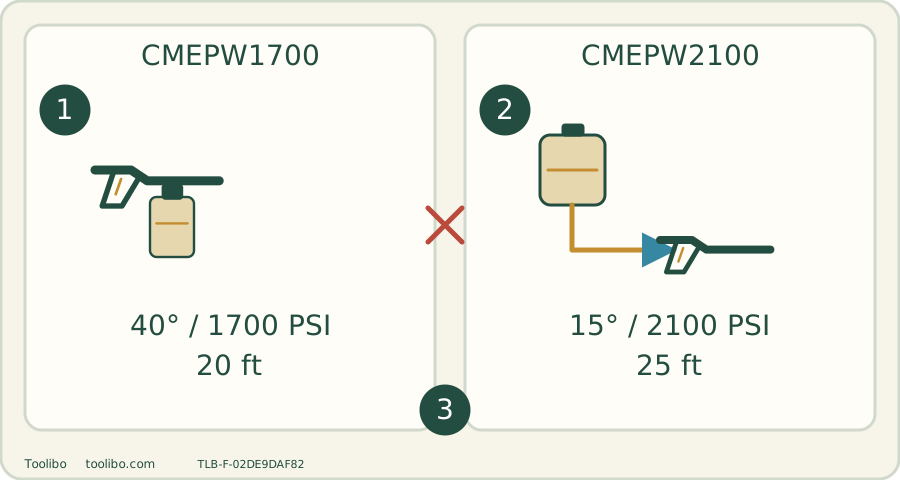
CMEPW1700
- 1700 PSI maximum pressure; product footnote uses the 40° nozzle condition.
- 20 ft hose and 35 ft cord. 40° and turbo tips; soap bottle replaces the wand and hangs below the handle barrel.
CMEPW2100
- 2100 PSI maximum pressure; product footnote uses the 15° nozzle condition.
- 25 ft hose, 35 ft cord, 10-inch wheels and onboard tank. Manual describes 15°, 25°, 40°, soap and turbo tips; verify actual box because product overview and inventory counts conflict.
CMEPW1700
Bottle replaces wand; 40° product rating condition.
CMEPW2100
Tank uses soap tip; 15° product rating condition.
Both
Isolate and depressurize before changing an attachment.
Different nozzle conditions prevent treating the pressure gap as a controlled cleaning-speed test.
Establish the common supply first
Both US models are corded 120 V AC, 60 Hz, 13 A washers with a minimum 15 A source. Their matched manuals specify cold tap water at 20–100 PSI and 35 ft electrical cords. Neither is a battery machine, and neither set of documents establishes a bucket-fed replacement for the tap.
CMEPW1700 lists 1700 PSI maximum pressure and 1.2 GPM rated flow; its product footnote uses the 40° nozzle. CMEPW2100 lists 2100 PSI maximum and 1.2 GPM rated flow with a 15° product footnote. The 400 PSI difference is therefore not a controlled same-nozzle cleaning test. Do not turn it into a percentage improvement in cleaning time or claim identical output behavior because the flow labels match.
Carry unit versus assembled wheeled frame
CMEPW1700’s compact body has a carrying handle and a 20 ft high-pressure hose. It is a useful configuration to evaluate for small work positions where the unit must be picked up rather than rolled. This guide does not supply a matched verified weight comparison: check the real lifting task and storage space.
CMEPW2100 has a wheeled upright frame, 10-inch wheels and a 25 ft hose. Its assembly includes wheel retainers, frame detents and separate storage supports. That can organize longer repeated sessions, but introduces parts that must be correctly assembled and inspected before rolling.
The additional 5 ft of hose is about 1.5 m. It may help around an obstruction, but it does not automatically eliminate repositioning. Draw the full route around the object and leave slack at the connections. Shut down, isolate and depressurize before moving either model; do not use the hose as a tow rope.
Bottle changeover is different from changing a tip
On CMEPW1700, the soap bottle replaces the wand at the spray handle. The two are not installed together, and the bottle hangs below the barrel. The owner must change the front assembly between soap and normal rinsing.
On CMEPW2100, the onboard tank supplies the detergent mode selected with the soap nozzle. The wand stays part of the normal assembly while the tip changes. This is not a claim that the tank works with every pressure nozzle: the low-pressure soap route matters.
Both changes need the same safety boundary: stop the motor, disconnect electricity, shut water, release trapped pressure and lock the trigger before removing a pressurized attachment. An onboard tank does not justify swapping a nozzle while the machine is live. Use detergent according to its own label and plan a section small enough to rinse before it dries.
Check the actual accessory list
The verified 1700 package lists 40° and turbo tips plus the soap bottle. For 2100, the manual describes 15°, 25°, 40°, soap and turbo tips, but product-page prose and detailed inventory differ in their count. Confirm the actual package, especially when buying a used machine or a regional retail bundle.
A broad fan and a turbo nozzle perform different actions. Do not interpret the 1700’s 40° rating condition as proof that the turbo is safe on the same surfaces. Likewise, the 2100’s 15° condition is not permission to use a concentrated jet on every painted item. Material condition and the first test patch decide whether to continue.
Shared corporate ownership or brand does not establish compatible hoses, guns or bayonets. Before replacing an attachment, match the exact model and fitting rather than assuming anything labelled Craftsman will connect correctly.
Work through two household routines
For a few washable chairs near the tap, the carry unit may fit a short setup and small storage space. Its soap-bottle changeover is manageable if the rinse wand is ready and you can safely switch before the detergent dries. Its 20 ft hose may already cover the entire task.
For repeated sections along a level walkway, the upright frame’s hose length and tank route may reduce handling inconvenience. That is a practical preference, not an independently measured speed advantage. Check that the frame can stand stably and the hose can pass without pulling against it.
Choose neither until supply, storage and material questions are resolved. If the surface needs a non-pressure cleaning method, more tips will not change that. If the only outlet position requires an unsuitable electrical arrangement, do not trade safety for reach. If the used machine has a damaged hose or failed trigger lock, repairing it correctly comes before a comparison of PSI.
The ownership checks stay the same
Purge air with the motor off, verify nozzle retention and test the GFCI before use. Stop if the test fails or protection repeatedly trips. At the end, turn off, unplug, close water, release pressure and drain the hose and detergent equipment. Clean the bottle or tank rather than storing residue.
The 1700 offers a different carrying and soap arrangement; the 2100 offers a different frame and workflow. Choose by those concrete differences, not a brand-wide claim about reliability or a performance ranking unsupported by matched testing.
Both matched manuals prohibit operation or storage below 4°C. A merely frost-free location is not enough if it can fall below that minimum; select a dry indoor storage space that stays at or above 4°C.
Models referenced