
Use detergent and foam properly
Numbered schematic explaining Use detergent and foam properly.
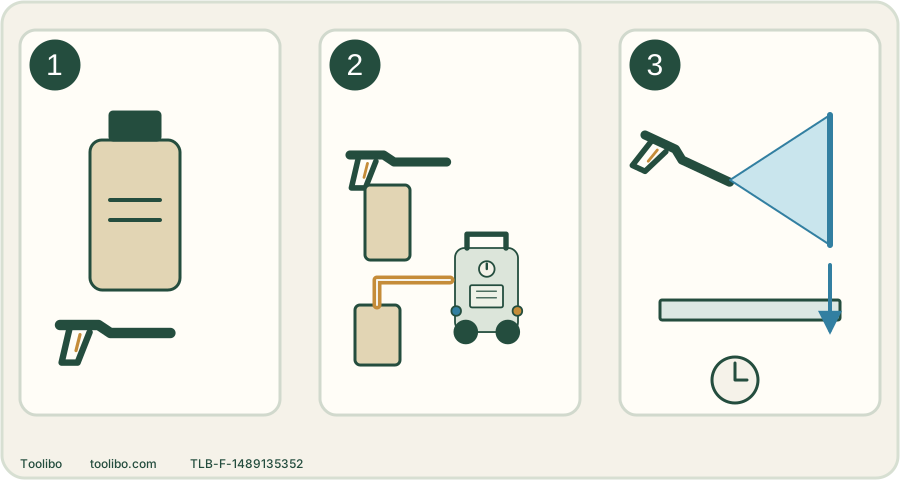
Bottle concentration
Measure the labelled dilution; it is not necessarily the final surface concentration.
Application system
A gun-mounted bottle and low-pressure suction use different delivery paths.
Dwell and rinse
Respect the labelled time, prevent drying and rinse thoroughly with clean water.
Follow the product label and the exact detergent system; do not assume every washer draws detergent at high pressure. Conceptual schematic, not a product image or scale drawing.
Match three things before filling the bottle
The cleaning product must be suitable for the target surface, the pressure washer and the applicator. A product for manual bucket washing is not automatically suitable for a pump, injector or foam bottle. Household bleach, solvents, acids or improvised mixtures are not substitutes for a permitted washer detergent.
Check the label for dilution, contact time, rinsing and environmental precautions. Keep the original container available so the instructions remain identifiable. Wear any protection required by the product and keep it away from children. Never mix products to make an unknown stronger solution.
Identify where your machine introduces detergent
Some systems draw detergent only with a low-pressure nozzle setting; others use a dedicated bottle on the gun or lance. The Bosch UniversalAquatak example includes a separate detergent applicator. Do not apply another model’s suction-tube instructions to it, or assume that an attachment called a foam cannon has the same connector and flow requirement.
If the product label specifies a dilution in the bottle, make that solution as directed. If it specifies a final concentration at the surface, the applicator’s mixing ratio also matters. These are different measurements. Do not use foam thickness to infer either one, and do not double the concentration merely because the foam looks thin.
Use a small test area
After removing loose dirt where the method requires it, test the product on an inconspicuous compatible patch. Look for discoloration or coating changes after rinsing. If instructions are unclear for a painted, sealed or delicate surface, use a confirmed suitable hand-cleaning product instead of testing a strong unknown chemical.
For vertical work, follow the cleaner’s application direction. The Bosch example applies detergent to a vertical surface from lower areas upward and rinses from the top downward. This is a documented method, not permission to ignore a different product label.
Apply, allow time, and rinse
- Stop and depressurize before changing the attachment; fit the matching applicator and secure it.
- Apply the stated amount to a manageable area. Do not spray into electrical fittings, vents or places from which the chemical cannot be rinsed.
- Allow only the labelled dwell time, preventing drying on the surface. Use a suitable brush if the product and surface permit it.
- Change back to the approved rinsing attachment safely and rinse the loosened dirt and detergent thoroughly.
More chemical is not the first answer to poor cleaning. Check product choice, contact time, brush suitability and dirt type before increasing anything.
Flush the system before storage
Follow the applicator’s instructions for drawing or rinsing with clean water so detergent is not left to dry in its passages. Dispose of remaining solution and wash water according to the label and local requirements; do not pour it into soil or a storm drain by default. Store the labelled chemical separately from the drained washer. Persistent failure to draw detergent belongs in external fault diagnosis, not pump disassembly.
Write the product name and mixing instruction beside a reused applicator, and empty it after use as directed. Never leave an unlabelled liquid for the next person to identify by colour or smell.