
Temperature history and battery checks
Original schematic: Record the move between environments. Allow normal settling within the instructions. Check the specified battery procedure separately. Not to scale.
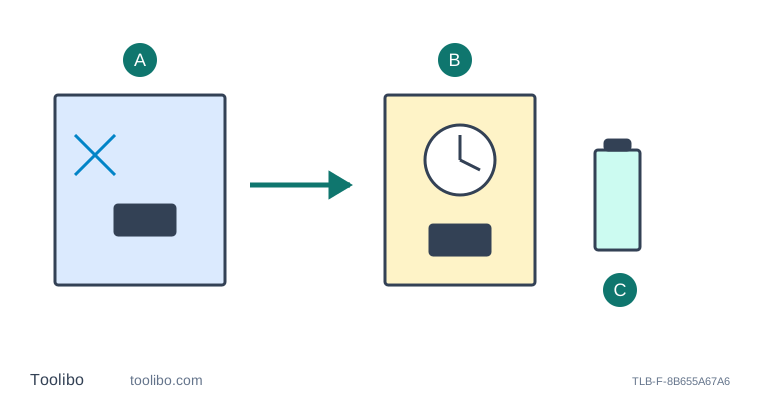
A
Record the move between environments
B
Allow normal settling within the instructions
C
Check the specified battery procedure separately
Conceptual geometry only, not to scale. The diagram does not establish installation clearances or reproduce a manufacturer control layout.
Begin with the exact indication and recent history
A meter that behaves differently after storage may be responding to its environment, its batteries or a difficult target. Start by recording the exact model and what the display actually shows. A battery symbol, an error code, a dim display and changing distance values are different observations. Do not translate one brand’s code using another brand’s manual just because the number is the same.
Note where the instrument was stored and whether it recently moved between markedly different temperatures. Keep this factual: “brought from a cold garage into a heated room” is useful, while “the sensor must be broken” is a diagnosis not yet supported by the evidence. Also identify the target and reference so that an ordinary setup error is not hidden behind the storage story. Note whether the warning appears immediately at startup or only after requesting a measurement; that timing is useful factual context for service advice.
Let the instrument reach permitted conditions normally
Use and store the instrument within its own specified conditions. If the manual requires temperature stabilisation after a move, allow it to settle naturally before important measurements. Do not invent one waiting time for every model or claim that a warm exterior proves the internal instrument has stabilised. Follow the manufacturer’s procedure and any relevant warning indication.
Do not accelerate the process with a heater, hair dryer, hot water or direct exposure to strong heat. Do not refrigerate or deliberately wet the meter to reproduce a symptom. If condensation or moisture is suspected, stop use and follow the instrument’s care instructions rather than wiping the outside and assuming the optics are ready. A household troubleshooting exercise should stay within normal use, not create new environmental stress.
Treat battery replacement as a model-specific maintenance step
If the instrument indicates a battery problem, consult its instructions for the permitted battery type, polarity and replacement procedure. Do not assume that another model’s rechargeable pack or charger is suitable. Do not mix improvised power sources or attempt to recharge cells that are not intended for charging. A battery compartment is not an invitation to open the rest of the housing.
Inspect only accessible external parts within the normal maintenance procedure. If cells are leaking, the compartment is damaged or the meter shows signs of overheating, stop and use the appropriate manufacturer guidance. Do not scrape internal contacts, bridge terminals or improvise an electrical repair. Keep removed batteries away from children and handle storage or disposal according to the battery instructions and local requirements.
Recheck a simple span and separate old measurements from new ones
Once the instrument is in its permitted conditions and any ordinary battery maintenance is complete, measure a simple indoor span with a stable opaque target and firm support. Confirm the unit and reference first. Repeat after repositioning and record the results. This checks whether normal operation appears restored under that setup; it does not replace a formal accuracy check or certify the instrument after damage.
If the symptom persists, provide the exact display indication, storage history and normal steps already completed when seeking service advice. Do not keep changing batteries, targets and settings at random until one convenient number appears. Changing one relevant condition at a time makes the observations more useful and avoids turning uncertainty into an invented correction rule.
Retake important project dimensions that were collected while the instrument was behaving abnormally. New stable readings do not retrospectively prove which earlier values were sound. Keep any uncertain measurements out of fabrication or safety-clearance decisions until independently checked. Never aim the laser at eyes, people or optical instruments, and switch it off when moving between setups. The purpose of these external checks is to restore a clearly defined normal measuring situation or identify the need for service, not to perform an internal diagnosis at home.
Models referenced