
No start checks
Three panels distinguish a silent motor from a running airflow stop, show unplugged external cord/switch inspection, and route unresolved faults to service without opening the head.
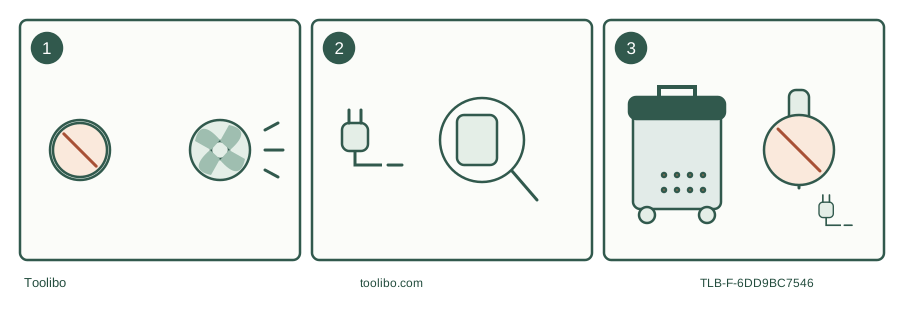
Distinguish
Silent motor is different from lost airflow.
Check
Inspect switch, matching supply and visible cable safely.
Escalate
Leave unresolved electrical faults disconnected.
Model-specific decision path; isolate power before opening or changing the collection system.
First distinguish silence from loss of suction
If the motor can be heard running but nothing is being collected, use the suction-loss or wet-pickup-stop path instead. A full-tank float can close airflow while the motor continues running. This article addresses a corded bucket vacuum that does not start when its normal switch is used. It does not provide internal electrical testing or a universal reset sequence.
Stop immediately if there was smoke, a burning smell, a hot or damaged plug, water exposure, repeated protection tripping or a damaged cord. Do not try another socket to see whether a dangerous symptom follows the machine. Keep the vacuum disconnected and arrange qualified help. If the plug cannot be reached safely because of water, do not enter that area to disconnect it.
Make the machine safe before checking labels
Set the switch to off and unplug from a dry safe location. Read the nameplate and confirm that the selected manual matches the regional electrical version. The Kärcher WD 4 in manual 59510240 is a 220–240 V example; RIDGID HD12000 SP7160 (04/24) describes a 120 V, 60 Hz machine. Those examples are not interchangeable through a simple travel adapter.
Inspect the accessible cable, plug, strain-relief area and housing for visible damage without opening them. Do not flex a suspect cable while powered or hold a switch in an unusual position to make contact. Tape is not a repair for damaged insulation. A unit dropped into water or damaged in storage needs service advice even if the outside later appears dry.
Check the simplest external controls
For the documented WD 4, the normal switch positions are off and on. The documented HD12000 uses O for off and I for on. Check the real switch marking rather than assuming that every rocker or socket-equipped vacuum behaves alike. A tool-triggered extraction mode on a different product may require a separate setup; do not invent that mode for a simple vacuum.
Make sure the plug had been fully inserted into an appropriate known-working outlet before the failed start, but only retry when there is no damage, moisture or other stop condition. If the outlet itself is uncertain, have it checked through a safe established household procedure or by a qualified electrician. Do not insert probes or objects into a socket, open a panel or repair building wiring as part of this routine.
Swipe or scroll horizontally to see all columns.
| Observation | Owner-level response | Boundary |
|---|---|---|
| Switch was off | Restore normal approved setup, then select on | No forced or bypassed switch |
| Supply unavailable | Resolve through safe supply checks | No live electrical troubleshooting |
| Cord, plug or housing damaged | Disconnect and arrange service | No tape repair or powered flex test |
| Protective device trips again | Stop using the machine | No repeated reset or bypass |
| Supply and external setup seem normal | Record observations for service | Do not open the motor housing |
Treat protective devices as information
A breaker or residual-current/ground-fault device that trips may indicate a supply or equipment problem; it is not merely an obstacle to cleaning. Follow the device’s and vacuum’s instructions, and stop if protection will not remain set or trips again. Do not install a larger fuse, defeat grounding or use an unprotected alternative circuit to continue.
Do not look for a generic reset button based on another model’s support page. Shop-Vac’s official troubleshooting page includes a circuit-breaker note specifically for On Demand models 925-63, 925-64 and 925-65. That exception is not a reset instruction for every Shop-Vac or another brand. The same page directs unresolved switch or motor faults to customer service.
Make one clear service handover
If the supply and visible setup are normal but the vacuum still does not start, leave it switched off and disconnected. Record the full model, regional voltage, what happened immediately before the failure, any protection trip and whether the machine was recently used for water. Include the external checks already completed without claiming that they prove internal safety.
Do not remove screws from the electrical head, bridge a switch, probe internal terminals or operate with covers removed. A silent motor can have several causes, and this routine cannot distinguish them safely. The useful endpoint is either a simple external setup correction with normal operation restored, or a concise service request that avoids further exposure to an unresolved electrical fault.