
Three material questions before the hose
Three separate icons show ash with a heat question, powder with a material-identification question and a liquid container with a flammability question; none leads directly to a vacuum inlet.
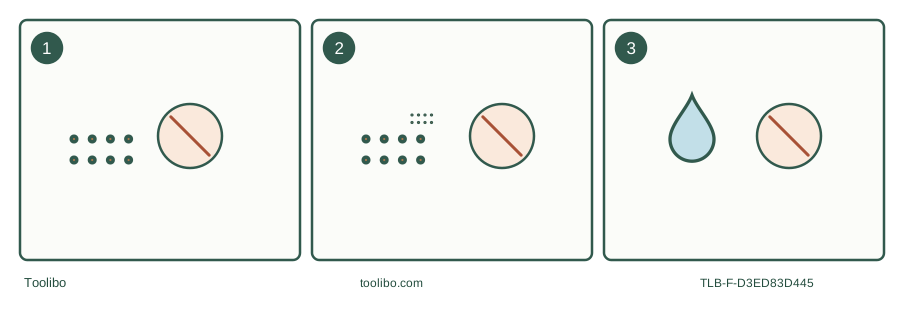
Ash
Heat and exact accessory permission
Powder
Identify combustible material
Liquid
Identify chemical and flammability
A wet/dry label does not answer temperature, combustibility or chemical compatibility.
Two misleading labels
“Dry pickup” describes a mode, not permission to collect every powder. “Wet pickup” likewise does not make a machine a universal spill extractor. Begin by identifying what has been spilled, whether it could still be hot, and whether it has mixed with anything else. Do this before changing the filter or switching the hose to another port.
The questions are different for a fireplace, a bag of flour and a fuel container. Combining them under the label “garage mess” hides the information needed to choose a safe response. The decision should be made from the material and the exact equipment instructions, not from how easily the hose can reach it.
Ash needs more than a waiting-time guess
Do not use an ordinary shop vacuum to investigate whether ash is cool enough. The absence of visible glow is not a permission statement. Follow the fireplace or stove guidance and the cleaning equipment’s stated limits; if there is uncertainty about retained heat, postpone the cleaning rather than try a small patch.
There are genuine differences between manufacturers’ instructions. The covered Kärcher WD4 manual permits cold ash only with an ash pre-separator. That is a particular machine/accessory arrangement, not a rule allowing every bucket vacuum to collect ash. It also does not turn that accessory into a hot-ash collector. Confirm the exact approved accessory and its own restrictions before considering this route.
A useful purchase question is therefore: “Does this machine’s manual explicitly permit the proposed cold-ash configuration?” It is not simply: “Does the filter catch fine particles?” If permission is absent, choose an appropriate dedicated method rather than interpreting silence as approval.
Flour is not the same as ordinary crumbs
OSHA identifies flour and several other powdered organic materials among combustible-dust concerns. HSE’s food-industry guidance explains why selecting a suitable vacuum for these materials involves ignition risks as well as filtration. Those workplace examples do not define a harmless household quantity or certify an ordinary domestic machine.
For a household spill, do not use the shop vacuum as an experiment with a combustible powder. Keep the material from being dispersed and follow an appropriate cleaning method for the product and surface. A larger spill, an unknown powder or an industrial setting needs competent assessment. Do not adapt industrial earthing instructions into a homemade modification to a household vacuum.
Swipe or scroll horizontally to see all columns.
| Material question | Why it matters | Decision to avoid |
|---|---|---|
| Could ash still hold heat? | Heat can enter the collection system | Judging by surface colour alone |
| Is it a finely divided combustible powder? | Filtration is only one part of the risk | Buying a finer cartridge as the whole solution |
| Is the liquid fuel, solvent or otherwise flammable? | Wet capability does not establish suitability | Assuming a float valve makes the task safe |
| Are substances mixed or unidentified? | The mixture may change the required method | Selecting the least concerning label |
Do not build a DIY explosion-proof machine
A metal tank, brushless motor, antistatic hose or HEPA filter is not a complete explosion-protection declaration. Do not add a wire, substitute a hose or modify a motor housing to claim that an ordinary vacuum can now handle combustible material. The equipment, environment and material must be assessed together.
Similarly, do not deliberately mix water with an unknown chemical or combustible spill to make it “wet pickup”. You may create a different problem without making the machine suitable. If there is smoke, fire, strong fuel vapour or immediate danger, leave the affected area and seek emergency assistance rather than operate electrical equipment nearby.
Keep the next task separate
If an unsuitable substance has already entered the machine, stop using it and obtain appropriate handling advice. Do not open the tank in a living area, run the blower to clear it or continue with an ordinary household job. Tell the person advising you what entered the machine and what else may already have been in its tank.
For normal permitted cleanup, a brief task note is enough: material identity, machine permission, required configuration and disposal plan. That note prevents a successful previous job from becoming false permission for the next, very different spill.