
Garage cleanup boundary
Three panels map an accepted storage-litter patch, an untouched powder boundary by a bench, and a vacuum exhaust aimed away from excluded material.
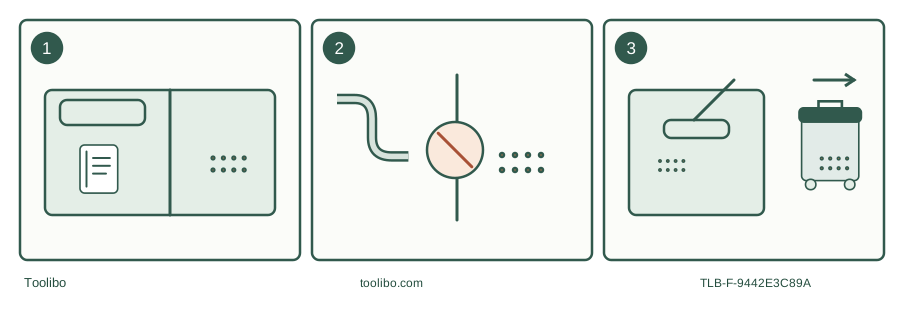
Identify
Name the material and its source.
Separate
Leave unknown or hazardous areas untouched.
Collect
Clean only the accepted dry area.
Model-specific decision path; isolate power before opening or changing the collection system.
Divide the garage by what happened there
A single garage may contain household storage, vehicle parking, a repair bench and recent building work. Those areas can produce very different residues. Start with a small patch whose history you know, such as ordinary loose household litter beside storage shelves. Do not label the whole floor “general dirt” because the vacuum is marketed for a garage.
The RIDGID HD12000 documentation describes general debris collection and household use, with explicit exclusions around hazardous materials and flammable atmospheres. This guide deliberately narrows the job to identifiable routine dry litter. It does not cover concrete, mortar, sanding dust, treated-wood dust, old paint, brake residue, ash, metal powders, chemical absorbents or unidentified spill residue.
Look for a reason not to start
Keep the vacuum off while walking the intended route. Check whether fuel, solvents, aerosol products or other flammable materials are present where the motor would operate. Do not run an ordinary vacuum in a flammable-vapour or combustible-dust environment, even if the nozzle is aimed at a harmless-looking corner. The surrounding atmosphere matters as well as the material at the tip.
If you find an unfamiliar fine deposit, stop and identify the source without stirring it up. Do not dry-brush it into a pile, blow it across the garage or test a small amount in the vacuum. UK HSE construction-cleaning guidance treats fine building dust as a separately assessed task with suitable extraction; that workplace context is not a universal legal instruction, but it explains why ordinary garage housekeeping should not silently include renovation dust.
Swipe or scroll horizontally to see all columns.
| Area or finding | This routine? | Next decision |
|---|---|---|
| Known ordinary dry household litter | Possibly, if the manual permits it | Check machine, surface and route |
| Fresh powder near drilling or sanding | No | Identify material and suitable dust-control plan |
| Oily, chemical or fuel-contaminated residue | No | Use appropriate spill guidance and help |
| Unknown history or suspected hazardous dust | No | Keep the area undisturbed pending assessment |
Prepare only the accepted area
Remove personal items and large objects by an appropriate safe method. Keep sharp or heavy pieces out of the hose rather than using the vacuum as a disposal chute. Move only things you can handle safely; a heavy storage unit does not need to be shifted just to improve the cleaning reach. Leave a clear path for the hose, cord and operator.
With the vacuum off and unplugged, verify that it contains no incompatible residue from an earlier job. Fit the correct intact dry filter and compatible bag if specified or selected. A bag is useful for routine disposal, but it cannot turn an unsuitable material into an acceptable one. A HEPA replacement filter alone does not establish whole-machine hazardous-dust certification.
Work from the boundary inward
Place the machine on a stable dry surface where its exhaust is not directed at a suspect pile or loose nearby material. Use the appropriate floor or utility nozzle and collect the accepted routine debris in manageable sections. Do not push the nozzle into an unknown powder line simply to finish a neat rectangle.
Watch what appears as objects are uncovered. Finding paint fragments, powder from a damaged package or an unexplained oily patch changes the task. Stop before disturbing the new material, isolate the vacuum safely and decide what it is. The useful outcome is a clean accepted area, not a promise to remove every visible mark in one pass.
Respond to a changed machine, not just a changed floor
Loss of suction, dust from the exhaust, escaping liquid, unusual noise or a burning smell are stop conditions. Disconnect before inspecting the normal collection path. Do not remove the filter and continue, or use the blower to clear a blocked dusty corner. If the vacuum may have collected excluded material, the ordinary emptying and filter-cleaning instructions no longer apply automatically.
Close the job with a truthful record
Empty known ordinary contents using the manual’s procedure and local disposal arrangements. Keep dry consumables and wet-pickup equipment identified separately. Note any area intentionally left untouched and why, especially if another household member might resume the cleanup.
A practical handover says “storage-side routine litter removed; powder near the drill bench not identified,” rather than “garage cleaned.” That distinction preserves the material boundary. A more powerful motor, finer filter or larger bag does not remove the need to know what the machine is collecting.