
Dust from exhaust
Three panels show an exhaust plume with stop switch, a magnified torn or misseated filter seal, and an intact correctly seated system before a limited normal-job check.
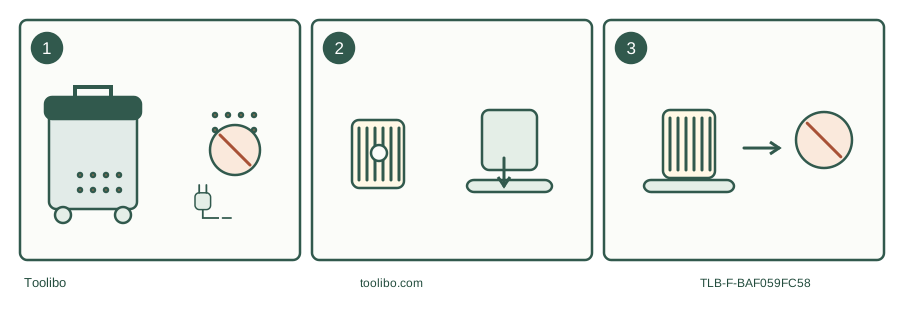
Stop
End the emission and identify the material.
Inspect
Check media and seal only if contents are routine.
Correct
Replace or reseat; persistent dust means service.
Model-specific decision path; isolate power before opening or changing the collection system.
End the cleaning pass immediately
If dust appears at the exhaust, switch off rather than finishing the section. Keep people away from the discharge and avoid walking the machine through clean rooms while it is running. Do not direct the exhaust into a bag, wrap fabric around the outlet or block ventilation to hide the plume. Those measures do not repair the collection system and may create another problem.
RIDGID HD12000 manual SP7160 (04/24) tells the operator to stop for debris or liquid leaving the exhaust. Shop-Vac’s official troubleshooting page lists missing, damaged, clogged, unsuitable or non-functional filters among possible exhaust-dust causes. The visible symptom identifies a loss of proper collection, not the exact cause or the safety of the released material.
Identify the material before opening the tank
Ask what was collected immediately before the dust appeared and what was already in the vacuum. If there is any possibility of silica, asbestos, lead, unknown fine powder or another hazardous contaminant, do not shake out the filter, sweep up the plume or try another pass. Keep the area undisturbed and obtain appropriate advice on the material and contaminated equipment.
This owner-level procedure continues only for known ordinary debris within the machine’s permitted use. A replacement HEPA filter alone does not establish whole-machine certification or make a prohibited task safe. UK HSE construction-cleaning guidance treats construction dust as an assessed workplace task with suitable extraction; that is a separate context, not permission to upgrade an ordinary household vacuum and carry on.
Swipe or scroll horizontally to see all columns.
| Finding after safe isolation | Meaning to consider | Next action |
|---|---|---|
| Main filter absent | Collection path incomplete | Fit the exact approved filter before any dry use |
| Tear, hole or split seal | Damaged barrier or bypass | Replace approved affected part |
| Filter fitted but not seated | Air can bypass media | Refit by the model-specific method |
| Filter intact but material too fine or unidentified | Task/filter suitability unresolved | Stop and establish suitable equipment |
| Correct system still emits dust | Fault not resolved | Arrange service; do not keep testing |
Inspect the filter and its seat while disconnected
Switch off and unplug from a safe dry location. Open only the owner-accessible collection system. Confirm the actual filter part and orientation against its instructions. An empty filter cage is not a dry-pickup configuration, and a collection bag does not replace a required main filter. A bag that tore can also load the filter more quickly than expected.
Examine the media and seal without aggressively flexing them. Small holes matter; a patch of tape or glue is not an approved filter repair. Check whether ordinary debris lies on the sealing surface or whether a retaining plate is incompletely engaged. Do not run the motor with the lid open to watch where dust travels.
Use the exact retention method
The documented HD12000 Qwik Lock system requires the bottom rubber gasket to seat around the cage base and the integrated plate to engage the stud. Its manual specifically warns that incorrect seating can let debris bypass the filter. Other filter model numbers can have different installation details, so read the replacement part’s instructions too.
On a Kärcher WD 4 using manual 59510240, the flat pleated filter and filter box form a different arrangement. The filter must be present, intact and dry for dry work. Do not force a cartridge-style part into a box-style holder or assume that an apparently closed cover proves the filter is seated.
Resume only if the cause is clear and corrected
For known permitted ordinary debris, replace a damaged part or correctly refit a misseated filter, then restore the complete closed assembly. Resume only a limited portion of the intended normal job while attending the machine. Do not create a cloud with flour, ash or building dust as a containment test. Absence of a visible plume cannot certify capture of invisible hazardous particles.
If dust reappears, stop the check and contact service with the model, filter part number, collected material and observed defect. Arrange appropriate cleanup of any released material; do not use the unresolved faulty vacuum to collect its own plume. The successful endpoint is both a corrected collection system and a suitable task, not merely less visible dust at the outlet.