
Wet pickup stops
Three panels branch a stopped water stream into full tank, tipped tank and kinked hose, then show isolated correction before an upright complete assembly.
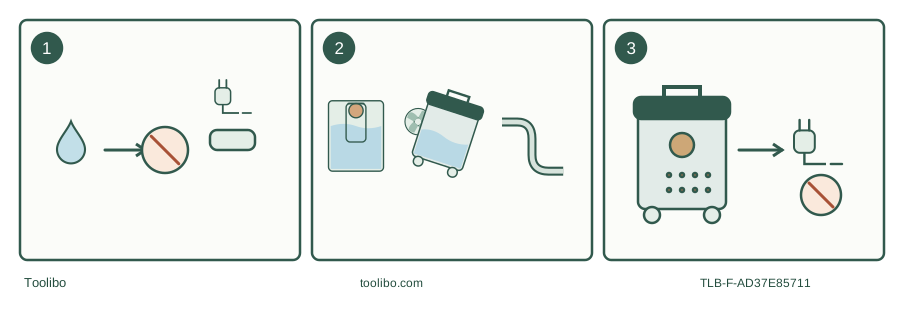
Observe
Stop and note pitch, tipping or foam.
Isolate
Check actual level, hose and wet setup.
Resolve
Correct a clear cause; repeated cutoff needs service.
Model-specific decision path; isolate power before opening or changing the collection system.
Start with the sound and the scene
If the motor continues running but the nozzle no longer collects water, stop promptly. Note whether the sound became higher pitched, the machine tipped, the hose kinked or foam appeared. Do not keep running while deciding. RIDGID HD12000 manual SP7160 (04/24) warns against operation with the float raised; Kärcher WD 4 manual 59510240 likewise requires stopping and emptying when the full-tank float closes suction.
If the motor is silent instead, this is a power/start problem, not necessarily a float event. If water reaches electrical connections, the motor head or another energized appliance, leave the ordinary diagnostic path and have the situation made safe. Do not reach through water to unplug equipment. This guide covers only known clean-water collection in a safe dry electrical setting.
Emptying is the first branch, not a reset trick
Switch off and unplug safely before opening or draining. Check the actual tank contents, not only how long the machine has been running. A nominal drum capacity does not tell you how much can be collected before protection acts. An initially partly filled tank or a particular collection arrangement can reach its stopping condition sooner than expected.
If full, empty by the model’s prescribed route, refit the drain cap if present and restore the proper head and latch seating. Keep the float and cage installed. Do not hold the float down, tilt the tank during operation or drill an extra vent to regain airflow. Those actions defeat the reason pickup stopped.
Swipe or scroll horizontally to see all columns.
| What changed | Check while isolated | Return-to-work condition |
|---|---|---|
| Pitch rose and tank is full | Full-tank protection | Empty, correctly reassembled tank |
| Machine tipped | Spillage, damage and float state | Safe dry machine and exact restart procedure |
| Tank low, hose visibly kinked | Accessible flow restriction | Undamaged clear hose and suitable nozzle |
| Wet job started after dry cleanup | Bag/filter configuration | Exact manual wet setup restored |
| Foam, mist or liquid at exhaust | Incorrect setup or unresolved fault | Stop; resolve before further use |
Handle a tip-over separately
The documented WD 4 can close its float after tipping. Its manual’s recovery note specifies standing it upright, switching off, waiting five seconds and restarting. Before using that sequence, check safely for water where it should not be and for physical damage. The note does not authorize energizing a wet electrical head or a damaged cable.
Do not borrow the five-second wait for an unrelated vacuum. Find its actual reset instructions. If the unit repeatedly shuts its airflow with little water while remaining upright, a simple tip-over reset is no longer an adequate explanation. Keep it out of use until the cause is understood.
Check the accessible water path and mode
With power isolated, inspect the nozzle, wand and hose for ordinary obstructions, kinks or a collapsed section. Do not push a sharp rod blindly toward the tank or motor. Ensure the nozzle and any insert are the approved wet arrangement for the surface. Confirm the hose is at the suction inlet rather than a blower outlet.
Check the filter state against the exact manual. The WD 4 example keeps the flat pleated filter and removes the bag. HD12000 SP7160 (04/24) uses its specified larger-liquid wet foam configuration rather than dry-only paper filters. A remembered rule from a different model is not sufficient. An accidentally retained wet, collapsed dry bag should be removed and handled as its condition requires, not squeezed and reinstalled.
Treat escaping foam or liquid as a stop condition
Do not add defoamer, detergent or another additive unless the actual manufacturer expressly specifies it for the machine and task. Foam can indicate that the collected water was not the simple clean-water job assumed here. Do not continue collecting to see whether the exhaust clears itself. If liquid may have entered the electrical head, arrange service advice before another start.
After a clear owner-correctable cause is resolved, restore the complete correct assembly and make only a limited return to the intended clean-water task while attending the machine. Recurrence, visible damage or an unexplained early cutoff ends the check. Give service the model, wet-filter part, liquid source and observations rather than dismantling the float assembly or motor housing.