
Identify before you collect
A renovation debris icon branches into known material with documentation, unresolved material to pause, and already-contaminated machine to advice; no collection arrow bypasses identification.
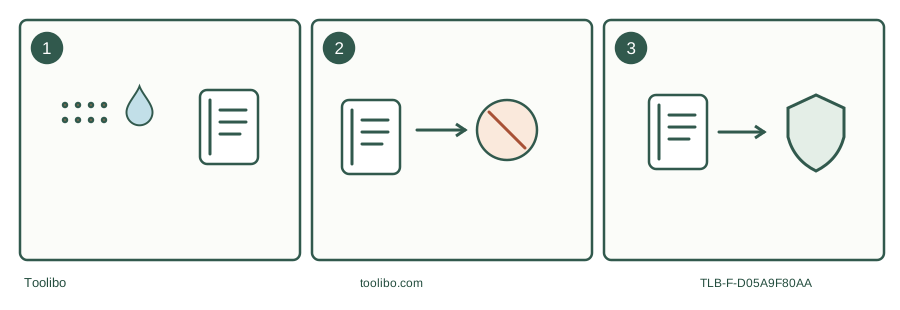
Identify
Material, process and mixture
Decide
Documented task or pause
Handover
Ask without disturbing it
Small quantity does not replace material identification.
A clean-looking pile is not an identification
Before reaching for the hose, describe where the debris came from. There is a meaningful difference between ordinary tracked-in dirt and powder created by drilling masonry, sanding a coating or disturbing old building material. Colour and texture are not enough to identify those substances, and the amount on the floor does not reveal how much fine dust is airborne.
Write down the material, the process that created it and any existing product or building records. “White dust” is not a usable identification. “Dust from the identified plasterboard product, without disturbing an unknown coating” is a more useful description, although it still does not prove a particular vacuum is suitable. If different debris has mixed, record the mixture rather than choosing the least worrying ingredient.
Use a stop point before a shopping decision
A common mistake is to see an uncertain material and immediately search for a stronger vacuum. Reverse that sequence. First decide whether the job belongs within a household cleaning guide at all. Only then select equipment for a confirmed task.
Swipe or scroll horizontally to see all columns.
| What is known? | Sensible next action | Shortcut to avoid |
|---|---|---|
| Ordinary material and an exact machine permission | Plan the permitted configuration | Assuming every filter is interchangeable |
| Known material, but unclear extraction requirement | Obtain task-specific advice | Treating a dust bag as a hazard rating |
| Unknown coating, board, insulation or mixed renovation dust | Stop disturbing it and arrange identification/advice | Trial vacuuming to see whether dust escapes |
| Machine already used on suspected hazardous material | Stop reuse and seek handling advice | Opening it in the home to inspect the contents |
This decision table intentionally has no “try a small amount” route for unknown hazardous dust. A trial can change the exposure before it answers anything useful.
Keep local examples local
UK HSE guidance for small-scale silica cleanup specifies suitable M- or H-class equipment for finer material and discourages methods that put dust back into the air. US EPA advises homeowners to use lead-safe certified contractors for renovation in pre-1978 US homes. New Zealand WorkSafe identifies H-class equipment for respirable crystalline silica and asbestos-contaminated material.
These are examples of task- and location-specific requirements, not interchangeable international labels. The US date is not a safe/unsafe cutoff for buildings everywhere. Likewise, a foreign product’s class or filter description is not automatically the correct answer for your local material and method.
Prepare a useful handover
When asking a contractor, building professional or competent supplier for help, provide the room and task, building or product information already available, photographs taken without disturbing the material, and what has already been done. Say whether anyone has swept, sanded or vacuumed it and whether the vacuum has been used elsewhere afterward.
Ask what identification is needed before further work, what equipment and containment are appropriate, and how affected tools or waste should be handled. Do not take your own sample simply to make the enquiry more complete. The handover should reduce uncertainty without creating a new disturbance.
Do not solve dust uncertainty with water or a blower
A blower setting is not a cleanup substitute when material identity is unresolved. Nor does adding water automatically make a substance suitable for wet pickup. A damp mixture can still require specialised handling, and the vacuum’s wet capability says nothing by itself about that material.
Once an appropriate person has resolved the task, keep the resulting boundaries with the project notes. Record the permitted machine configuration, who will do the work and the disposal route. If the project later changes, for example from loose surface dirt to sanding an old coating, return to the identification step. The earlier answer applied to the earlier job, not every future activity in the same room.