
Trace the collection path in order
Check aligned inlets, externally accessible restrictions and the complete container/filter arrangement; the red obstruction is conceptual, not permission to probe inside.
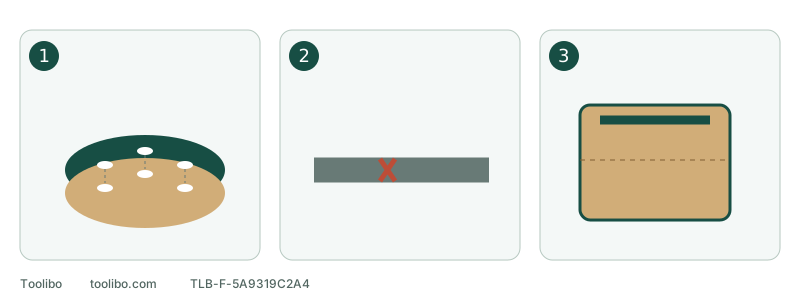
1. Disc and pad openings
A matching hole count still needs actual alignment.
2. Accessible outlet
Clear only permitted external debris; leave internal ducts to service.
3. Container and filter
Empty appropriately, retain required filtration and refit the closure.
Check aligned inlets, externally accessible restrictions and the complete container/filter arrangement; the red obstruction is conceptual, not permission to probe inside.
Establish material and equipment boundaries first
This checklist concerns known suitable ordinary dry wood and normally accessible equipment. Unknown old paint, suspected lead or asbestos and unidentified previous extractor contents require stopping for appropriate assessment, not opening a bag to test suction. Smoke, abnormal heat or danger in a bag or machine means move away and respond safely; do not approach a dangerous battery for troubleshooting.
Only with stable, safely accessible equipment, switch off, wait for all motion to stop and remove a normal battery or unplug. Isolate an external extractor as required too. All fitting, hole alignment and cleaning below take place with power isolated. More visible dust is an observation, not a measured airflow result; extractor noise does not prove adequate suction beneath the pad.
First: record what happened immediately before the change
Swipe or scroll horizontally to see all columns.
| Last change | First entry point | If no issue is found |
|---|---|---|
| New disc or intermediate pad | Hole paths, dimensions and approved layers | Continue to outlet and container; do not drill extra holes experimentally |
| Bag emptied or filter cleaned | Correct refitting, latched lid and filter still installed | Check other restrictions; empty does not mean flow restored |
| Hose, adapter or extractor replaced | Complete connection, locking, hose bends and equipment configuration | Return to abrasive inlets; do not judge from motor noise alone |
| Different material or coating | Reassess suitability, dust controls and abrasive loading | Stop for unknown material; stronger suction is not a substitute |
| No clear change, gradual decline | Follow the inlet-to-outlet sequence below | Do not bypass a full container or abrasive check to open the tool |
Do not repeat a suspect operation just to reconstruct events. Record what is known. An obvious bag tear, leaking lid or detached connector is a sealing problem to correct before following the remaining path.
Second: do the abrasive holes actually line up?
Inspect disc and pad holes while stationary. PCL406 and Milwaukee 2648-20 require alignment: matching diameter and hole count do not establish an unobstructed path. Reposition a misaligned hook-and-loop disc by the tool’s method rather than drilling larger holes.
For a protector or soft interface layer, verify the complete arrangement is approved and retains the required paths. An unverified stack stays out of use; softness is not approval. Passing this check means a suitable disc sits flat without installation blocking the inlets. Replace seriously loaded or damaged abrasive with an appropriate intact one rather than forcing it clear through pressure.
Third: is the externally accessible outlet restricted?
After removing only user-removable bags, boxes or adapters, inspect openings safely accessible from outside and clear visible loose debris only by permitted methods. Do not push rods or screwdrivers, or high-pressure air, into the housing to reach a suspected deep blockage. Do not open the housing to follow internal ducts.
A cracked or deformed interface or a connector that cannot seat normally requires stopping for correct replacement or service. An apparently clear external path with continuing symptoms does not diagnose a failed internal fan; it only completes this inspection stage.
Fourth: assess the container and filter separately
Empty the PCL406 bag at no more than half full; normal collection needs an intact bag seated onto the port with its specified slight twisting push. Empty the Milwaukee 2648-20 box at no more than half full too, then refit with vents upward and the lid snapped in place. Check closure and attachment as well as an empty container.
2648-20 permits tapping its filter clean by the specified method, not water or compressed air; replace with specified filter 43-31-0105 when necessary. Use controls suitable for the dust, not uncontrolled indoor dust release. Never remove the filter to run a comparison of “better suction,” or borrow another brand’s washing or brushing rules.
Passing means contents were handled appropriately, required filtration remains intact and installed, and lid and connector are correctly refitted. A missing filter, failed lid latch, torn bag or unresolved unidentified dust prevents a trial restart.
Fifth: an external extractor needs more than electrical power
Check the whole approved adapter–hose–extractor arrangement. A hose must not be kinked, crushed or wrapped around a table leg pulling on the joint. Check bag fullness, filter maintenance and settings by the extractor’s instructions. Do not remove its required filters or transfer hand-sander dust-box maintenance rules to it.
Do not hold or tape an incorrect connector into service while configuration remains unresolved. Confirm the actual extractor starting method for that system; do not assume running the sander automatically starts it.
Finish with one of two routes: controlled work or continued isolation
If an ordinary external cause was identified and corrected, with no danger signs, abnormal vibration, damage or unresolved operating problem, check material, workholding, abrasive and complete extraction while isolated. Confirm switches OFF, restore power and extraction in the system’s order, then follow the exact sander sequence for a brief controlled check on suitable scrap.
If collection recovers without unexpected escape, continue normally while observing emptying and maintenance requirements. Visible improvement still does not establish acceptable fine-dust exposure. If pickup remains clearly poor, a connection loosens again or a new abnormality appears, stop, wait for all motion to cease and isolate power. Give support the last change, completed checks and all component identities. An unidentified cause follows this same stop route, not internal dismantling or declaring removal of filtration a repair.
Models referenced