
Normal auto-stop versus unwanted restart
Qualitative timeline compares a motor stopping on trigger release with repeated restart while the trigger remains released; external leak zones are marked separately.
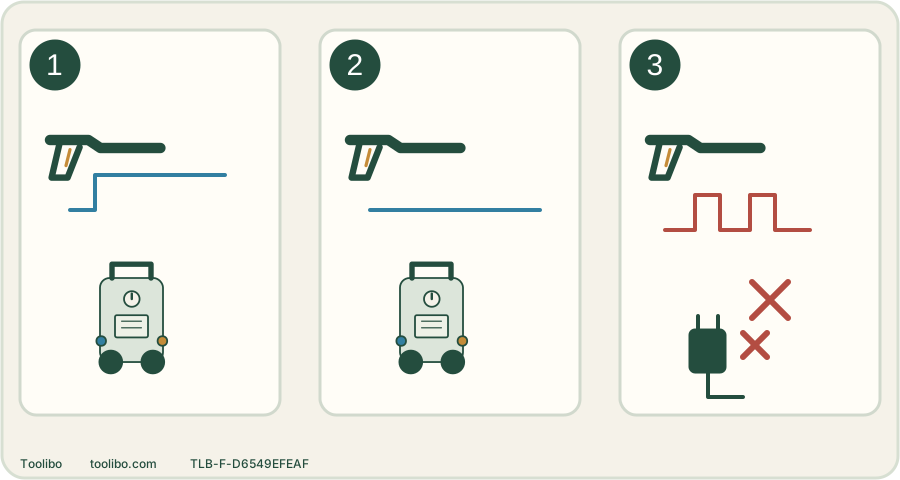
Normal run
The motor runs while the trigger is deliberately pressed.
Normal stop
Releasing the trigger stops an auto-stop machine.
Unwanted restart
Repeated restart without trigger operation calls for isolation and service-boundary checks.
Once repeated self-starting is clear, switch off and isolate. The symptom is not a diagnosis of a particular internal valve. Conceptual schematic, not a product image or scale drawing.
Observe the trigger state, not just the motor sound
For a normal auto-stop machine, the motor runs when the trigger is pressed and stops when it is released. If it starts again repeatedly with no one operating the trigger, write down that exact behaviour. A pressure pulse while you are actively spraying belongs to the separate supply-and-air diagnosis.
Do not stand beside a powered machine waiting for many cycles to count them. Once the symptom is clear, switch off and follow the model’s pressure-release and isolation procedure. Keep the gun pointed safely and do not allow children or bystanders near the controls.
Why this is not a reason to adjust a spring
A closed high-pressure circuit is meant to retain pressure under the system’s designed controls. Loss of pressure or a control fault can cause unwanted restart, but the sound alone cannot identify the failed part. Bosch UniversalAquatak 135 lists pump or gun leakage for irregular self-starting and directs the user to its service centre; problems with the total-stop system likewise require service.
This is not a recommendation to buy an unloader valve, turn an adjustment screw or replace an electrical switch on the basis of a video. Several components can produce similar behaviour, and opening the system introduces electrical and pressure hazards.
Inspect only the accessible outside
After unplugging, disconnecting water and releasing pressure, inspect the supply and pressure hoses for visible damage. Look at accessible connections for a missing seal, cross-threading or a loose latch. Note whether the gun handle or machine casing was wet, rather than only whether a puddle appeared beneath it.
If a manufacturer-approved user connection is visibly misassembled, correct it only by the matching instructions. A damaged pressure hose must be replaced; a leaking gun body or water from inside the machine is a service issue. Never feel for a high-pressure pinhole with a hand, and never add tape to hide the leak.
Decide whether another test adds useful information
If no simple permitted external cause is found, stop here and request service. A machine that is repeatedly restarting does not need a long endurance test to prove the fault. If you have corrected an obvious approved external connection, one short normal observation can show whether the behaviour is gone. Stop at once if it returns.
Do not tie the trigger open to keep the motor running continuously. Do not bypass the auto-stop switch or leave the main switch on merely because the gun trigger is locked. The trigger lock prevents unintended operation of the gun; it does not repair a pressure-retention fault.
Prepare a precise service description
Record the exact model, fitted hose and gun, any added extension, the water source, and whether visible leakage appeared at a connector, the gun body or under the machine. State that the trigger was released when the restart occurred. Mention recent frost exposure or hose changes if relevant, without concluding that either caused the fault.
Keep the machine isolated until the cause is resolved. Service can then distinguish a gun, pump or control fault with the appropriate procedure. User-level diagnosis has succeeded when it identifies the symptom and safe boundary, not when it names an internal part without evidence.
If the hose or gun was recently replaced, retain its packaging or part number and confirm the complete combination is approved for the machine. A connector that clicks into place does not establish the correct pressure rating or control compatibility. Do not add another adapter as an experiment. Record which parts were fitted before the symptom began so service can assess the change without asking for another unsafe test.