
Two filters along the inlet water path
An original inlet schematic distinguishes the outer adapter filter, sealing ring and inner machine strainer; arrows identify supply and rinse directions.
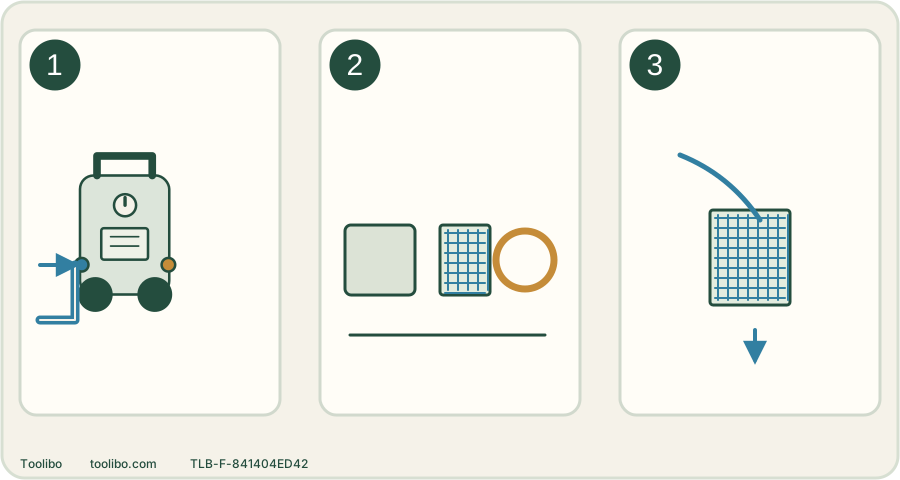
Low-pressure inlet
Trace the tap hose to the inlet before removing the adapter.
Outer adapter filter
Keep the filter insert and its sealing ring together in the parts tray.
Inner strainer
Rinse intact mesh; do not grip or puncture the fine mesh surface.
Follow the low-pressure supply into the machine; the high-pressure outlet is a different connection. Both strainers and the original seal must be refitted. Conceptual schematic, not a product image or scale drawing.
Find the filter, not the high-pressure outlet
The supply hose enters the low-pressure water inlet. The high-pressure hose leaves through a different connection; disconnecting that hose does not expose the inlet filter. Identify both from the machine diagram before undoing anything. The Bosch UniversalAquatak 135 illustrated here has two strainers: one in the external inlet adapter and another just inside the machine inlet. A single quick rinse of the visible adapter may leave the inner strainer blocked.
Set out a shallow tray, clean water, a soft cloth and the matched replacement filter if required. Work somewhere dropped sealing rings will be visible. Do not use a wire brush, drill, needle or high-pressure jet to clean fine mesh.
Isolate before removing parts
Finish the machine’s specified shutdown and pressure-release procedure. Switch off, unplug with dry hands, close and disconnect the water supply, and confirm the hose is depressurized before opening a connection. A stopped motor does not prove the hose is empty of pressure. Allow hot connections to cool.
On the UniversalAquatak 135, figure M shows the outer inlet adapter unscrewing from the machine, the inner strainer being withdrawn and the external filter insert being removed from the adapter. Photograph the assembled arrangement first. Grip the strainer’s solid rim with the tool shown in the matched manual, not its mesh. If it resists or you cannot identify the removable part, stop rather than forcing a pump component.
Rinse, inspect and rebuild
- Keep the outer adapter, inner strainer, external insert and sealing ring separated in the tray. Note their original direction.
- Rinse away loose grit using clean running water. A Kärcher K4 Power Control Flex manual explicitly specifies rinsing its inlet sieve against the normal flow direction; this helps move trapped particles out rather than deeper into the mesh.
- Hold the mesh toward a light. Look for remaining deposits, splits, a distorted rim or a hole. Cleaning cannot repair a tear. Replace a damaged strainer with the specified part.
- Check that the adapter and its seal are intact and free of grit. Do not add tape or sealant to compensate for a missing original seal.
- Refit every part in its original orientation. Seat the mesh element fully and fit the adapter without cross-threading or crushing the ring. Both Bosch filters must remain installed.
Test the supply before asking for pressure
Reconnect the supply hose and open the tap. With the motor still off, follow the machine’s air-clearing procedure until the gun supplies a steady stream. Look at the inlet connection for drips; correct a loose or poorly seated connection only after isolating it again. Then run a short normal test with the correct lance and a safe target.
A clean inlet may resolve pulsing or reduced output, but it does not prove the pump is healthy. If flow remains weak, check for a pinched supply hose and an inadequate water source next. If the filter quickly fills again, investigate the hose or stored-water source instead of repeatedly letting sediment reach the pump.
When to replace rather than clean
A broken frame, torn mesh or missing insert ends this cleaning job. Never remove the filter to “get more pressure”: the apparent improvement trades a restriction for unfiltered debris entering the machine. The Kärcher instructions likewise prohibit operation with a damaged or absent sieve. Parts that are inaccessible without opening the housing belong to service, not this procedure.