
Connect and check the water supply
Numbered schematic explaining Connect and check the water supply.
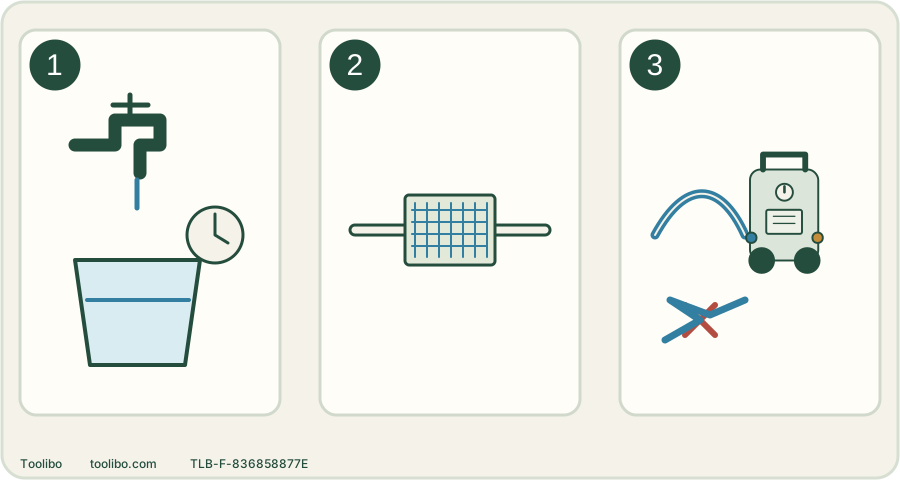
Measure at the hose end
5 litres in 40 seconds equals 7.5 L/min, exactly the example minimum with no margin.
Filter at the inlet
Use the specified clean filter and properly seated coupling seals.
Check restrictions
A kink or partly closed valve can reduce delivery through an otherwise suitable hose.
Meet the exact inlet flow, temperature and pressure requirements; an outlet pressure rating is not an inlet requirement. Conceptual schematic, not a product image or scale drawing.
Read the inlet requirements, not the headline bar figure
The Bosch UniversalAquatak 135 manual for the 230 V family gives a minimum supply of 7.5 L/min, maximum inlet temperature of 40°C and maximum inlet pressure of 1 MPa, or 10 bar. It separately lists rated outlet flow of 6.4 L/min and rated pressure of 9.2 MPa. These numbers describe different parts of the system and must not be substituted for one another.
The same manual gives minimum supply rates of 6 L/min for the 125 and 7 L/min for the 130. This is why even models in one family need their own row checked. Use the values for your regional model, including the stated supply-hose requirement; the troubleshooting section specifies at least 13 mm or 1/2 inch diameter.
Test delivery at the hose end
Disconnect the supply hose from the washer with the washer isolated, place its outlet securely in a known-volume container and time the fill. Calculate litres per minute as collected litres multiplied by 60, divided by seconds. For example, 5 litres collected in 40 seconds equals 7.5 L/min.
That exactly meets the example’s minimum in this simple test, with no margin for a later restriction or another tap being opened. It is a screening check, not a calibrated pressure-and-flow test. Repeat under the conditions of use and do not run the washer if delivery falls below its requirement. Do not waste water while leaving the test unattended.
Assemble the low-pressure side
- Turn off the tap and keep the machine switched off and isolated.
- Inspect the supply hose for kinks, cracks and debris. Flush it separately if needed.
- Fit the specified clean inlet filter and the correct inlet adapter with its seal properly seated.
- Connect the supply hose to the intended inlet and secure the tap connection. Confirm couplings have latched rather than merely been pushed together.
- Open the supply and follow the matched machine’s air-purge/startup procedure.
A leaking inlet coupling can admit air in some operating conditions even if the problem first appears as a weak or pulsing jet. Do not remove the filter or force an unsuitable adapter into place to increase output.
Protect the drinking-water connection
Follow local water-supply rules and the washer’s requirement for backflow protection or a system separator. A quick connector or ordinary hose-end valve is not automatically an approved backflow device. Where the requirements are unclear, ask the water supplier or a qualified installer rather than improvising a connection. Water passing through a required separator must not be treated as drinking water.
Recheck the easy restrictions first
If delivery deteriorates, stop the washer and check whether the tap was partly closed, a hose has folded, a connector valve is not opening or a filter needs permitted external cleaning. Check other demand on the water supply. A water tank with an outlet and an open bucket used for suction are different arrangements; do not transfer this tap-fed setup to either without checking the model’s instructions.