
One impact record, separate tool and power decisions
An event record, a detached battery with an exclusion mark, isolated guard inspection and a final assessment document.
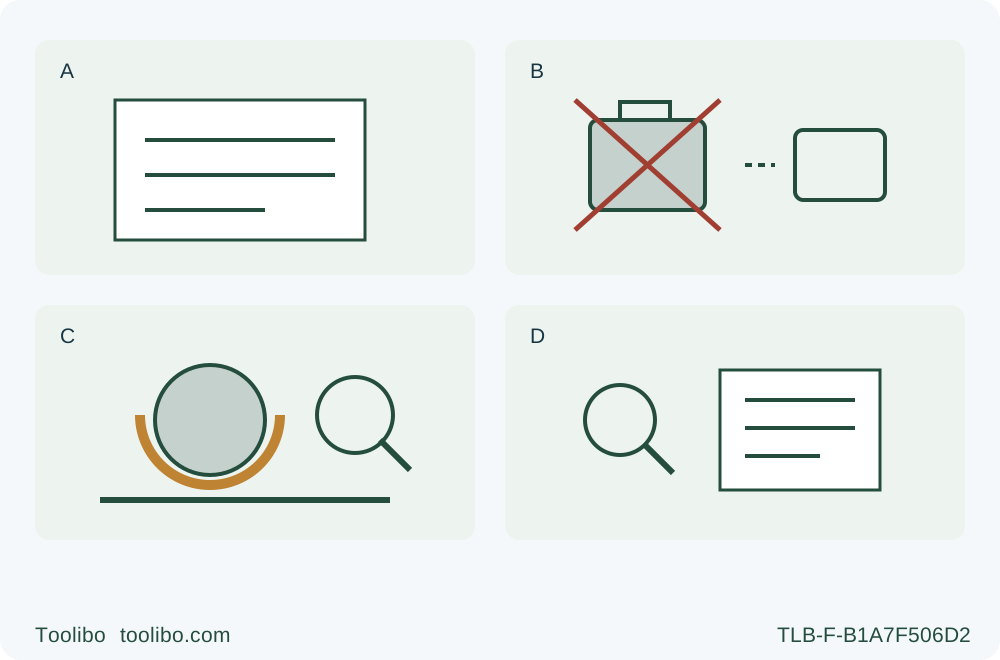
A · Record the event
Identify the saw, attached power item, known impact and uncertainties; no fall-height pass threshold is supplied.
B · Isolate and separate decisions
Remove the battery only when safe under complete instructions. A dropped or sharply impacted battery or charger remains out of use regardless of appearance.
C · Complete the isolated checks
Check the guard and bumper at all depth settings and guard clearance at all angles/depths as instructed; damage or unsafe inspection means a hold.
D · Document the disposition
Record service hold, missing-evidence hold or eligibility for the separate normal owner workflow with a qualified unaffected power system. Do not use a powered test to establish safety.
Conceptual assessment symbols, not a repair or powered-test sequence. B identifies removal and separate power-item status: the exact P507 source prohibits reuse of a dropped or sharply impacted pack or charger. C represents the required isolated guard/bumper checks, not an opened housing. D is a recorded decision, not automatic clearance to energize the tool.
A dropped saw is not cleared for use because its motor still runs. Impact can affect the guard, base, locks or original blade assembly without producing an obvious broken housing. On the documented RYOBI P507, the power system also needs a separate decision: its instructions prohibit using a battery pack or charger that has been dropped or received a sharp blow. A clean-looking pack is not an exception to that rule.
This guide produces an isolated post-impact record and a qualified return-or-hold decision for the US P507 under manual 990000975 REV:05, dated 5-6-20. It is not a powered fault-finding exercise, a repair recipe or proof that every dropped saw can be cleared by its owner. Keep the complete matching manual and the actual battery/charger instructions, including correlation supplement 987000-432. Do not substitute a generic 18 V pack to see whether the tool survived.
Secure the stopped situation first
If the tool is still running or trapped in the work, do not start inspecting it. Release the trigger and maintain control where possible until complete standstill; never pull a rotating blade backward from a kerf. This article does not teach recovery from a falling, trapped or damaged running tool. An unsafe immediate situation takes priority over preserving the workpiece.
Before ordinary inspection, remove the battery safely under the complete instructions and keep the tool from being inadvertently used. Wear eye protection with side shields marked to comply with ANSI Z87.1 during inspection and maintenance, as required by the manual. If the pack or its mounting area is deformed, stuck, hot, leaking or otherwise unsafe to handle, do not force removal or improvise a battery-opening procedure. Keep others away and obtain appropriate manufacturer or qualified assistance. Do not use a charger as a diagnostic device for a suspect pack.
Place the isolated saw on a stable surface with the stopped blade guarded and hands away from teeth. Keep the battery separate from loose conductive objects under its own instructions. Label the tool as awaiting assessment so another person does not reinstall a pack and try it. A lock-off button is not isolation, and an apparently empty battery is not a substitute for removal.
Record the event and identify every affected item
Write down what is known: which item fell, whether a battery was attached, the apparent contact area, and any visible change afterward. Record uncertainty rather than guessing the impact energy from height or surface. This guide provides no harmless-drop threshold, and a low fall is not an automatic pass.
Separate the saw-body decision from the battery and charger decision. P507 safety instructions say not to use a pack or charger that was dropped or received a sharp blow, and direct proper disposal of a dropped or damaged battery. Do not reinterpret that as “reuse if the casing looks intact.” Follow the actual battery instructions and appropriate disposal guidance; this article does not prescribe transport, disassembly or household disposal methods.
If it is uncertain whether an attached pack took the impact, leave its status unresolved rather than reinstalling it for a test. A saw body that can eventually return to use still needs an independently qualified, undamaged approved power system. The old commissioning record does not erase the drop event.
Identify the exact model and original assembly. If the saw was borrowed, preserve the owner’s manual and event information together. Missing history about a previous blade change or an already bent base is a separate unresolved condition, not evidence that the new impact caused it. The purpose of the record is to tell a competent reviewer what is known, not to assign blame.
Make only the permitted isolated observations
The general instructions require checking for misalignment or binding of moving parts, breakage and other conditions affecting operation, with damaged tools repaired before use. Inspect accessible housing, handles, base, adjustment locks and battery attachment areas without opening the tool. Record cracks, deformation, loose parts or changes from the known previous condition. Do not tighten unidentified fasteners or bend the base back by eye.
Keep the original blade, washers and bolt in place for this bounded assessment. Visible blade damage, contact marks or uncertainty about the assembly means a hold for complete instructions and qualified correction. Do not energize the saw to measure wobble, deliberately spin it against a reference or remove parts just to make an inspection look thorough. A functioning motor cannot certify blade retention or alignment.
Check whether the trigger and lock-off move and return normally while the battery remains removed. These are control observations, not a powered switch test. Any sticking, damaged control or inability to establish its condition keeps the tool held. Do not defeat the lock-off to see whether the trigger works without it.
Give the guard and bumper their specific checks
The P507 operating section explicitly requires checking the lower guard and bumper for damage at all depth settings after a drop. Its safety section also requires that the lower guard move freely, close instantly and avoid contacting the blade or another part at all angles and depths. A check at just the current setting is incomplete.
Use the documented retracting handle for the isolated guard check, keeping fingers and other body parts out of the tooth path. Change settings only with the battery removed and follow the full manual. Do not force a jammed guard or push it through a rubbing point. If you cannot safely carry out or understand the full specified checks, use qualified service rather than reducing the check to a glance.
The guard and return spring must operate properly before use. Slow return, incomplete closure, rubbing or damage requires service, not a live cut to “work it free.” Never tie the guard open. The source’s ordinary cleaning discussion is not a post-impact repair authorization; this guide provides no spring adjustment, lubrication, filing, hammering or replacement procedure.
A clear guard result is one entry in the record, not a certificate for the whole saw. Base condition, secure adjustment locks, original blade assembly and power-system status remain independent requirements. If a changed square setting or movement suggests an impact effect, do not assume that turning a calibration screw restores every affected part.
Decide what must remain out of service
Use a service hold when damage, interference, unreliable controls, loose parts or uncertain original assembly remains. The manual requires qualified repair using identical replacement parts. Provide the model, event record and specific observations to that service route; do not order a generic guard, spring or washer based on appearance.
Use an evidence hold when the inspection cannot be completed, history is missing or the actual power system is not qualified. That is a conservative workflow choice, not a claim that the manufacturer requires professional repair after every harmless-looking event. It means this record cannot support returning the tool to operation yet.
Keep dropped or sharply impacted batteries and chargers out of use as the exact safety instruction requires, regardless of the saw-body result. A replacement or alternative system must be genuinely approved for the tool and already commissioned under its full instructions. This article does not make a new charger pairing or fitting decision.
Only when all required checks are completed, no unresolved damage remains and any necessary correction is properly completed can the body be considered for the ordinary owner workflow. Record what was checked and who resolved any service item. “Nothing obvious” is not the same as “all required conditions established.”
Return to ordinary preparation, not a fault demonstration
An eligible return begins with the full model-specific preparation and a separate normal edge-start sample in known suitable wood, not the unfinished impact-site kerf. Re-establish support, guide clearance, depth, bevel locks and guarding. The P507 depth must satisfy both less than one full tooth showing and no more than 1/4 in below the material. Do not treat the old settings as still qualified merely because their knobs appear tight.
The sample is only appropriate after the tool and power-system questions are resolved. It is not a way to discover whether a bent guard or suspect battery is safe. Use the documented PPE, grips, starting, stopping and acceptance sequence; stop on any abnormality and isolate before further assessment. This guide intentionally gives no live vibration, brake, stall or protective-function test.
Close the event record with one clear outcome: body held for service, body held for missing evidence, or body eligible for the separate normal owner workflow with a qualified unaffected power system. Preserve the event and correction history even after return. A later borrower should not inherit a saw whose impact record vanished merely because one piece of wood was eventually cut.
Models referenced