
Trace the system, then restore its evidence
Detached saw battery, hose between saw and extractor, the system manual, and required performance highlighted at the tool-end connection.
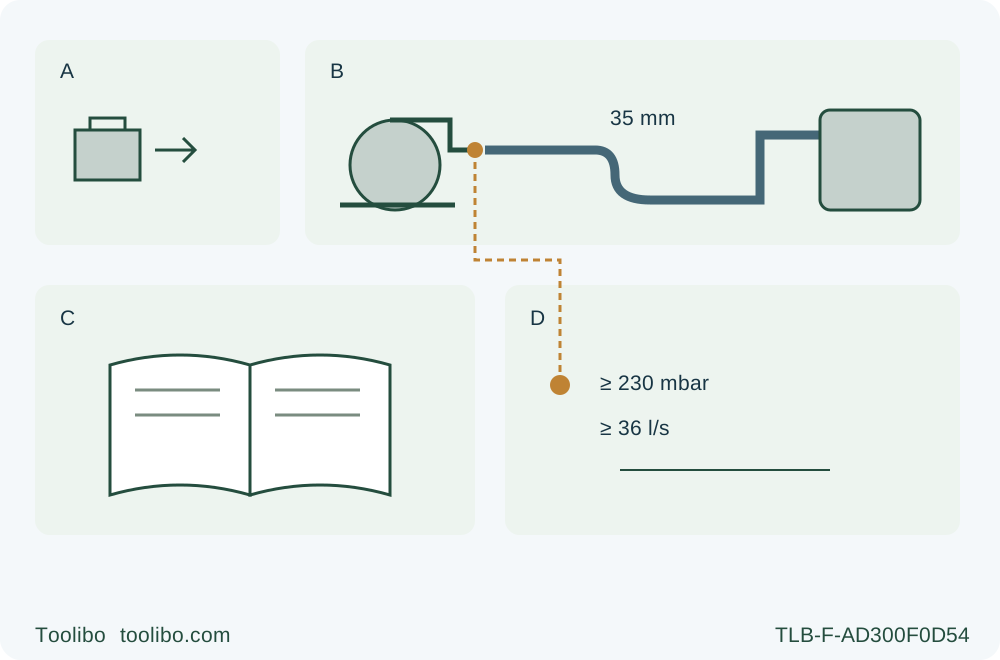
A · Establish the stopped condition
Release the trigger, hold the saw motionless until complete standstill, remove its battery and separately isolate the extractor under its instructions.
B · Trace the actual arrangement
Record hose, intended adapter and external connection changes. Inspect safe accessible routing while isolated; no bag or disconnected-adapter workaround.
C · Use the actual system instructions
Extractor container and filter work requires its complete instructions. Do not invent cleaning, washing, blowing or dismantling methods.
D · Requalify or hold
Confirm at least 230 mbar and 36 L/s at the tool connection for the actual installation. Missing evidence or recurring loss means a qualification or service hold.
A means remove the saw battery after standstill; the extractor must also be stopped and isolated under its own instructions. B is a conceptual connection trace, not a fitting recipe. The 35 mm label is the recommended nominal hose size; the separate 19 mm adapter fit does not waive performance. D points to the saw-end connection, where the required values apply, not the vacuum outlet or its free-air rating.
Reduced suction is a reason to stop work, not to finish the board and inspect the vacuum afterward. The Bosch GKS 12V-26 D1R instructions explicitly require stopping and eliminating the cause when extraction power falls. The difficult part is deciding what evidence is needed before the system can be used again: a hose that still fits, a running vacuum or a cleaner-looking cut line is not enough.
This guide produces a stopped-system assessment and a documented return-or-hold decision for the UK GKS 12V-26, product 06016A1001/type 3601FA1001, under manual 1 609 92A D1R. It starts with an already qualified original wood-cutting assembly, genuine commissioned power system and previously verified external extraction installation. It does not select a new extractor, teach filter servicing or restart a saw in an interrupted kerf. If the system was never qualified, return to initial qualification rather than describing an unknown baseline as a repair.
Stop the cut without creating another hazard
When suction is reduced during cutting, release the trigger and keep the saw controlled and motionless until the blade completely stops. Do not pull a rotating blade backward or lift it out to look at the hose. A loss of extraction can coincide with a hose snag, changing support or binding; none is a reason to rush the tool out of the work.
After complete standstill, remove the saw battery before investigating or making adjustments. Follow the actual extractor’s instructions for stopping and isolating that machine too. Removing the saw’s battery does not isolate a mains-powered extractor. Keep other people away from the work and dust, and do not continue cutting merely because a respirator is being worn.
Preserve the workholding. Do not remove a clamp or reach under unsupported stock to free a hose. If the stopped blade or workpiece is trapped, this guide does not provide a freeing or restart sequence. Keep the task held and use the complete tool instructions and appropriate qualified assistance. A safe stopped condition is the first outcome; restoring suction does not by itself resolve a binding event.
Record the change before altering the system
Write down what was observed: a changed extractor indication, less apparent collection, a displaced hose, a tug on the tool or a growing escape of dust. These observations identify where to investigate; they do not prove a motor fault, blocked filter or hazardous-dust concentration. Avoid diagnostic claims based only on sound or the visibility of airborne dust.
Record the exact extractor, hose, adapter and connection arrangement that was previously qualified. Note any intervening change in hose routing, length, accessory, material, collection state or maintenance. If someone has substituted a hose or adapter since the baseline check, mark the installation unverified rather than assuming the original evidence still applies.
Keep a separate note of the saw and workpiece. Unexpected blade slip, damaged guarding, loss of support or a changed setting needs its own correction. Do not merge these into a single “vacuum issue” and declare the whole cut safe when the extractor starts again. This is a conservative assessment rule, not a claim that every loss of suction proves another machine fault.
Inspect accessible external conditions while isolated
With the saw battery removed and the extractor isolated under its instructions, look for an externally disconnected, damaged, kinked or trapped hose and for a route that snags the guide, clamps or work edge. Do not run the saw to see whether a suspect route pulls tight. Check the planned travel beside or safely above the cut path with the blade guarded and teeth clear of the stock; stop if that cannot be assessed safely.
For this exact saw, extraction adapter 29 is secured to the base with its intended screw 28. An uncertain screw, loose adapter or improvised fitting keeps the system held. The adapter may only be fitted when connected external extraction is present; a dust bag is expressly prohibited at this adapter. Do not remove the hose and leave the adapter fitted as an alternative discharge chute, and do not fit a bag as a quick workaround.
The manual requires regular adapter cleaning and keeping the tool and ventilation slots clean. It specifically allows dust and chips around the retracting guard to be removed with a paintbrush so that the guard moves freely and closes automatically. That is not permission to poke inside a connected system, blow dust toward people, use unapproved solvents or dismantle the saw. If a blockage cannot be addressed within the exact instructions and safe accessible scope, stop and seek appropriate service.
The extractor has its own requirements for container, filter, collection medium and maintenance. This article does not know the selected extractor’s design. Read its complete instructions before opening, emptying or cleaning anything, including the isolation and dust-handling precautions. Do not assume that a filter may be washed, shaken, blown clean or removed for better suction. When those instructions or the necessary protection are unavailable, leave that branch of the assessment on hold.
Re-establish performance at the right location
D1R specifies at least 230 mbar vacuum pressure and 36 L/s flow at the power tool’s dust-extractor connection. Its table recommends a 35 mm nominal hose and dust-class M filtration. A separate fit statement permits a 19 mm hose at the adapter. The latter does not lower the required performance or make every 19 mm hose installation acceptable.
Ask whether the actual corrected arrangement is still the one covered by the original qualification. If it has changed, obtain appropriate confirmation under the complete system instructions. Do not add a home-made reducer, remove filtration or shorten a hose by an invented amount to reach a presumed target. This guide supplies neither an approved extractor model nor a DIY measurement method.
A vacuum’s free-air maximum, its rating at its own inlet or the fact that its motor runs does not establish these at-tool values. Likewise, briefly seeing less dust is not a substitute for required system performance. If the prior evidence cannot be recovered, the reduced-suction event ends in a qualification hold, not a guessed successful repair.
Document what changed, what permissible action resolved it and what evidence now supports the actual installation. If the cause remains unknown, the same problem recurs or damage is found, obtain the appropriate manufacturer or qualified service assessment. Do not keep repeating cuts to make an intermittent failure easier to observe.
Decide whether a later sample is eligible
A later sample is eligible only after the cause is resolved, the actual extraction arrangement meets its requirements, and the original saw assembly, guard, power system and workholding are independently acceptable. That does not authorize restarting in the old kerf. This bounded workflow returns only to a separate normal edge-start sample under the complete owner instructions, with fresh support and clearance checks.
Before that sample, confirm the hose remains secure and follows without snagging or tugging through the intended movement. The guide and clamps must not displace it or compromise guard operation. Keep ventilation, eye and hearing protection and suitable breathing protection in place; extraction does not erase the material’s precautions. The exact D1R wood section specifically requires extraction for beech and oak dust. Unknown hazardous material is outside this task.
During the eligible sample, stop again if suction falls, the hose moves unexpectedly or another abnormality appears. This is not an instruction to provoke a fault or test the protection by obstructing airflow. After a normal completed cut, release the trigger, maintain control through complete standstill and guard closure, then remove the battery before inspection. Follow the extractor’s own stopping and housekeeping instructions.
Close the assessment with evidence, not reassurance
Record one of three outcomes. “Cause corrected and qualified arrangement restored” identifies the actual permissible correction and supporting evidence, then points to the separate owner sample. “Qualification hold” identifies the missing system evidence or unavailable instructions. “Service hold” identifies unresolved damage, repeated loss or a condition outside permitted owner maintenance. These are workflow labels, not diagnoses or manufacturer warranty determinations.
Keep the record with the original installation details so that a later hose, filter, adapter or material change is visible. A successful sample is evidence about that controlled setup, not proof that every future task will have adequate extraction. The complete outcome is either a qualified route back to ordinary work or a clear reason not to resume. Finishing an unfinished cut is never the criterion for deciding whether the extraction problem has been solved.
Models referenced