
Separate a silent tool from a resisting fastening
Three panels separate a tool held clear of the work, a screw and fitting requiring inspection after a stop, and an externally damaged housing marked out of use.
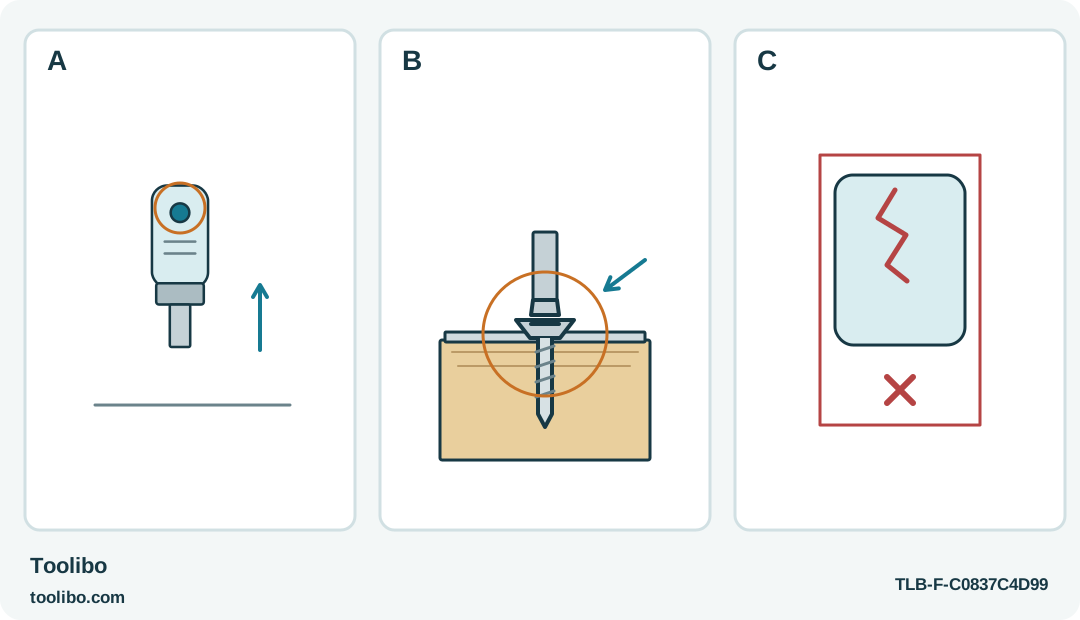
A · No response before contact
A silent tool clear of the work calls for the exact model’s permitted external setup and charge checks.
B · Stop during fastening
A stop during fastening first calls for inspection of the bit, screw, seat and joint.
C · Damage or recurrence: stop
Damage, abnormal heat, smell or a recurring fault ends owner-level trials; arrange appropriate service.
Owner-level triage only. The drawing contains no electrical probing, internal repair or bypass procedure.
Stop pressing and separate the symptoms
A driver that is silent before touching a screw presents a different problem from one that stops while tightening. Repeatedly operating the control can hide that distinction and damage a resisting fastener. Release the switch, move the tool away from the work and note what happened: no response at all, a brief response, a stop near the seat or a stop accompanied by heat, smell or damage.
Do not continue testing a tool with smoke, an unusual smell, a distorted battery, liquid entry, a damaged cable or an unreliable stop control. Keep it out of use and follow the manufacturer’s service guidance. This procedure covers safe external owner checks, not internal electrical diagnosis or battery repair.
Make the workpiece safe before inspecting the tool. Support any fitting that has become loose and keep hands away from the bit and screw path. Remove the battery where applicable before changing accessories or investigating the fastening.
Check the intended operating condition
First identify the actual model. Similar-looking drivers can have different locks, start controls and charging behavior. Check that a lock has not been left engaged, but do not defeat it or hold it in an improvised position.
On the SD561201, the direction selector also starts the motor, and the tool does not run while charging. Disconnect the charging cable after charging is complete before expecting normal operation. Do not diagnose that designed charging behavior as a faulty motor.
On the Milwaukee 2101-20, verify the M4 battery’s insert-and-turn locking arrangement. A partially engaged battery can prevent operation. Remove and refit only the correct, undamaged pack according to the instructions; forcing a connector or trying an M12 battery is not a test.
For the DF012D, check the documented battery condition and controls. A low battery can interrupt operation. Keep charging and battery replacement within the specified system rather than experimenting with another pack that happens to fit loosely.
If the tool is silent, inspect the external chain
- With the tool safely stopped, check the correct control and lock positions for that model.
- Inspect the tool and battery externally for visible damage. Stop if a component is cracked, distorted or wet.
- Check the documented charge indicator and use the correct charging equipment if charging is required.
- Confirm proper battery seating on a removable-pack tool, without forcing it.
- Once the normal setup is restored, make only a brief safe check with the bit clear of the work and people. Stop if the response remains abnormal.
A known working household outlet can be checked using an ordinary intact appliance if appropriate, but do not open outlets, probe them with the driver or perform electrical repairs. The presence of a voltage-sensing feature on a tool does not change that boundary.
If the external checks do not restore normal operation, record the model and symptoms for support. A description such as “the indicator lights, but the motor does not respond with the cable disconnected” is more useful than repeatedly trying the same screw.
If it stops in the screw, inspect the joint first
A stop near the intended seat may be the clutch doing its job. Release the control and inspect the fitting. On a DF012D clutch-controlled setup, release the switch after the clutch stops the motor. Do not repeatedly trigger it to force an already seated screw deeper.
A WX240L can stop because of charge state or an unsuitable torque selection, but check the fastener and work before changing the level. The screw may be the wrong length, angled, blocked or damaging the hole. More torque is not the first response to an unexplained stop.
Check whether the bit has slipped or the recess is damaged. If so, stop powered work until the bit/fastener problem is resolved. A screw that spins without tightening is also a joint problem; increasing motor effort will not restore lost material.
On the Milwaukee, keep gear and clutch restrictions in mind. In high gear, automatic shutoff may not work above clutch position ten. Do not move between gears and high clutch settings while expecting identical stopping behavior.
Decide whether another trial is justified
Before retrying a screw with the SD561201, check the application as well as the control. Its listed powered softwood application uses self-tapping screws no larger than ST3.5; the steel-plate entry requires threaded mounting holes and machine screws no larger than M6. Unlisted screws are for manual, non-powered use. A recovered motor does not make an unsuitable fastening suitable.
Retry only after finding and correcting a straightforward permitted cause, such as a control left locked, a correctly recharged battery or a safely corrected work alignment. Use a supported sample or a clear no-load check as appropriate, not a damaged finished joint as a test bench.
Stop if the symptom recurs, the tool becomes abnormally hot or the control is unreliable. Do not keep charging a damaged battery, open a housing, short contacts or bypass protective behavior. A replacement screw or a different fastening method may solve a workpiece problem; a service provider may be needed for a tool problem.
Write down what was checked and what changed. That small record helps distinguish a repeatable tool fault from one damaged hole in a project, and prevents the next attempt from starting with the same unhelpful cycle of pressing harder and hoping the motor will recover.
Models referenced