
Check feed, readiness and output without force
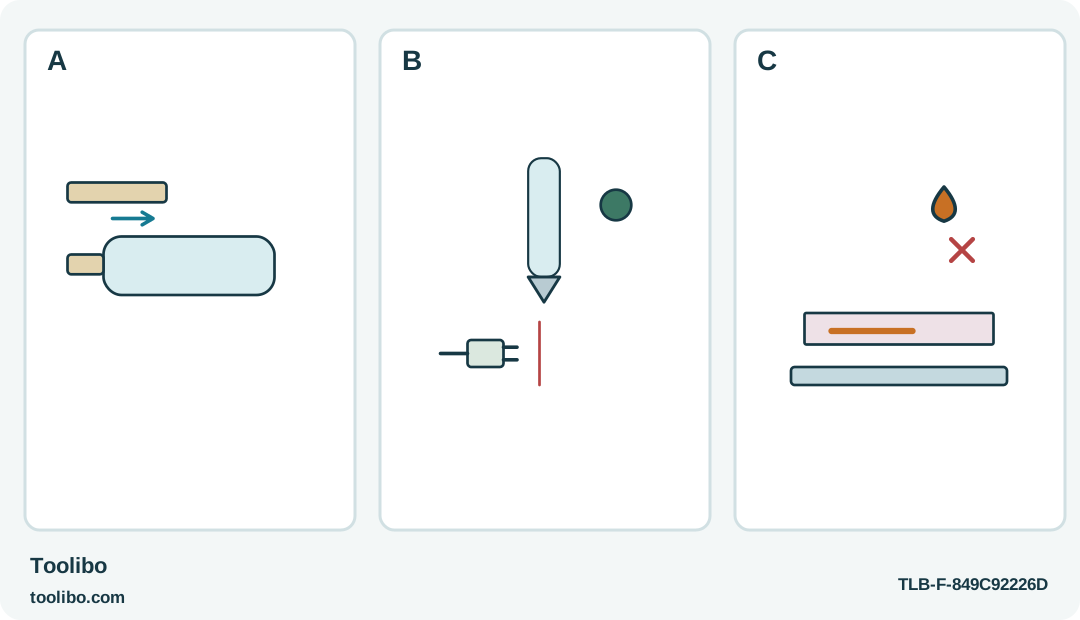
A correct new stick beside a short remainder, disconnected ready pen and small scrap output with a crossed abnormal-leak cue show the external checks.
A
A consumed short remainder may need the next correct stick through the normal rear feed, never a rod or backward extraction.
B
Confirm charge, disconnected charging lead and completed warm-up before testing with moderate pressure.
C
Use a small supported scrap bead only if setup is sound. Resistance or backflow ends the attempt; do not force or probe.
A correct replacement stick and completed warm-up can resolve ordinary feed conditions, but backward leakage ends the check.
Stop the squeezing and describe the failure
“No glue” can mean several things: the trigger moves but nothing emerges, the trigger resists, a short tail remains in the feed, or glue escapes backwards instead of reaching the tip. Those are not interchangeable symptoms. Stop feeding and put the pen safely down before deciding what to check. Repeated hard squeezes can make a wrong-stick problem worse without identifying it.
Keep the nozzle pointed away from people and animals and protect the bench beneath it. If the pen has been running, its silicone covering and hot end are not safe to grip. Switch off and allow it to cool before inspecting the accessible rear feed area. Do not pull the existing stick backwards to find out how much remains.
This routine is for the identified Bosch GluePen and its recommended adhesive system. It does not include removing a nozzle, opening the body, bypassing a heater or using a second heat source to clear an imagined blockage.
Check what has actually been loaded
Find the stick packaging. The matching GluePen uses recommended 7 mm sticks, normally supplied in the specified 150 mm length. A stick described merely as “mini” is not enough information. Diameter, adhesive type and suitability for this tool all matter; do not sand down a large stick, wrap a small one or substitute liquid glue.
Check whether the loaded stick has been consumed to a short remaining portion. The normal remedy for a used-up or too-short stick is to introduce another correct stick through the normal feed, not to reach into the tool with a rod. Keep loading pressure controlled and follow the ordinary insertion direction.
If the stick falls out easily or adhesive has appeared at the rear, stop the test. Those observations can accompany an unsuitable consumable. Do not try to retain it with tape or force it past the feed. An already loaded wrong adhesive may require manufacturer advice rather than an improvised extraction.
Establish charge and readiness separately
Charge the pen with its specified arrangement if needed, then disconnect the charging lead before use. The GluePen cannot operate while charging. That intentional behaviour must be ruled out before interpreting lack of flow as a mechanical defect.
Switch on over a protected work area and watch the indicator. Allow the flashing warm-up indication to reach its steady ready state. Do not use trigger resistance as a thermometer by repeatedly pushing throughout heating. A ready indication and a correct stick are prerequisites for the next small test, not a guarantee that every feed problem has been solved.
Prepare a piece of matching scrap on a heat-resistant silicone mat. Keep hands out from behind thin or porous material. Move any valuable work away; the first application is a functional check, not the moment to resume a partly finished decoration.
Try a small, even feed
Apply moderate, steady pressure and observe the output. If a normal bead appears, stop feeding before lifting the pen away and allow the sample to cool. Check whether the flow stayed even rather than judging only the first drop. A short controlled test tells you more than a large waste pile of adhesive.
If the trigger becomes hard, the flow remains irregular or glue returns toward the rear, stop. Do not press harder simply because the indicator is steady. Recheck the exact stick identity and the operating state, but do not repeat the same failed attempt over and over.
Never insert wire, a needle or a screwdriver into the nozzle. Do not use compressed air, solvents or an open flame to clear it. These actions do not belong to the normal owner checks and can create a new burn, electrical or equipment-damage hazard.
Decide whether to resume or seek help
Resume the real project only after the tool gives an ordinary controlled sample with the correct adhesive and no abnormal behaviour. Rehearse the joint again if the interruption has changed the materials’ position or exposed them to dirt. A recovered flow does not repair a bond that already cooled before it was assembled.
For a persistent problem, note the model, adhesive packaging, whether charging was complete, the observed LED state and whether the symptom was resistance, no output or backflow. That description is useful for service without opening the tool. Switch off, cool fully and leave inserted glue in place for storage; the safe endpoint of unsuccessful troubleshooting is a stopped pen, not a forced feed.
Models referenced