
Retreat from a developing hazard
A person moves away from a smoking pack; a lower isolated setup remains separate from a crossed-out suspect battery.
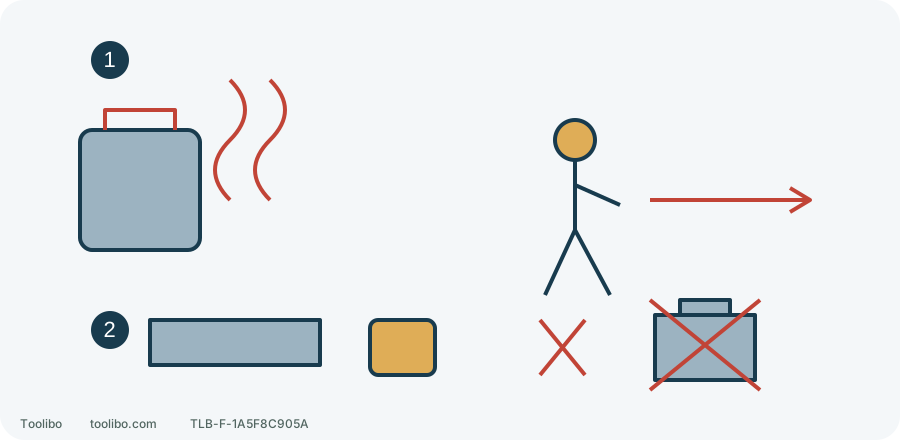
1. People first
Keep clear of smoke and worsening heat; use emergency arrangements.
2. Stable shutdown only
Isolate only when safe; recurring heat or damage means no use or charge.
Upper scene: do not approach to remove or carry. Lower scene applies only to stable equipment safe to handle; cooling does not clear a suspect pack for charging.
A developing incident takes priority
Smoke, flame, leakage, abnormal hissing or rapidly worsening heat is not an ordinary inspection. Do not pick up the tool to remove its pack or carry it outdoors to save a surface. Keep people away, avoid fumes and preserve an exit route. Call local emergency services for fire or a developing incident and follow their directions.
Do not prioritize model numbers, videos or blink counts. Do not touch unsafe components merely to disconnect them. This is not a firefighting, cell-opening or hazardous-battery transport procedure; the site’s emergency arrangements come before repair.
Stable equipment may permit ordinary shutdown
If equipment is only unusually warm, stable and safe to approach, release, wait for full standstill and stop the current job. Remove the battery only when safe and permitted by its instructions. Repeated bare-hand contact is not calibrated thermometry, and “too hot to touch” is not a universal acceptance threshold.
Allow natural cooling in a manufacturer-permitted environment, away from sun, hot vehicles and combustible clutter. Do not use immersion, a refrigerator or freezer, bypass protection or test-charge a suspect battery. Cooling stops further heat accumulation; it does not repair damage.
Record the area already noticed: motor housing, grip area, whole pack or connection area. Do not run again to find a hotspot or approach unsafe parts. Location helps support understand the event without identifying an internal failed component.
Review four aspects of the preceding job
Swipe or scroll horizontally to see all columns.
| Aspect | External information | Response |
|---|---|---|
| Accessory/material | Dull or damaged cutter, suitable type and size | Replace unsuitable accessories while isolated, not with more pressure |
| Load/settings | Repeated stalling, side loading, full gear engagement | Identify resistance first; adjust stopped, never force restart |
| Continuous duty | Fresh pack immediately following heavy use | A fresh battery does not cool the motor; arrange a break |
| Ventilation/environment | Visible blocked exterior vents, excessive ambient heat | Permitted external cleaning and suitable environment |
These are clues, not proof that the pack is undamaged. Clearing dust does not cancel swelling or odour. Treat simultaneous problems separately; an unexplained event is not permission for another heavy-load trial.
Read the exact model’s indication
North American DS18DEX/DV18DEX manual C99268561G Table 9 lists tool-light temperature protection as on 0.5 second/off 0.5 second, requiring thorough cooling of tool and battery. It is not a charger code or universal brand convention.
That manual also calls for about 15 minutes of tool rest when replacing a pack after continuous wood-screw driving. This does not make 15 minutes a universal thermal-reset timer or authorize reuse of a deformed or odorous pack. Routine duty breaks and suspect-battery decisions are different paths.
Cooling does not resolve every cause
Only absence of damage/suspicion, an identified corrected cause and satisfied tool/battery recovery conditions justify full preparation. Keep your finger off the trigger before reinstalling and securing a compatible pack. Stop immediately if abnormality returns during normal use; do not repeat trials.
Recurring abnormal heat, swelling, cracks, discoloration, odour or leakage keeps the affected component out of use and charging pending manufacturer advice. A cool case does not remove these restrictions. Report model, accessory, material, duty and observed symptoms without reenactment.
Do not put damaged batteries in ordinary garbage or recycling. Ask the manufacturer or appropriate local collection service about acceptance and transport rather than mailing as an ordinary parcel. Tell other users it remains unavailable so cooling is not mistaken for charging clearance.