
Read the 3403/3404 tool gauge
Four and eight counted pulses beside one lit gauge segment; a separate hot-pack symbol has no invented pulse count.
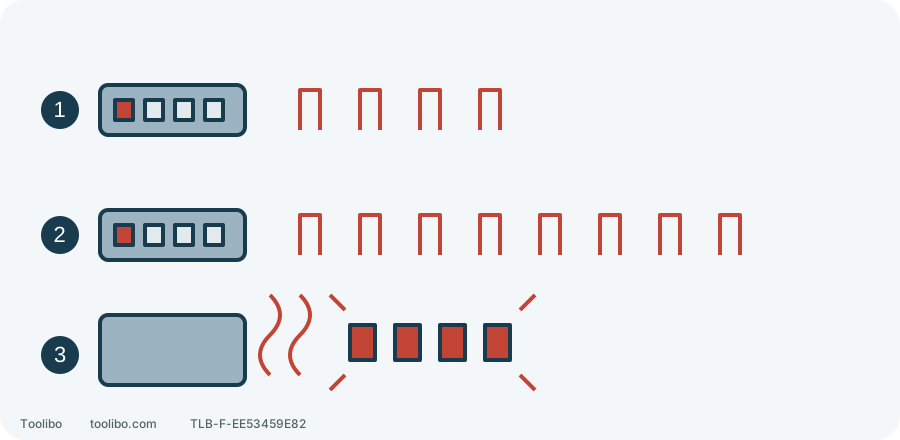
1. Four flashes
One gauge segment: less than 10% charge.
2. Eight flashes
One segment: end of charge; tool will not run.
3. Hot pack
Gauge lights flash and the tool will not run; no count is specified here.
Static explanation of already observed tool indications, not charger codes or an instruction to reproduce shutdown. Pulse spacing is not a time scale.
Decide whether further checks are safe
For smoke, leakage or persistent abnormal battery heat, do not approach to remove, charge or swap packs for another trial. Move away and follow emergency arrangements. Cracks, burns, water ingress or obvious impact damage also mean stop using. This covers stable removable-battery drills safe to handle, not internal circuitry, terminal probing or pack repair.
Record the existing symptom: a blocked trigger, no response or lights without rotation. Do not repeatedly recreate it for a video. A drill stopped with a bit trapped in work belongs to a loaded-stop procedure, not an unloaded start test.
A blocked trigger may be centre lock
On Milwaukee 3403-20/3404-20 the centred direction switch locks the trigger normally. Release, confirm standstill and remove the battery before checking position. Select the required direction fully by the model markings, never halfway or while pressing the trigger.
Restored trigger movement removes only that setup cause; battery and work preparation remain. A stuck or unstable selector, or a trigger still abnormal away from centre, requires inspection. Do not spray lubricant, wedge the control or remove the lock mechanism.
Retention and charge are separate checks
With the pack removed, inspect visible latches, guides and contact surroundings. Obstruction, distorted housing or broken latches can prevent reliable fit. No metal probes, sanding or bending terminals. Visible damage ends the check.
Keep your finger off the trigger before inserting a sound compatible pack, then install it by the instructions until secured. Gently verify it will not withdraw by itself. A pack that works only when held in place is unusable. Latching does not prove charge, and a gauge does not prove latching; record both.
Read the 3403/3404 fuel gauge correctly
This table is only for these tools’ fuel gauge, not charger lights or other models. Prefer indications already observed, not repeated energizing of abnormal equipment.
Swipe or scroll horizontally to see all columns.
| Observed indication | Meaning | Next action |
|---|---|---|
| One light flashes 4 times | Less than 10% charge remains | Arrange correct charging, not a motor-failure diagnosis |
| One light flashes 8 times and tool will not run | End-of-charge indication | Remove a sound pack and charge by its charger instructions |
| Gauge lights flash when the battery is too hot and tool will not run | Temperature protection | Stop and let a sound pack cool normally; no universal blink count or waiting time |
| No match or no indication | No reliable single-cause diagnosis | Review lock, retention and pack condition; service if normal checks fail |
Do not ignore temperature protection by swapping batteries for more heavy work; the tool may need rest too. Smell, deformation or worsening abnormality leaves the ordinary-cooling branch.
Confirm recovery only after a normal cause is corrected
Only an identified correction, such as leaving centre lock or properly charging a sound pack, justifies preparing one normal function check. Verify sound accessory, correct retention, clear area, clamped work and suitable task. Install the compatible battery securely before normal operation. Do not free-spin an unsuitable long bit at high speed as a start test.
If it still will not run, makes new noise or stops again, end the trial. Supply tool/pack models, indication, lock and latch results and correct-charge history to authorized service. A useful record is “3403-20; one light 8 times; direction fully selected; latch sound; still no operation after charging,” rather than claiming the battery must be good. Temporary recovery alone does not prove a fault repaired.
Models referenced