
Decide whether the task needs to generate this dust
Bare wood is not harmless dust. Identify species, treatment/coating, planned area and other people nearby. Unknown coatings, treatment history or suspected hazardous substrates need assessment before using an ordinary bare-wood plan.
If correctly sized and finished material is available, do not leave major preparation to a sander unnecessarily. For substantial joint steps, consider suitable machining rather than prolonged sanding instead of proper flattening. Handwork may reduce some dust generation but does not automatically remove control requirements.
Choose a dedicated area away from eating, living and other people’s routine activities. A fan blowing dust through a doorway, toward neighbours or another workstation only moves the problem.
A completed plan should reveal what remains unconfirmed
This is a planning example for six new, uncoated, preservative-untreated pine shelves in a separate woodshop. It is not a completed test or permission to start.
Swipe or scroll horizontally to see all columns.
| Plan item | Example arrangement and acceptance check |
|---|---|
| Material and task | Keep supplier information; confirm untreated solid wood; prepare defined faces for coating without mixing in reclaimed or painted boards |
| People and space | Exclude others during work; bench, extractor and cleanup stay in the shop; move shelves out after cleanup |
| Mechanical connection example | DWE6423 with DWV010, DWV9316 AirLock hose, two DWV9330 filters and DWV9402 bag; install correctly, not with taped joints |
| Still to establish | Extraction capacity, respiratory protection and other controls needed for this location/task; complete applicable DWE6423 starting/stopping instructions, not another model’s sequence |
| During work | Watch abnormal escape at joints, exhaust and work, plus equipment indicators; pause when problems appear, not after all six boards |
| Finish | Complete appropriate vacuum cleaning, bag/filter handling and disposal within the controlled area before storing tools |
Product names do not complete the checklist. Without answers in the unconfirmed row, this example cannot start. Mechanical compatibility and exposure control are separate acceptance questions; neither replaces the other. Other machines do not inherit this combination.
Before starting: follow the dust route
Only with stable equipment safe to approach, switch off, wait for complete stop and isolate relevant power. For fire, smoke, electrical or battery danger, move away and seek help first. Inspect and fit abrasives, connectors and filters while isolated.
- Start with the abrasive: verify shape, accessory compatibility and alignment with pad dust passages. Do not make unauthorized holes or cuts for extra airflow.
- Follow outlet, fittings and hose to collector. Seat joints correctly; avoid pinching, damage and blockage, and prevent end-of-travel hose pull.
- Check required filters, bag, seals and secured head. In the DWV010 dry configuration, install both DWV9330 filters and the appropriate bag correctly. A bag without filters is not the same configuration.
- Use the maker’s indicators and checks, not an invented “sounds loud enough” standard. Complete needed competent assessment, respiratory-protection selection and tight-fitting-mask fit testing before starting, rather than filling gaps with a randomly chosen mask.
After static preparation, confirm switches OFF, then restore power, activate extraction and operate under exact-model instructions. Without a clear applicable start/stop procedure, remain at static preparation; do not experiment powered.
During work: reasons to pause
A loose connection, clear loss of extraction, continuing dust at the exhaust or an alarm warrants stopping. In otherwise safe conditions stop as instructed, wait for motion to cease, isolate power and check connections, blockage, bag capacity and filters. Do not disconnect a running hose and reach inside, or hide the issue with speed or pressure.
Changed material or scope, such as an unknown underlying coating or treated wood, requires reviewing the plan. Crowding, someone entering or dust spreading elsewhere also need attention before finishing the job.
After correcting a specific blockage, recheck assembly and controls. Continue only without danger signs or unexplained faults and while the plan still applies, using the same OFF confirmation and reconnection sequence. No visible dust is an observation, not an air measurement.
Cleanup: do not release collected dust again
- Complete normal shutdown/isolation and organize equipment within the controlled area. Do not carry dusty tools or clothing into living areas to shake them out.
- Use industrial cleaning equipment appropriate for wood dust and site hazards on benches, supports and floors. Do not dry-sweep or use compressed air on tools, clothing or floors. UK HSE woodworking guidance specifies suitable industrial vacuum equipment of at least Class M; that classification is not automatically a certification for models in other regions.
- Follow the exact collector’s shutdown, isolation and bag-changing procedure, maintaining required personal protection. Do not repeatedly empty collection bags like open waste sacks, compress dust into clouds, or mix in sparks, cigarette ends or incompatible waste. Follow material and local requirements for closure and disposal.
- Follow model-specific filter care. DWV010 filters must not be brushed or cleaned with compressed air; another maker’s soft-brush instruction does not transfer. Where its applicable washing procedure is used, follow it and its complete-drying requirement. Do not use before restoring the correct configuration.
- Record leaks, bag changes, filter maintenance and unfinished checks for next time. Confirm planned cleanup, not merely that tools are back in a cupboard.
Repeated workplace use needs suitable continuing checks, exposure assessment and occupational-health arrangements determined by competent people. Stop work and obtain medical advice for respiratory discomfort or other health concerns. This checklist neither diagnoses a cause nor certifies an individual’s exposure.
Capture at the tool and avoid raising settled dust
The connected route and cleanup nozzle are concepts, not a certified equipment combination or proof of safe exposure. Select the complete controls for the actual task.
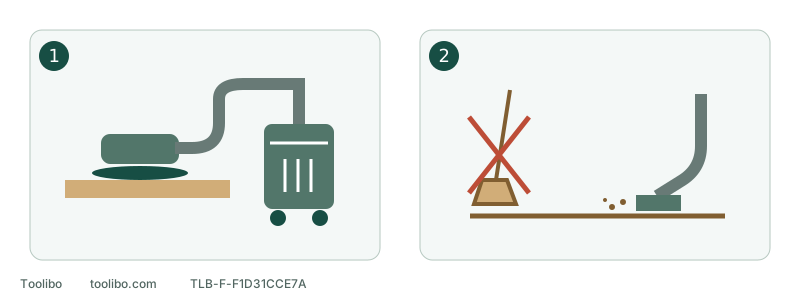
1. Follow the source-capture path
Check abrasive passages, joints, hose, filters and collector before operation.
2. Clean without spreading dust
Use suitable industrial vacuum cleaning, not dry sweeping or compressed air.
The connected route and cleanup nozzle are concepts, not a certified equipment combination or proof of safe exposure. Select the complete controls for the actual task.
Models referenced