
When should you stop before trial sanding?
Unknown coating or substrate, knowledge of only a recent topcoat, or uncertainty about earlier layers is insufficient for ordinary power sanding. New paint does not identify every layer beneath it, and an intact-looking surface does not establish safety when disturbed.
In the United States, lead paint in pre-1978 homes warrants particular checking. Building age is a risk clue, not a material test. Elsewhere use local qualified assessment routes rather than treating a US date as a worldwide safety threshold. A later date does not replace identifying other coating or substrate hazards.
Do not sand a window into the layers to inspect colour, or identify composition by smell, hardness or a photograph. That trial already generates dust requiring assessment.
Prepare the information an assessor needs
Use existing records and observations possible without disturbing the surface. Do not scrape, drill or sand to fill blanks. “Unknown” is useful information, not an invitation to verify with a machine.
Swipe or scroll horizontally to see all columns.
| Item | Known information to provide | What may remain unknown |
|---|---|---|
| Location and extent | For example one old wooden window, proposed work on its room-facing side | Whether adjoining walls, joints or deeper layers are involved |
| Age and history | Documented construction/renovation dates, coating names and receipts | Earlier layers’ age and materials |
| Coating and substrate | Materials, layers and areas covered by existing reliable reports | Only the topcoat known; underlying layers and substrate unassessed |
| Proposed task | Repainting preparation, intended removal area, whether work has started | Final method undecided; power sanding not approved |
| Previous disturbance | Where, when and what happened; possible dust spread | Anything unmeasured or unconfirmed |
For example: “An old-house wooden window; recent topcoat has product records, underlying layers unknown; no sanding yet; repainting planned.” This is more useful than assuming it looks like ordinary water-based paint.
Find the right service, not just a test strip
US users can start with the EPA qualified-firm lookup information. For lead determination, specifically ask about a certified lead inspector or risk assessor; renovation certification and testing roles are not identical. Elsewhere find corresponding local assessment and qualified-work services.
On the EPA website search “How can I find a certified renovation firm in my area” and open its certified-firm lookup. Follow the relevant state or local authority route where indicated.
Explain the recorded area, proposed disturbance and any work already done. Confirm whether the service covers material inspection, risk assessment or subsequent work. A single negative result not covering all affected layers, substrates or other suspected hazards cannot approve unrestricted sanding of the whole item.
What do an ordinary sander and dust accessories establish?
A tool intended for some painting preparation is not automatically a hazardous-coating removal system. The relevant DCW210 and DWE6423 instructions warn about lead-paint sanding risks rather than presenting ordinary dust accessories as a solution; their application limits also exclude drywall. A generic dust-hazard list is not permission to work every listed material.
A bag, microfilter name, connector size and normal motor each address collection or mechanical questions. They do not establish suitable containment, filtration, personal protection and cleanup for the material. A stronger vacuum does not bypass assessment.
Do not convert a dry-use power tool to wet sanding, or switch without assessment to heat guns or chemical strippers. Different methods introduce their own hazards and limitations, not an automatic answer to unknown material.
If sanding has already happened
Stop further disturbance and keep others out of the potentially affected area. Only where safe to approach, stop according to the applicable procedure, wait for motion to cease and isolate power. With simultaneous fire, smoke, electrical or battery danger, move away and seek appropriate assistance instead of risking operation.
Do not dry-sweep, use compressed air or vacuum unknown contamination with an ordinary household vacuum. Avoid moving dusty tools, clothing or packaging into other rooms. Obtain material- and location-appropriate cleanup, protection and disposal advice before cleaning; this is not a hazardous-material removal recipe.
Tell the assessor what has already happened; do not restart for a better demonstration. For symptoms or immediate health concerns, contact appropriate medical or emergency services. Exposure and response need professional judgment, not decisions based on dust colour or normal smell.
What must be established before tool preparation resumes?
Confirmed material, area and depth must match an approved method, collection/containment, personal protection, cleanup and disposal arrangement. Ensure the actual workers have those requirements, not merely a verbal claim that testing was fine.
Only when assessment allows ordinary sanding and the exact tool and complete controls fit should you return to abrasive, workholding and operating preparation. Permission does not automatically cover another window face, adjoining wall or newly exposed layer. Stop to reassess changed scope.
Do not trial-sand first. Prepare verifiable information and obtain an applicable plan so that dust has not spread elsewhere before the answer arrives.
Keep unknown layers intact while preparing assessment
The layers represent an unknown coating stack, not a colour-based diagnosis. Record existing facts and photographs without scraping a sample or trial sanding.
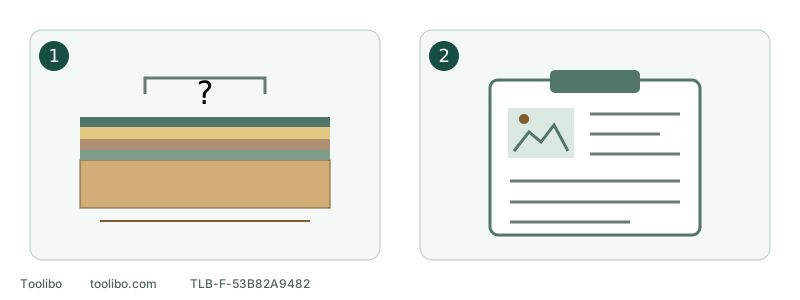
1. Leave the surface undisturbed
A known topcoat does not identify underlying layers or substrate.
2. Prepare an assessment record
Give the assessor location, history, proposed task and any disturbance already caused.
The layers represent an unknown coating stack, not a colour-based diagnosis. Record existing facts and photographs without scraping a sample or trial sanding.
Models referenced