
Identify what you will collect
This example is for identified ordinary dry wood suitable for sanding, not unknown old coatings, suspected lead/asbestos, burning debris, solvents, metal sparks or unassessed dust. Preservative-treated wood is not automatically ordinary wood dust.
For uncertain material, establish its origin, coating and safety information and obtain qualified assessment when needed. A HEPA label does not replace material identification, containment, respiratory protection or applicable requirements. Invisible dust is not proof of safe exposure.
A specific ordinary-wood setup
Swipe or scroll horizontally to see all columns.
| Component | This example | Check |
|---|---|---|
| Sander | US DWE6423 | Correct disc, extraction holes and condition |
| Extractor | DWV010 | Actual nameplate supply and Type instructions |
| Hose/connection | DWV9316 antistatic hose with original AirLock end | DWE6423 lists direct DWV010 connection; proper lock |
| Main filtration | Two DWV9330 HEPA filters | Sound, sealed and properly tightened |
| Dry collection bag | DWV9402 fleece | Securely fitted to rear of tank inlet without tearing |
The current US DWV010 contents list this hose, two filters and one bag. NA131184, DEC21, lists wood dust as an application and DWV9402 for wood-dust collection. Match replacement parts to the actual model/Type, not all extractors of the same brand.
Assemble filtration before connecting
Switch both machines off, wait for movement to stop and unplug both. These steps concern equipment containing known ordinary wood dust that is safe to handle. Do not open a tank with uncertain or hazardous prior contents to investigate it yourself.
- Inspect both main filters and seals for tears, distortion or damage. Align each filter thread with the head thread and turn clockwise with moderate force until tight; replace if condition is doubtful.
- Fit the correct DWV9402 bag securely over the back of the tank inlet without tearing it. A bag is additional collection, never a substitute for the filters.
- Refit the head and close the latches without trapping bag material or debris at the rim.
- Insert the hose end into the extractor inlet and rotate clockwise to lock; check cracks, blockage and crushing.
This is a dry-dust setup. Do not import wet-pickup filter-removal steps into sanding or collect dry dust with a wet tank or wet filters.
Connect the tool end
DWE6423 lists direct connection to DWV010. Put the matching AirLock collar in its unlocked position, push it onto the matching tool outlet and rotate to lock. Check normal retention; do not tape or force a mismatched connection.
DWV9000 is the listed alternative for other vacuum systems with 1-1/4-inch hoses, not an extra mandatory purchase for this supplied-hose example. A different extractor needs a fresh material/filter/bag check as well as a connector check.
After static checks, confirm tool switches are OFF before restoring power according to both machines’ requirements. For the tool-actuation outlet, separately verify its rating and the tool load; plug fit is insufficient. Confirm suction before beginning the sander’s normal operating sequence.
Stop when collection changes
Visible leakage, persistent loss of collection, hose detachment or abnormal sound requires stopping sanding and safely shutting down and unplugging before checking the bag, filters and air path. Automatic filter cleaning does not empty the bag or repair a torn filter. Do not continue in escaping dust.
Dispose of DWV9402 when airflow becomes restricted; do not empty and reuse it. DWV010 filter care is separate: its manual forbids compressed air and brushing because they damage the membrane. If cleaned by the permitted washing method, filters must air-dry fully and remain fit for use. Do not transfer this method to the differently maintained SKIL SR250801 microfilter.
Finish the purchasing list
Record material, sander, extractor/Type, hose/connector, filter quantity and part number, and bag number. Compare those with actual package contents. Buy the missing correct bag rather than duplicate connectors; resolve uncertain material or filtration before treating a larger or more expensive machine as the answer.
Connection outside, filtration inside
The schematic separates the hose connection from two main filters and an additional bag; it is not the extractor’s internal layout.
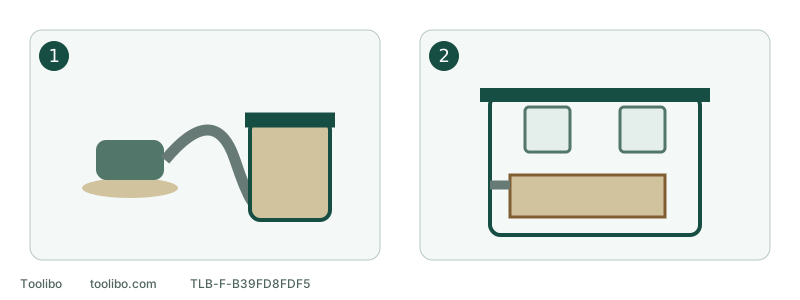
1. Complete the hose path
DWE6423 connects to DWV010 through the matching supplied DWV9316/AirLock arrangement.
2. Keep both filtration stages
Fit two sound DWV9330 filters and DWV9402 bag; the bag does not replace the filters.
The schematic separates the hose connection from two main filters and an additional bag; it is not the extractor’s internal layout.
Models referenced