
Length, area and volume conversion
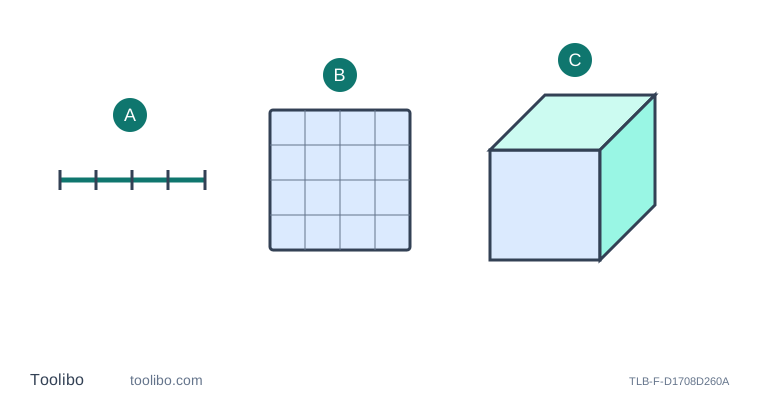
Original schematic: A length conversion changes one dimension. An area conversion changes two dimensions. A volume conversion changes three dimensions. Not to scale.
A
A length conversion changes one dimension
B
An area conversion changes two dimensions
C
A volume conversion changes three dimensions
Conceptual geometry only, not to scale. The diagram does not establish installation clearances or reproduce a manufacturer control layout.
Keep the original unit attached to the measurement
A number such as 2.40 is incomplete without a unit and a description of the measured quantity. Before starting a room, choose one unit for the raw measurements and write it on the worksheet. Confirm the meter’s actual display setting rather than assuming that it retained the setting from a previous job. Different models use different controls for units, so follow the exact instrument’s instructions.
If you transfer values to software, check the receiving field as well as the meter. A correctly transmitted number can still be interpreted in the wrong unit. Preserve at least one simple test measurement in both places before collecting a full survey. When a supplier requests another unit, make a deliberate conversion from the original record instead of changing settings repeatedly and leaving an unlabelled mixture of numbers.
Apply the conversion factor to the kind of quantity
For a hypothetical floor 2.40 m by 3.60 m, the area is 8.64 square metres. Converting the two lengths into another unit and multiplying them should agree with converting the area using the corresponding squared conversion factor. Applying a length conversion factor just once to an area is wrong, even if the result looks like a plausible room size.
The same distinction extends to volume: the factor is cubed when all three dimensions change unit. Keep length, area and volume in separate fields. A square-metre result is not a long distance, and a cubic-metre result is not a floor area. If a recalled value’s unit or function is unclear, return to the identifiable raw dimensions rather than deciding what it means from its numerical size.
Delay rounding until you know what the result will be used for
Retain the original displayed measurements in the working record, while recognising that displayed digits are not a guarantee of equivalent real-world accuracy. Do not remove useful digits from every input merely to make arithmetic easier. Small rounding changes can accumulate over several walls or change a calculated area. At the same time, do not present an estimate with excessive precision that implies the room boundary is known more accurately than it is.
Keep three stages distinct: the recorded measurement, the calculated geometric quantity and the purchase quantity. For flooring, the measured area might remain 8.64 square metres in the worksheet, while the order must use whole packs and an appropriate layout allowance. For paint, coats and coverage enter after the wall-area calculation. Rounding the final order to available package sizes is not a correction to the original room dimensions.
Check conversions with a reverse calculation
After converting, convert a sample value back to the original unit and compare it with the starting record. A major difference can reveal an incorrect factor, a decimal error or confusion between centimetres and metres. For an area, also compare the result with a rough bounding rectangle. These checks do not calibrate the instrument, but they help catch mistakes introduced after the measurement was taken.
When a supplier’s form asks for millimetres, enter the converted length in the requested format and confirm whether decimals are accepted. Do not assume a form uses the unit shown in a photograph or a previous order. Likewise, a drawing imported into software may use a different scale or unit convention. Verify one known dimension after import before treating the whole drawing as correctly sized.
Keep the source value and the conversion visible when handing the work to someone else. If a number is revised, identify whether the cause was a new measurement, corrected arithmetic or a changed ordering allowance. Those are different changes and should not erase each other’s history. For final fitted parts, follow the supplier’s required measuring method and tolerance convention rather than inventing extra decimal places. Keep laser use safe and external: never aim at eyes, people or optical instruments, and do not modify the instrument to resolve what is actually a unit or arithmetic problem.
Models referenced