
A short history is not a complete worksheet
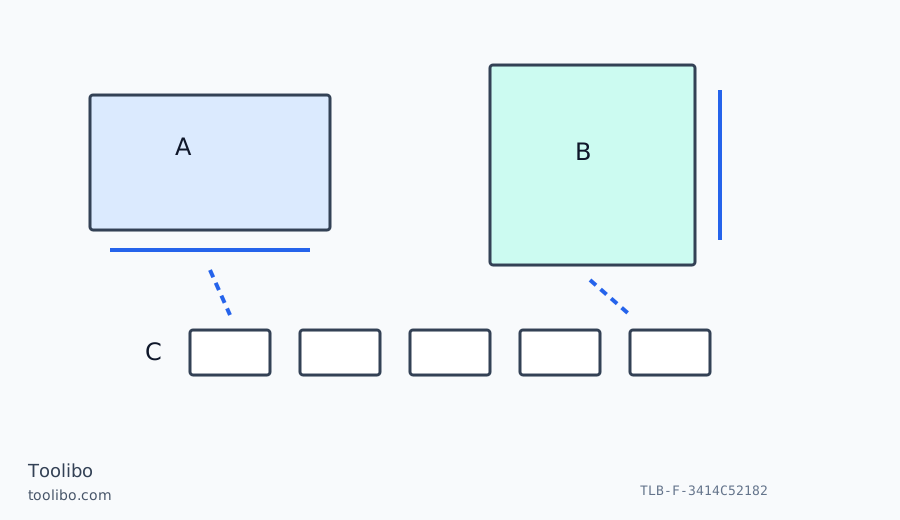
Separate floor and wall rectangles feed a worksheet while five small result positions form a temporary history beneath them.
A
Keep the floor inputs with their calculated area.
B
Keep the wall calculation as a separate entry.
C
Use the five-result history only when the result can be identified.
Length inputs and calculated areas have different meanings; a recalled value must be identified before reuse.
Treat memory as a temporary buffer
Makita New Zealand lists the LD050P with memory for the last five displays. Its Area/Volume/Pythagoras/Memory control serves several modes, while a separate Reference/Unit control changes the measurement setup. Check the displayed mode instead of assuming the previous operation has finished. Regional package contents and commercial terms can differ. A short history is convenient for recovering a missed note, but it is not a room survey database.
Before measuring, write the room name and a numbered list of surfaces. Take one distance, read the unit and record it against its number. If interrupted, recover a value only when you can identify the physical span it belongs to. Several plausible numbers without labels are not a reliable record.
Separate a result from its ingredients
Area and volume modes produce calculated results. Record the lengths used as well as the result, so a missed target can be traced. Do not assume every recalled display represents an independent wall length. When checking an opening, return to direct distance measurement and confirm the reference symbol before the next shot.
The manual distinguishes front and rear references. For wall-to-wall work, the selected reference must be the part touching the wall. For a tabletop edge, a different reference may be practical. After changing the setup, repeat a known span; do not carry a remembered correction from the previous room.
Make interruption recovery deliberate
If someone asks a question halfway through the survey, stop the laser and mark the last completed item. Resume from that mark, not from an uncertain recollection of the button sequence. A duplicate labelled reading costs less than an unlabelled gap in a kitchen plan.
Finish by checking that every sketch dimension has a value and every stored value has a purpose. Missing or unstable readings should be retaken on a suitable opaque target. Do not open the instrument or aim at eyes, people or optical aids. Memory cannot establish structural safety, installation tolerance or permission to cut a fitted component.
Audit a mixed length-and-area record
Consider an illustrative worksheet, not a tested room: a floor length of 3.20 m and width of 2.50 m produce an area of 8.00 square metres. A separate wall length of 4.10 m and height of 2.40 m produce 9.84 square metres. These six worksheet entries have different meanings. They are not six interchangeable distances, and the instrument’s five-result memory cannot be treated as a complete archive of the worksheet.
Write the floor’s two inputs and calculated area together, then start a separate wall entry. Mark the unit beside every value. If you later recall 8.00, first establish whether it is an area result or an unrelated length. Check the function and unit shown with the recalled result against the worksheet. Do not turn an area into a length merely because its numerical value looks plausible for a long room.
This example does not claim that the meter stores every intermediate input or that the six entries appear in a particular recall order. Follow the actual memory display and the matched instructions. If you cannot identify what a recalled value represents, remeasure the named span or repeat the area calculation from identifiable inputs. Guessing its position in a sequence is especially unreliable after someone has taken an extra measurement.
Suppose the wall area looks wrong. Check the recorded 4.10 m and 2.40 m inputs individually before replacing the total. One may have ended on furniture rather than the intended wall or ceiling. Correct the affected input, recalculate the area and mark the revised entry. Keep the original floor calculation separate: a correction to the wall does not justify changing the floor. This small ledger makes the memory useful as a recovery aid while leaving the project record understandable even after the meter is switched off or its recent history changes.
Models referenced