
A short gap and instrument access
Original schematic: The housing may obstruct the intended start. A short target distance may be unsuitable. A direct ruler can define both contact points. Not to scale.
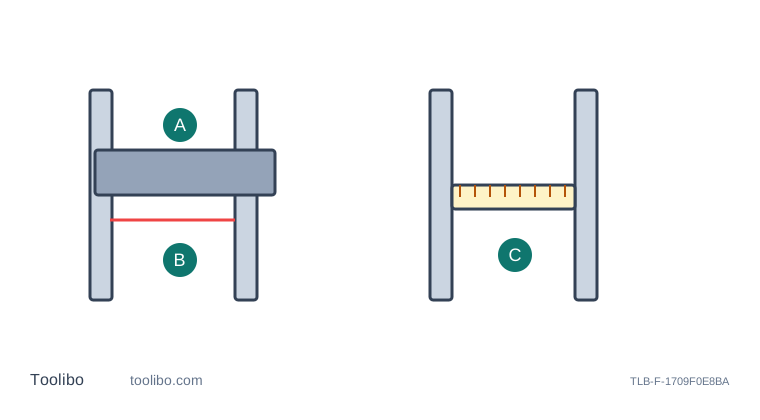
A
The housing may obstruct the intended start
B
A short target distance may be unsuitable
C
A direct ruler can define both contact points
Conceptual geometry only, not to scale. The diagram does not establish installation clearances or reproduce a manufacturer control layout.
Check the lower limit and physical access
A laser meter’s maximum range attracts attention, but a shallow recess can be limited by the minimum measuring distance or by the space needed to position the instrument. Read the exact regional model’s instructions and product data. Do not import a minimum-range figure from another region or a similar-looking model. The selected LD030P records, for example, are kept region-specific rather than merging every online listing into one specification.
Even a gap within the stated range may be awkward if the housing cannot sit at the intended starting point or the outgoing beam clips an adjacent edge. Decide where both endpoints actually lie. If the case blocks access to one of them, a longer advertised range does not solve the problem. A tape, ruler, suitable gauge or physical template may provide a more direct and understandable measurement.
Match the method to the feature
Consider the short return beside a window frame. The useful dimension may be from the finished wall face to the frame, not from whichever edge happens to support the meter. A tape or ruler can often contact both intended surfaces without needing a distant target. Inspect the contact points and keep the tool aligned with the required direction rather than taking a diagonal across the gap.
For a furniture opening, a physical template can sometimes reveal a local obstruction that one distance misses. A screw head, hinge or curved corner may interfere even when the nominal width looks adequate. Do not force a template into the opening or treat flexible material as proof that a rigid final component will fit. The aim is to understand the geometry and choose a suitable final verification method, not to replace one ambiguous number with another.
Avoid extending the instrument’s capability by guesswork
Do not measure a longer convenient span and subtract an unrelated distance merely to avoid the minimum-range issue. Subtraction is valid only when the measurements share the intended line, reference and endpoints. Two distances taken at different heights or to different faces can produce a plausible result that does not describe the short gap. If you use a derived dimension, preserve the inputs and explain the geometry.
Similarly, a target placed behind the desired endpoint introduces an offset rather than making the original gap directly measurable. That may be workable in a carefully defined setup, but it can be more complicated than using a ruler. Do not add a guessed housing length or endpiece extension. A fixed rear reference cannot be turned into a front reference by an undocumented button sequence or a remembered correction from another meter.
Combine methods without disguising disagreements
On the worksheet, identify which dimensions came from the laser and which came from a tape or template. There is no requirement that one household tool measure every feature. Use the laser for well-defined spans where it is practical, and direct methods for small details. If two methods disagree, compare their actual endpoints and alignment before deciding that either instrument is defective.
For final fitted work, ask the supplier or installer how they want short clearances and local profiles checked. A planning width may not include the allowances needed for assembly, movement or finishing. Keep the measured opening separate from the manufactured size. Do not create a universal deduction simply because a previous shelf happened to fit after one was applied.
Keep all checks external and safe. Never aim at eyes, people or optical instruments, and do not peer into the laser window while trying to position the meter in a confined space. Do not open the housing or modify an endpiece to reach a smaller gap. Choosing a simpler direct method is often the most accurate way to describe a small feature, provided its contact points, alignment and limitations are understood. The goal is a reliable dimension for the task, not proof that the laser can be used everywhere.
Models referenced