
Clear external dust paths with power isolated · Diagram
Three separated components trace dust from the base opening through a hose to a downstream filter.
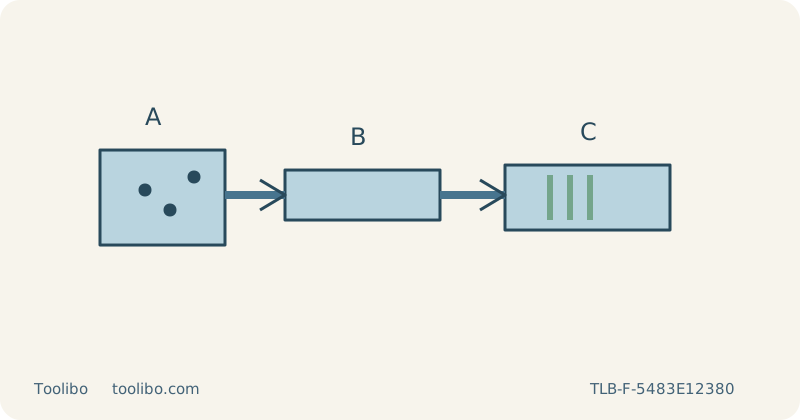
A
Inspect accessible openings
B
Check the disconnected hose
C
Follow the extractor manual
Inspect removable dust components and restore the model-specific extraction arrangement without opening the saw.
Separate a dirty path from a damaged tool
A dusty cut line does not necessarily mean that the extractor has failed. Dust can accumulate at the base opening, the removable attachment, the hose connection or the extractor itself. Check these accessible points systematically rather than immediately opening the saw. This guide covers external cleaning after cutting known, uncoated wood. It excludes internal repairs, unknown hazardous dust and any attempt to bypass a guard to improve airflow.
Stop if the tool has an electrical smell, a damaged housing or an accessory that will not remain attached. Cleaning cannot restore cracked parts or faulty switches. Identify the exact model before removing anything: a blower selector, a dust cover and an extraction outlet are different components, and not every jigsaw permits the same combination at every base angle.
Isolate both machines before disconnecting anything
Switch the jigsaw off and wait for the blade to stop fully before setting it down. Remove the battery or unplug a corded saw. Switch off and isolate the extractor according to its instructions before disconnecting the hose or opening a dust container. Allow hot components and the blade to cool. Keep power disconnected throughout the cleaning and reassembly checks, even if the obstruction looks easy to dislodge.
Work in a ventilated area and use appropriate respiratory and eye protection. Avoid spreading settled dust through the room. Do not blow debris toward your face or use a jet that drives dust deeper into the tool. Follow the manufacturer’s cleaning instructions for accessible openings, using an appropriate soft brush or compatible vacuum where permitted. Do not insert metal probes into the motor vents or blade clamp.
Follow the accessible route from front to rear
Inspect the base opening and removable dust components without reaching onto sharp teeth. Remove only attachments that the operating instructions identify as user-removable. On the Bosch GST 18V-125 models, bevel restrictions mean that a hood or extraction outlet used for a straight cut cannot simply be assumed suitable for an angled setup. Check the permitted configuration before reinstalling rather than forcing parts around the tilted base.
Inspect the disconnected hose for a visible obstruction and check its connection surfaces. Avoid pushing an obstruction into a smaller passage. If clearing the hose requires a procedure not covered by its instructions, consult the accessory maker rather than improvising with sharp objects. Check the extractor container and filter by its own manual; an apparently clear jigsaw outlet cannot compensate for a full container or an incorrectly fitted filter downstream.
Restore the correct operating mode
Reinstall permitted attachments securely with power still isolated. Check that the base is locked, the guard remains intact and the blade is correctly retained with its back located in the guide roller where required. Route the hose behind the saw with enough freedom for the planned cut. A firmly connected hose can still spoil control if its weight pulls the base sideways or its bend catches a bench edge.
For the RYOBI PSBJS01, choose the specified vacuum mode when using the dust attachment rather than assuming the blower position improves extraction. On the Bosch models, turn the blower off when extracting as the instructions specify. Do not transfer one maker’s selector wording to another tool. A light illuminating the line also does not prove that airborne dust is being captured adequately.
Verify on scrap and set a stopping boundary
Use a supported, clamped wood sample with independently supported waste and complete clearance beneath the blade stroke. Wear eye and hearing protection and suitable respiratory protection, and provide ventilation. Start with the base supported and the blade clear, establish speed, then make a short normal cut. Watch whether the line remains visible and whether the hose stays clear without pulling on the saw. This is a practical check, not a measurement of dust exposure or filtration efficiency.
Switch off and wait for a full stop before inspection, then isolate power before further changes. If blockage returns quickly, recheck the blade, feed and permitted extraction setup rather than repeatedly removing dust while the saw remains powered. Stop using damaged attachments or a tool with persistent abnormal heat or airflow problems and obtain service advice. Empty collected wood dust and maintain the extractor according to its instructions; do not store a hot, dusty tool in a closed case immediately after work.
Models referenced